Introduction
“If I just said quantum, the stock price goes up. Quantum, quantum, quantum.”
Jensen Huang, Nvidia Founder and CEO, October 2025 (GTC Keynote Pregame)
Since our previous quantum note in June 2025, the field has gathered significant momentum. There has been a range of technical breakthroughs, such as IBM’s Nighthawk r2 chip, announced in August 2026, which increased circuit throughput 25-fold compared with its Heron chips. Funding has also risen sharply, with investment in quantum technology start-ups reaching US$12.6 billion in 2025, 6.3 times the 2024 total. This momentum is being reinforced by growing industry and government support. Nvidia is expanding its involvement through AI tools to help accelerate quantum development. Meanwhile, the US government has announced funding for nine quantum companies in return for minority equity stakes and launched an initiative to deploy a scientifically relevant, fault-tolerant quantum computing capability by 2028.
Despite this progress, the quest for quantum advantage, where a quantum computer outperforms the best-known classical methods, has remained challenging. Several quantum advantage claims have faced classical comebacks, as researchers have found faster ways for classical computers to solve the same problem, sometimes within months of the announcement. However, Google’s Quantum Echoes result has so far held up, though it is still less than a year old. Nevertheless, building reliable quantum computers at scale remains a major engineering challenge and financial returns for customers are difficult to quantify. Turning technical progress into consistent commercial benefits is still the crucial test.
In this note, we first review recent breakthroughs and the classical comebacks challenging quantum advantage claims. We then examine the growing support from Nvidia and the US government, assess how companies are adopting quantum technology and finally discuss the market’s size and growth prospects.
Breakthroughs and Classical Comebacks
The field has seen a series of breakthroughs since our last report. For example, in March 2026, Google reported a more efficient method for estimating the resources needed to break the cryptography protecting many cryptocurrencies. It calculated that a future superconducting quantum computer could do this in minutes with fewer than 500,000 physical qubits, roughly one-twentieth of the number an earlier method would require. That is a resource estimate, not a demonstration on hardware.
There was progress on the hardware side too. In August 2026, IBM announced that its new Nighthawk r2 processor could execute 100,000 quantum circuits per second, a 25-fold speed-up over its previous Heron chips. The improvement came from reducing the time spent resetting the qubits between runs. IBM expects the device to demonstrate quantum advantage on a wider range of problems.
In September 2026, Quantinuum reported that its new Helix error-correction architecture achieved an error rate roughly a quarter of that for equivalent unprotected operations in tests involving two logical qubits on its Helios machine. Quantinuum described the result as an important step towards large-scale fault-tolerant quantum computing, the holy grail of the field, where errors are detected and corrected so that long, complex calculations can run reliably.
“With a single clear exception, every NISQ-era flagship demonstration of ‘quantum advantage’ has, within eighteen months of its announcement, been classically reproduced, shown to rest on classically tractable structure or closed by a simulability theorem.”
Amit Hagar, Professor of Philosophy of Science, Indiana University, July 2026
Despite these breakthroughs, a quantum advantage that withstands scrutiny has often proved elusive as a result of classical comebacks. A classical comeback happens when researchers find better ways for conventional computers to perform the same task, narrowing or eliminating the claimed quantum advantage. For example, in May 2026, Q-CTRL reported performing a calculation about 3,000 times faster than the classical methods it tested against. By August 2026, a group at Caltech had reproduced the experiment’s results on a single graphics chip in about an hour. They also estimated that with up to 120 graphics chips they could have done it in about 161 seconds, slightly faster than the 166 seconds the quantum computer took.
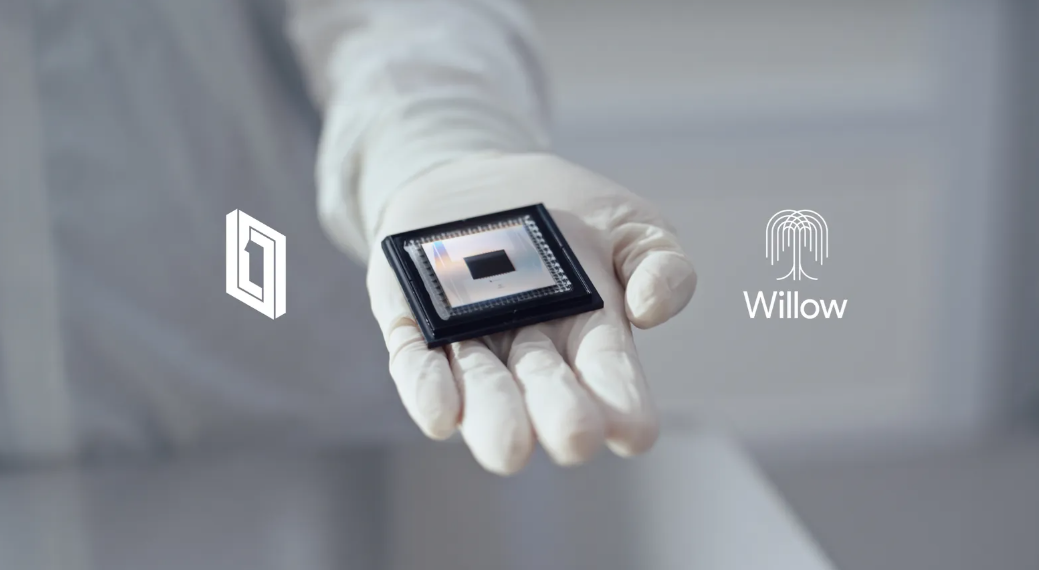
The most prominent result still standing is Google’s Quantum Echoes. In October 2025, Google announced that its Willow quantum chip had performed a calculation 13,000 times faster than the best classical algorithm running on one of the world’s fastest supercomputers (Figure 1). Google described the result, achieved using its Quantum Echoes algorithm, as the first demonstration of “verifiable quantum advantage” in history. Verifiable here means another sufficiently capable quantum computer could repeat the calculation and reproduce the result. Like sonar, which uses echoes to reveal its surroundings, the technique sent a signal into the Willow chip itself, creating an “echo” that revealed how different parts of the system function. Google said the technique could also help scientists understand the structure of systems in nature, from molecules and magnets to black holes. For example, the technique could help scientists work out how atoms are arranged within a molecule, revealing its shape, an important factor when designing new drugs.
Figure 1: Google’s Willow chip
Source: Google
“As of this past year, however, we have some strong candidates for verifiable quantum advantage. One is the Google OTOC experiment…”
Scott Aaronson, Director of the Quantum Information Center, University of Texas, July 2026
Google’s Quantum Echoes result has so far proved resistant to a classical comeback, with backing from prominent researchers such as Scott Aaronson. In August 2026, he included it among several experiments that together had “clearly shifted the burden of proof” towards the sceptics of quantum advantage. He nevertheless acknowledged that sustained work on classical methods could still overturn individual results.
Tailwinds Ahoy
“AI is essential to making quantum computing practical.”
Jensen Huang, Nvidia Founder and CEO, April 2026
Alongside the technical breakthroughs, growing industry and government support is adding to the sector’s momentum. Nvidia is expanding its involvement in quantum computing, providing both a vote of confidence in the technology and practical tools to accelerate its development. In April 2026, it introduced Ising, a family of AI models designed to help tune quantum processors and support error correction, two key challenges in building large-scale, reliable quantum computers. It broadened that support in September with software that enables researchers to design and test fault-tolerant quantum computing applications and identify optimal system configurations. That same month, Nvidia and IonQ highlighted joint research with other partners showing how generative AI could design quantum circuits without repetitive trial-and-error parameter tuning. In one simulation, this approach reduced the time needed to find a circuit from more than 11 minutes to about 28 seconds.
“Scientific discovery is one of the most powerful drivers of human flourishing and quantum computing has the potential to dramatically accelerate that discovery.”
Chris Wright, U.S. Secretary of Energy, June 2026
U.S. government support is also becoming more concrete. In May 2026, the U.S. Commerce Department announced US$2 billion in proposed funding for nine companies developing quantum computers and their foundry infrastructure. The funding aims to help solve critical technological challenges in the race to develop utility-scale, fault-tolerant quantum computers. In September 2026, the department finalised an award of up to US$1 billion to Anderon, IBM’s quantum-foundry subsidiary.
Following President Trump’s June 2026 executive order on quantum innovation, the Department of Energy announced Quantum Genesis, bringing together national laboratories, universities and private companies. The initiative’s plans include a competition, a shared quantum computing facility for researchers and research into scientific applications. These support its goal of developing and deploying the world’s first scientifically relevant, fault-tolerant quantum computing capability by 2028. A separate White House order set deadlines in 2030 and 2031 for specified federal systems to adopt quantum-resistant cryptography, which should also support demand for cybersecurity upgrades.
Industry Adoption
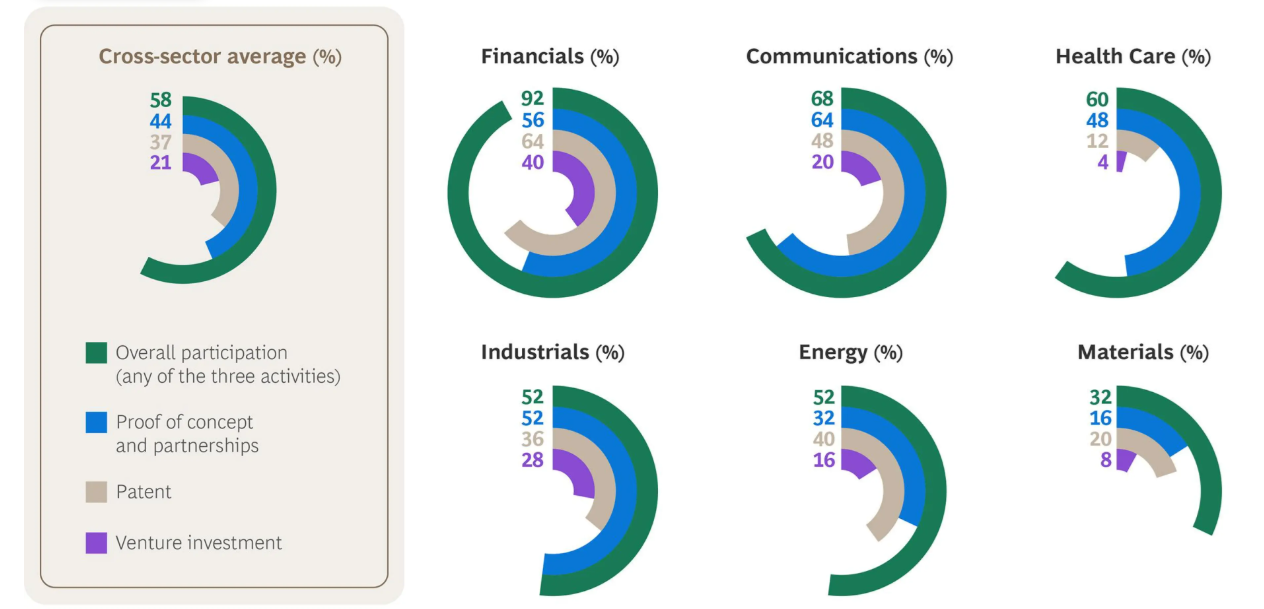
Just as important as these breakthroughs and tailwinds is the work companies are doing to identify practical uses for quantum computing. The signs are encouraging, with the technology attracting interest from major companies across a wide range of sectors. A June 2026 report by BCG put participation in quantum computing at 92% in finance, 60% in healthcare and 52% in industrials, based on the top 25 global companies in each sector (Figure 2). This included research projects, partnerships, talent hiring and venture investment, so the figures measure engagement rather than routine operational use. Applications being explored include optimising transport routes and supply chains, testing financial risk scenarios and simulating molecules for drug and materials research. In May 2026, for example, Quantinuum announced a multi-year expansion of its partnership with BMW to study materials and the chemistry behind fuel cells, giving BMW access to successive generations of Quantinuum’s quantum computers.
Figure 2: Commercial adoption of quantum computing – top 25 global enterprises per sector
Source: BCG
BCG found that enterprises accounted for more than half of customer spending on quantum computing in 2025, overtaking academia and government combined for the first time. McKinsey’s April 2026 report found that Europe accounted for the largest share of its global sample of 162 quantum customers. It also analysed spending by a selection of large global companies, finding that one-third allocated more than US$10 million to quantum initiatives in 2025 and 7% allocated more than US$50 million. The money primarily went towards use-case and application development, integration with existing tech stacks and internal capability building. McKinsey found that first movers are transitioning from pilots to applications embedded in end-to-end workflows. It sees the clearest near-term potential in hybrid systems, where conventional computers handle most of the work, AI helps coordinate it and quantum computers tackle selected difficult calculations.
Sizing the Opportunity
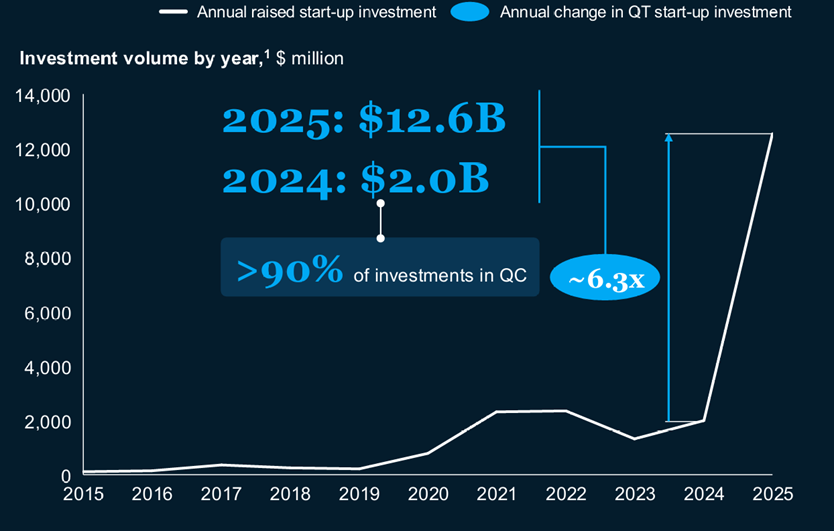
Funding for quantum technology companies rose sharply in 2025. McKinsey’s April 2026 report puts investment in quantum technology start-ups at US$12.6 billion, 6.3 times the 2024 total, with more than 90% going to quantum computing (Figure 3).
Figure 3: Quantum technology investment
Source: McKinsey
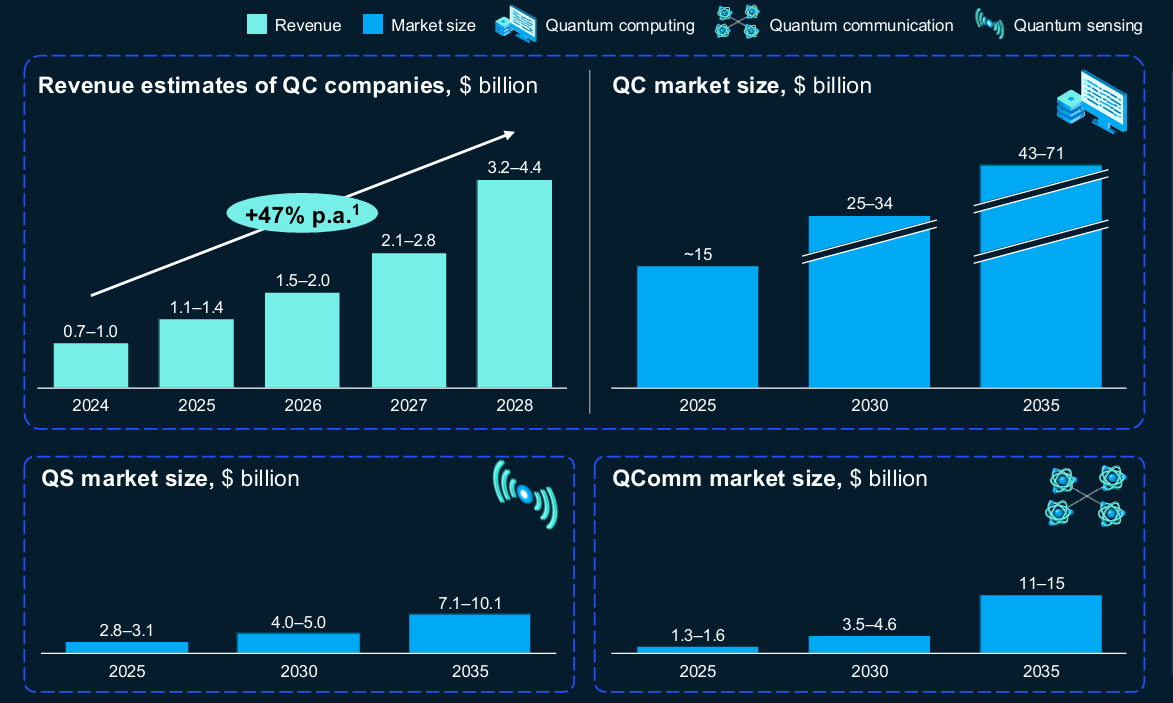
Company revenue remains much smaller than the sums being invested, though rapid growth is expected. McKinsey estimated that quantum computing companies generated US$1.1-1.4 billion in revenue in 2025 and forecasts it reaching US$3.2-4.4 billion in 2028 (Figure 4). McKinsey also estimates the size of the broader quantum computing market, combining company revenue, investment and internal funding from major technology companies. On this basis, it puts the market at about US$15 billion in 2025, growing to US$25-34 billion in 2030 and US$43-71 billion in 2035. BCG suggests a commercial turning point could arrive by 2030, but warns that useful business applications are developing more slowly than the hardware. Better chips and error correction must be accompanied by algorithms that solve business problems.
Figure 4: Quantum technology market size forecast
Source: McKinsey
The potential economic benefits to users are larger still. McKinsey estimates that quantum computing could create US$1.3-2.7 trillion in economic value across industries by 2035 through additional revenue and cost savings. For example, a manufacturer could save substantially more from improving an industrial process than it pays the quantum computing supplier. For investors, the question is how much of that potential becomes measurable customer value and how much quantum companies can capture through sustained sales.
Conclusion
Quantum computing is increasingly well placed to succeed. Technical advances and early evidence of quantum advantage, though sometimes contested, are being reinforced by growing investment, government support and AI tools that help accelerate development. However, AI's history of false dawns over the decades is a reminder that promising technology can take much longer than expected to fulfil its potential, and there is still no guarantee of widespread commercial benefits. Even so, the progress made over the past year has exceeded our expectations and gives us greater confidence that quantum computing can deliver on its promise.
At AlphaTarget, we invest our capital in some of the most promising disruptive businesses at the forefront of secular trends; and utilise stage analysis and other technical tools to continuously monitor our holdings and manage our investment portfolio. AlphaTarget produces cutting edge research and our subscribers gain exclusive access to information such as the holdings in our investment portfolio, our in-depth fundamental and technical analysis of each company, our portfolio management moves and details of our proprietary systematic trend following hedging strategy to reduce portfolio drawdowns. To learn more about our research service, please visit https://alphatarget.com/subscriptions/.