


Introduction
“We want to put these data centres in space… There’s no doubt to me that a decade or so away we’ll be viewing it as a more normal way to build data centres.”
Sundar Pichai, CEO of Google, December 2025 (Fox)
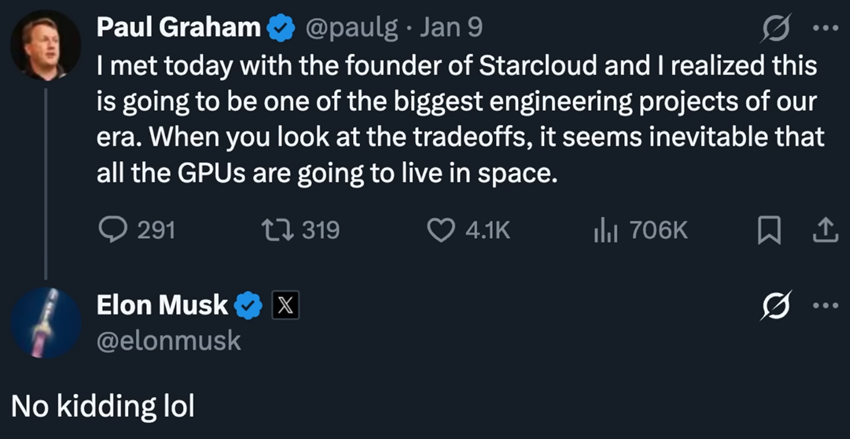
To many, AI data centres in space may sound like a pie-in-the-sky idea. Yet, a growing number of tech titans, companies and nation states are increasingly viewing orbital data centres as a potential solution to rising energy and infrastructure constraints. The attraction lies in their access to near-constant solar energy, the absence of land and freshwater restrictions and insulation from grid bottlenecks that are already limiting AI data centre expansion on Earth. However, the hurdles to making space-based data centres economically viable at scale remain significant, with launch costs still needing to fall by more than 10x. As a result, space-based compute is not a near-term replacement for terrestrial infrastructure, but a potential longer-term solution, with economic viability most commonly estimated for the early to mid-2030s.
Figure 1: Paul Graham’s and Elon Musk’s exchange on the future of AI data centres
Source: X
In this note, we first examine SpaceX and its role as the primary enabler of the modern space economy. Next, we highlight a set of space data centre initiatives and assess the potential long-term benefits. We then outline the key challenges that must be overcome for space data centres to scale, alongside the early progress made by pioneers such as Starcloud, which recently trained the first AI model in orbit. Finally, we highlight some of the publicly listed companies that have exposure to this emerging field.
SpaceX
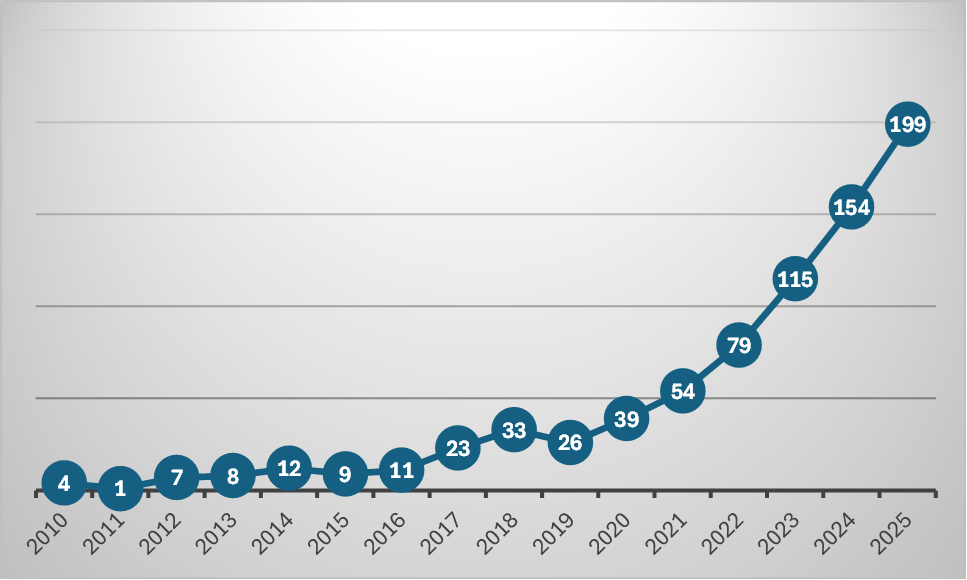
There has been a sharp acceleration in launch activity over the past decade, driven primarily by SpaceX. Founded in 2002 by Elon Musk, the company’s long-term objective was to make life multiplanetary. To pursue this long-term vision, SpaceX first needed to overcome foundational challenges of payload economics and operational scale, while also establishing a sustainable commercial business. A key pillar of this strategy has been to reduce launch costs by recovering and re-flying rocket boosters after launch, first achieved in 2016. This approach is now critical to SpaceX’s operating model, materially increasing launch cadence, lowering the cost per kilogram to orbit and underpinning a wide range of commercial activity in space.
Figure 2: FAA-licensed U.S. Orbital Commercial launches
Source: FAA
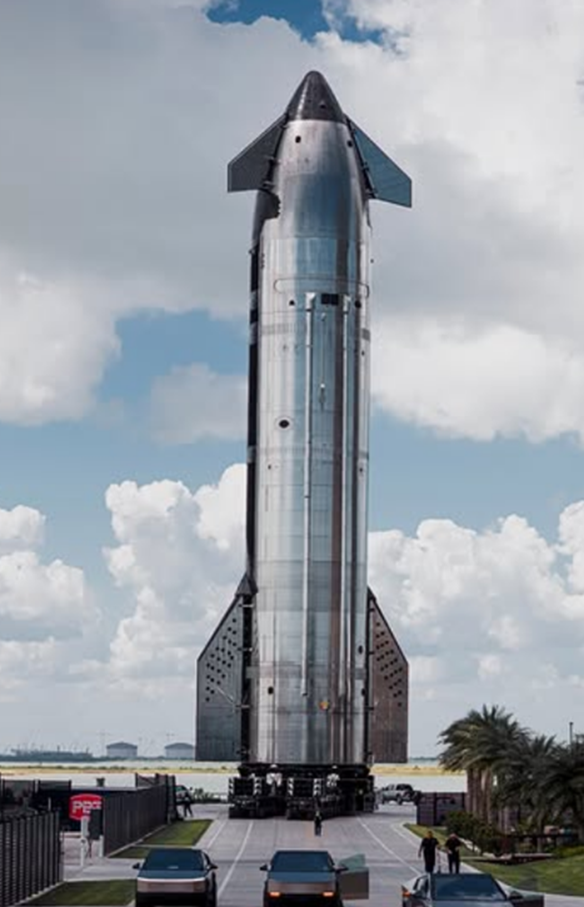
The focus on reusability and operational scale has culminated in the development of Starship, SpaceX’s next-generation rocket, designed to be fully reusable. Compared to the Falcon 9 rocket, which can deliver roughly 23 tonnes to low Earth orbit, Starship is expected to carry up to 150 tonnes when fully reusable (250 tonnes in an expendable configuration). This would represent a step-change in payload capacity and fundamentally alter the economics of deploying large assets in space. Starship flights are currently targeted for 2026, with Musk expecting this to increase SpaceX’s share of Earth’s total payload to orbit from around 90% to 98% over the next two years.
Figure 3: Starship
Source: SpaceX Instagram
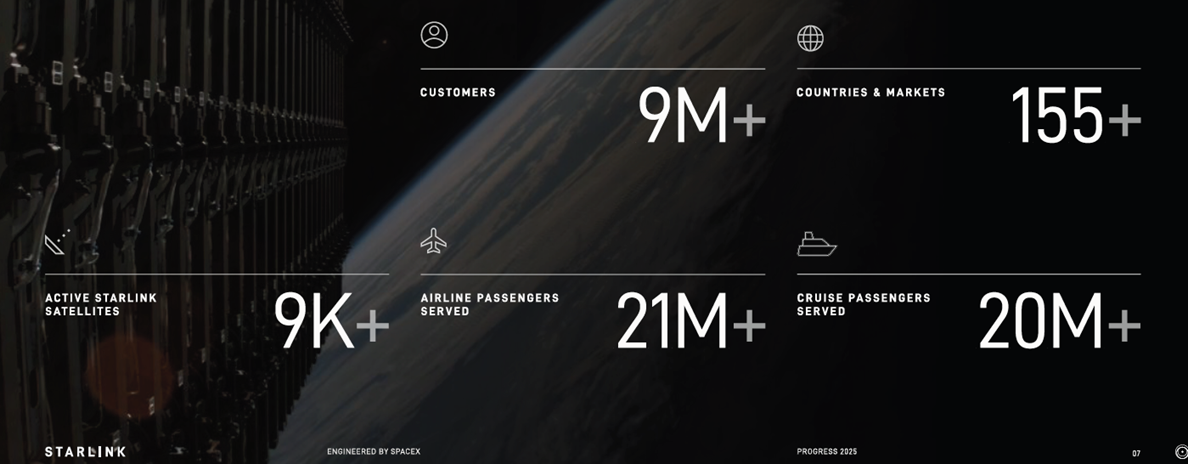
In terms of financials, Musk has commented that SpaceX has been cashflow-positive for many years and that 2025 revenues were projected at US$15.5 billion. Of this, only US$1.1 billion is expected to come from NASA, with the largest revenue contributor being Starlink. Starlink is the company’s satellite constellation which delivers internet access across the globe, typically used in remote and underserved regions. It is also powering in-flight Wi-Fi for major airlines, including United Airlines and Qatar Airways, as well as Wi-Fi for cruise lines such as Royal Caribbean and Carnival.
Figure 4: Starlink data
Source: Starlink 2025 Progress Report
In 2024, Starlink also began deploying satellites with Direct-to-Cell capabilities, aiming ultimately to eliminate worldwide mobile dead zones. The service is currently available in 22 countries with 27 mobile network operator partners such as T-Mobile. Initial Direct-to-Cell capabilities have generally been limited to texting and certain apps, although functionality is expected to expand. Its next-generation Direct-to-Cell satellites will be launched by Starship and within two years it aims to deliver high-bandwidth internet enabling medium-resolution video streaming. This is being enabled by its US$17 billion purchase of spectrum from EchoStar, announced in September 2025.
According to a December 2025 article by Bloomberg, SpaceX is reported to now be targeting a potential US$1.5 trillion IPO in 2026, raising more than US$30 billion. This implies a roughly 100x revenue multiple on 2025 estimates, a valuation that embeds significant optimism around Starship, Starlink growth, and nascent opportunities such as space-based compute. Musk has linked valuation growth to advances in Starship, Starlink, and direct-to-cell spectrum, but to the best of our knowledge has not confirmed the valuation. Musk did however appear to indirectly confirm the IPO plans by responding that “Eric is accurate” on X to an article written by Eric Berger. The article argued that a primary rationale for going public would be to secure a substantial capital injection to fund the development of data centres in space.
A new era of data centres
“I think even perhaps in the four or five year time frame the lowest cost way to do AI compute will be with solar powered AI satellites.”
Elon Musk, SpaceX CEO, November 2025 (U.S.-Saudi Investment Forum)
Beyond SpaceX, interest in orbital data centres is expanding across both the technology sector and among governments. In November 2025, Google outlined plans under Project Suncatcher to deploy solar-powered satellites to house its tensor processing units (TPUs), with prototype launches targeted for early 2027. Eric Schmidt, former Google CEO, indicated that orbital compute formed part of the strategic rationale behind his investment in the rocket company Relativity Space. Nvidia is also investing in the sector by backing the startup Starcloud, which is building space data centres. Jeff Bezos, owner of the space company Blue Origin, has also endorsed the concept, commenting that there will eventually be giant gigawatt space data centres. China’s Zhejiang Lab is also pursuing orbital data centres, aiming to build a network of thousands of satellites to enable AI data processing, having already launched its first batch in May 2025.
Benefits
“We still don’t appreciate the energy needs of this technology…there’s no way to get there without a breakthrough…we need fusion or we need like radically cheaper solar plus storage or something at massive scale like a scale that no one is really planning for.”
Sam Altman, CEO of OpenAI, January 2024 (Bloomberg, Davos)
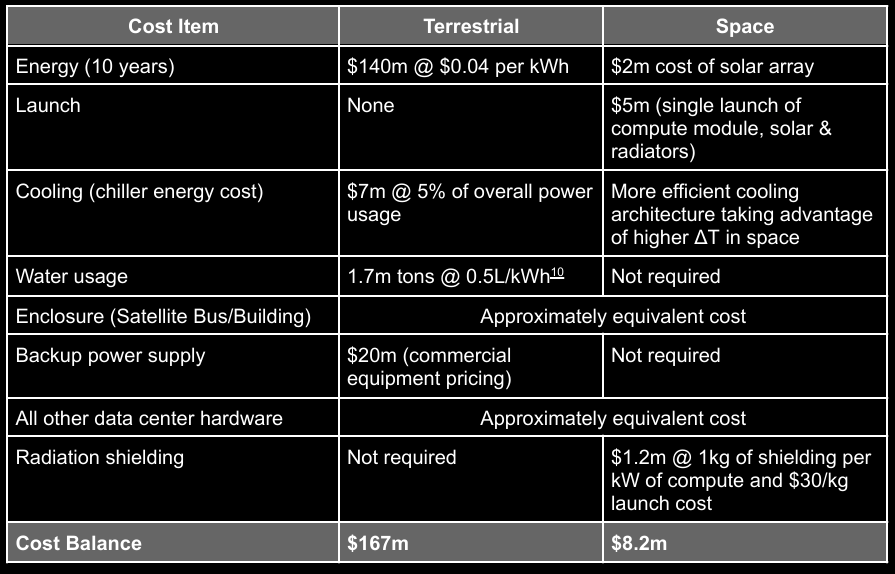
There are several compelling reasons to deploy data centres in space, but energy is the primary driver. AI data centres require vast amounts of power, currently placing significant strains on electricity grids and restricting future expansion. In space, however, data centres will have access to an abundance of solar energy as the satellites can stay exposed to nearly constant sunlight, unaffected by both weather and day-night cycles. This steady energy flow also removes the need for backup-power/batteries. Additionally, sunlight is stronger in space because there is no atmosphere to attenuate and scatter the solar radiation, resulting in peak power generation that is approximately 40% higher than on Earth, even on a clear day. Proponents estimate that solar panels in space could generate roughly 5x more energy than equivalent terrestrial arrays and, when comparing total system costs to prevailing grid electricity prices, it is estimated that energy costs could be around 10–20x lower.
Figure 5: Cost comparison of a single 40 MW cluster operated for 10 years in space vs on land
Source: Starcloud Whitepaper 2024
“The only cost on the environment will be on the launch, then there will be 10x carbon-dioxide savings over the life of the data centre compared with powering the data centre terrestrially on Earth.”
Philip Johnston, Starcloud CEO, October 2025 (NVIDIA blog)
Other benefits of space-based data centres relate to environmental impact. Due to its higher effectiveness, terrestrial data centres are increasingly shifting from air to water cooling, particularly in warmer climates. An EESI article reported that an estimated 80% of the water consumed in such systems is lost to evaporation. It also found that a single large hyperscale data centre may consume up to 1.8 billion gallons of water annually, equivalent to the needs of a town of 10,000–50,000 people. This can create significant pressure on local freshwater sources, such as rivers and aquifers, increasing risks for nearby communities. While the industry is evolving, with some operators deploying closed-loop cooling designs that materially reduce water consumption, locating data centres in space would still eliminate the need for water-based cooling altogether, reducing pressure on local water supplies. In addition, it would remove the need to acquire large areas of land and associated terrestrial infrastructure, while also reducing greenhouse gas emissions.
Challenges and risks
While the theoretical benefits are compelling, the practical hurdles to achieving space-based data centres at scale are substantial and should not be underestimated.
The most significant barrier is launch costs. SpaceX currently charges US$6,500/kg. Starcloud estimates that launch costs will need to fall to US$500/kg before it can break even. Google estimates that launch costs will have to fall to US$200/kg before space data centres become comparable to those on Earth, and expects this to happen by the mid-2030s under the current trajectory. By contrast, Musk is more optimistic, with a 4-5 year timeline for when AI data centres become economically viable and is expecting to get launch costs down well below US$100/kg.
This divergence in timelines (mid-2030s versus 2029–2030) warrants scrutiny. Musk has a well-documented history of ambitious forecasting: Tesla’s Robotaxi was originally promised for 2020, Full Self-Driving has been “one year away” for nearly a decade, and the Cybertruck shipped years behind schedule. Furthermore, the gap between US$6,500/kg today and US$200–500/kg required for viability represents a 10–30x reduction, a transformation that, even under optimistic assumptions, will likely take years to eventuate.
Another challenge is cooling. Space-based data centres cannot rely on terrestrial cooling methods and must instead dissipate heat through radiation. Heat is absorbed by a fluid and transferred to large radiator surfaces, which then emit it into deep space. These radiators must be substantial in size, making them a significant contributor to launch mass and cost, with meaningful design and manufacturing challenges.
Additionally, space does not benefit from Earth’s atmosphere, which helps shield electronics from harmful radiation. As a result, space-based data centres must incorporate mitigation measures such as shielding or error-correcting software to ensure reliable operations. Maintenance, logistics and regulation also remain meaningful hurdles. Unlike terrestrial data centres, failed components cannot easily be replaced or upgraded once deployed in orbit. In parallel, operators must manage orbital debris risk, navigate unclear data sovereignty and security frameworks for space-based compute and address concerns from regulators and astronomers around orbital congestion and interference with scientific observation.
Early progress
“Anything you can do in a terrestrial data centre, I’m expecting to be able to be done in space.”
Philip Johnston, Starcloud CEO, December 2025 (CNBC)
Despite these challenges, initial progress is already being made. In November 2025, Starcloud deployed the first Nvidia H100 GPU to space via SpaceX. In December, it was announced that it had trained the first LLM in space and had successfully run inference on it. The purpose was to prove that their thermal management and radiation shielding techniques allowed them to operate state-of-the-art in the harsh conditions of space. Going forward, Starcloud will continue to deploy more advanced satellites, with their second launch planned for October 2026, which will be at least 10x more powerful.
In their 2024 white paper, Starcloud outlined a vision for an eventual 5 gigawatt orbital data centre, with massive solar and radiators which would be approximately 4 kilometres in width and height. This equates to over 2000 football fields. However, the leap from a single GPU to a 5 GW orbital installation is immense, and investors should treat such projections as aspirational rather than operational guidance.
Figure 6: Illustrative concept of Starcloud’s proposed 5GW orbital data centre

Source: Starcloud
To the moon
“The Moon is a gift from the universe.”
Jeff Bezos, October 2025 (Italian Tech Week)
While initial orbital data centres rely on Earth-launched satellites, the ultimate vision extends to the Moon. Jeff Bezos has long advocated for moving heavy industry off Earth to preserve the planet, highlighting the Moon’s low gravity, proximity and resources for fuel and infrastructure. Additionally, President Trump’s December 2025 Executive Order calls for Americans to return to the Moon by 2028 and establish initial elements of a permanent lunar outpost by 2030. Musk’s longer-term ambitions aligns with this, envisioning factories on the Moon that use local resources to produce data centre satellites in vast quantities, potentially exceeding 100 terawatts of compute capacity. Due to the Moon’s low gravity, these satellites would be launched directly into orbit via mass drivers (electromagnetic railguns), dramatically lowering costs, enabling massive scale and unlocking a future of vast orbital AI compute.
Listed companies in the space
Below we highlight some publicly listed companies that have direct or indirect exposure to space data centres.
Figure 7: Public companies with exposure to space data centers

Source: SimplyWallSt.
Note: Market cap.as of 9 Jan 2026
Conclusion
The concept of data centres in space is now moving from speculation to early experimentation as AI compute demand collides with hard, Earth-based constraints. While the challenges ahead remain substantial, with launch costs still representing a major barrier, early demonstrations and growing engagement from technology leaders and governments show this is no longer a fringe idea. However, this trajectory is not inevitable. Breakthroughs elsewhere could eliminate the need for space-based compute, whether through fusion delivering radically cheaper terrestrial energy or major gains in algorithmic or hardware efficiency. Yet, under today’s technological landscape, space-based data centres represent the most direct path being actively pursued to unlock the scale of energy required for future AI infrastructure.
At AlphaTarget, we invest our capital in some of the most promising disruptive businesses at the forefront of secular trends; and utilise stage analysis and other technical tools to continuously monitor our holdings and manage our investment portfolio. AlphaTarget produces cutting edge research and our subscribers gain exclusive access to information such as the holdings in our investment portfolio, our in-depth fundamental and technical analysis of each company, our portfolio management moves and details of our proprietary systematic trend following hedging strategy to reduce portfolio drawdowns. To learn more about our research service, please visit https://alphatarget.com/subscriptions/.
Introduction
Although there are still concerns that the AI market may be in a bubble, industry investment continues at pace with little sign of slowing. Hyperscalers continue to guide towards record capital expenditure, consultancies report surging AI bookings, and enterprise software vendors are racing to embed agentic capabilities into their platforms. As with other major technology shifts, it will take time before the returns from this investment become fully visible. Even so, for investors it remains important to monitor how AI is being adopted and used in practice, as this helps assess whether current developments are on track to realise its long-term promise.
In this note, we focus on enterprise AI and examine how organisations are moving beyond chatbots and narrow point solutions to embed AI deeper into business workflows. In the first section, we look at AI adoption and find that it is widespread but generally remains shallow, with most organisations in the early phases of deployments. We then explore the key challenges and limitations shaping adoption, where reliability currently remains an important constraint. Finally, we assess the rise of AI platforms and the emerging competition to become the organising layer for enterprise AI.
Overall, the evidence points to early signs of real value being realised, even if deployments remain constrained at this stage. Given the early stage of the cycle and the pace of ongoing advances, we remain optimistic that enterprise AI is on a healthy trajectory with substantially more value still to be unlocked.
Enterprise adoption
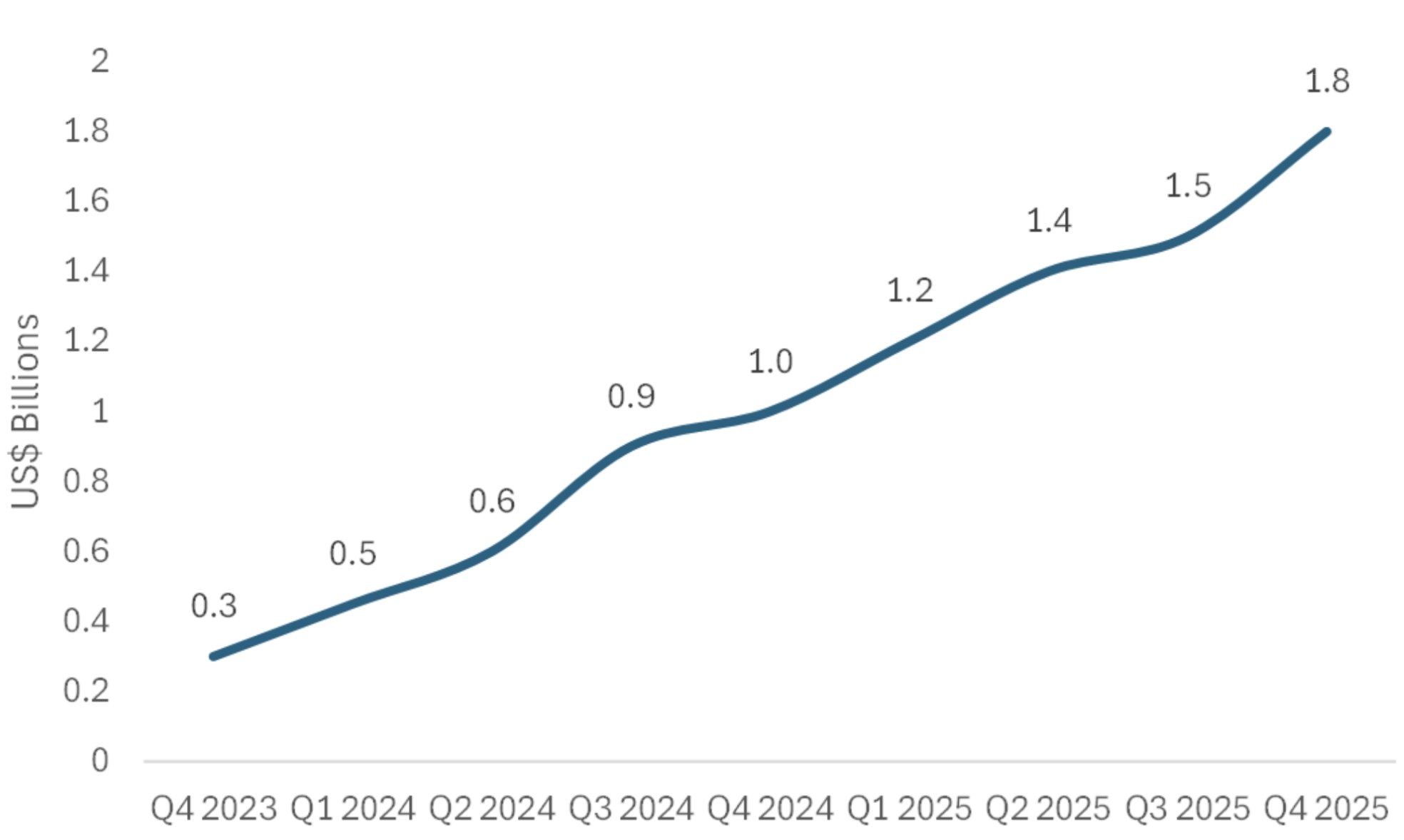
In general, enterprises appear eager to embrace AI. A McKinsey study which surveyed organisations in the summer of 2025 found that 88% use AI in at least one business function, up from 78% a year ago. Additionally, we have observed strong demand for AI services at consultancy companies such as Accenture and Capgemini. Accenture reached US$1.8 billion in AI bookings in Q4 2025 (ended 31 August) and for FY25 it achieved US$5.9 billion, nearly doubling year-over-year and representing over 7% of total company bookings. Similarly, Capgemini’s AI bookings in Q3 2025 (ended 30 September) were 8% of total bookings. This shows growing willingness among enterprises to commit budget to AI initiatives.
Figure 1: Accenture’s Generative AI Quarterly Bookings (Fiscal Year end August)
Source: Accenture
However, breadth of adoption does not imply depth. Most enterprise AI deployments remain incremental rather than transformative. These deployments are typically augmenting existing workflows with copilots and chatbots rather than fundamentally redesigning processes or enabling entirely new capabilities.
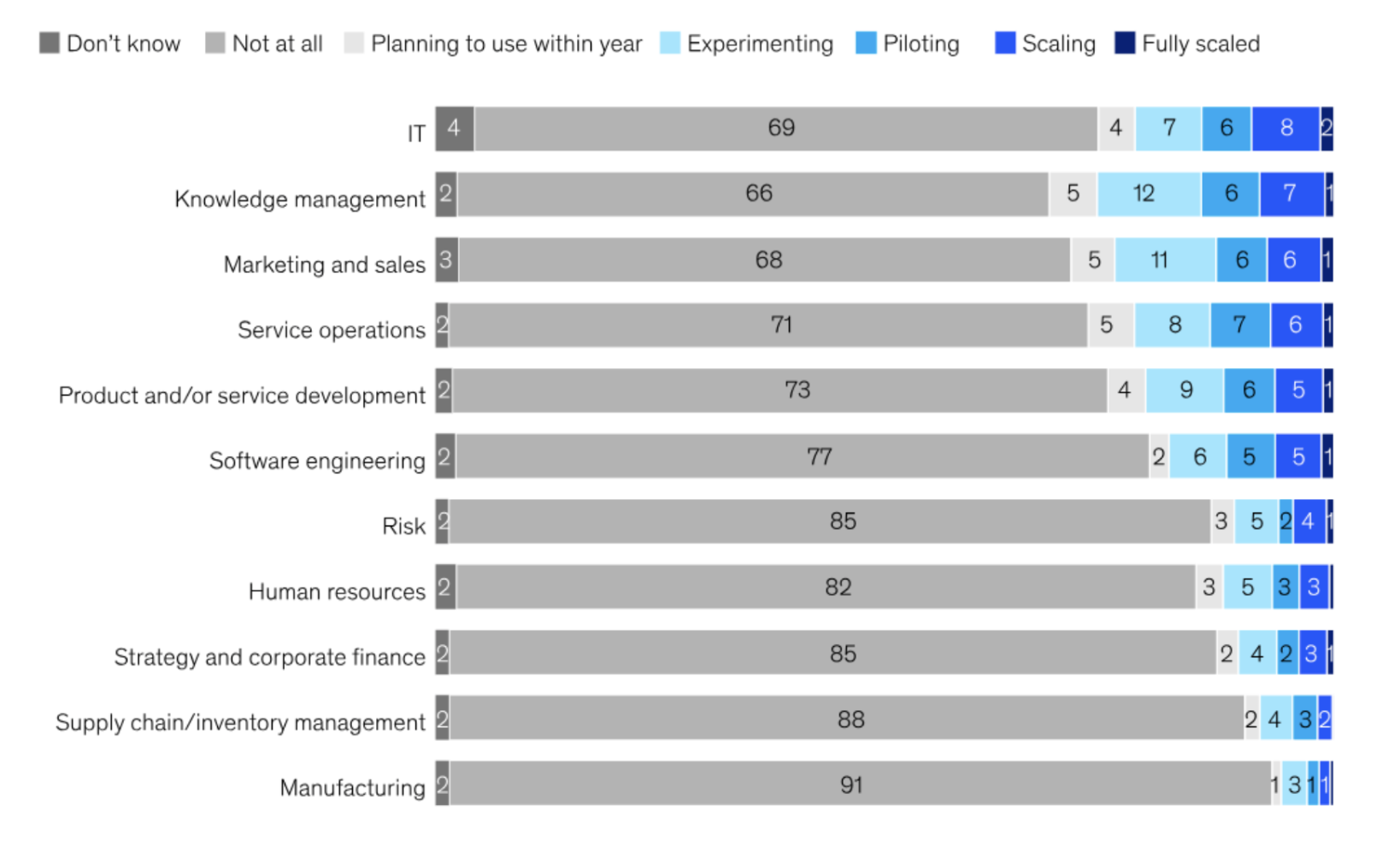
This shallow pattern is evident in the data. According to the McKinsey study, 62% of organisations are still in the AI experimentation and piloting phase, whereas just 7% have AI fully deployed and integrated across their organisation.
In terms of deeper AI deployments using agents (systems that autonomously execute multi-step tasks using a model and tools within defined constraints), only 23% of organisations report that they are scaling these somewhere within their organisation, though usually limited to 1-2 business functions. An additional 39% of organisations are still experimenting. The relative scarcity of agentic deployments underscores the gap between current practice and AI’s fuller potential: agents represent a shift from AI as a tool that assists human workers to AI as a participant that executes tasks with meaningful autonomy.
Figure 2: Phase of AI agent use by business function (% of respondents)
Source: McKinsey
Challenges, constraints and value
The fact that adoption remains shallow reflects not only the early stage of the cycle, but also a range of practical challenges and constraints.
Organisational readiness: Many departments lack leadership ownership for AI initiatives, as these often involve upfront costs and the redesign of workflows, which can represent a short-term burden. Resistance to change is compounded by the lack of talent to both understand which workflows can be optimised and the ability to implement these changes.
Technical foundations: Many companies lack the necessary data infrastructure and carry significant technical debt that limits their ability to support AI initiatives. Clean, accessible, well-governed data is a prerequisite for most meaningful AI applications, yet remains elusive for many organisations.
Risk and governance: Finally, there is ongoing hesitation driven by concerns around data privacy and cybersecurity risks.
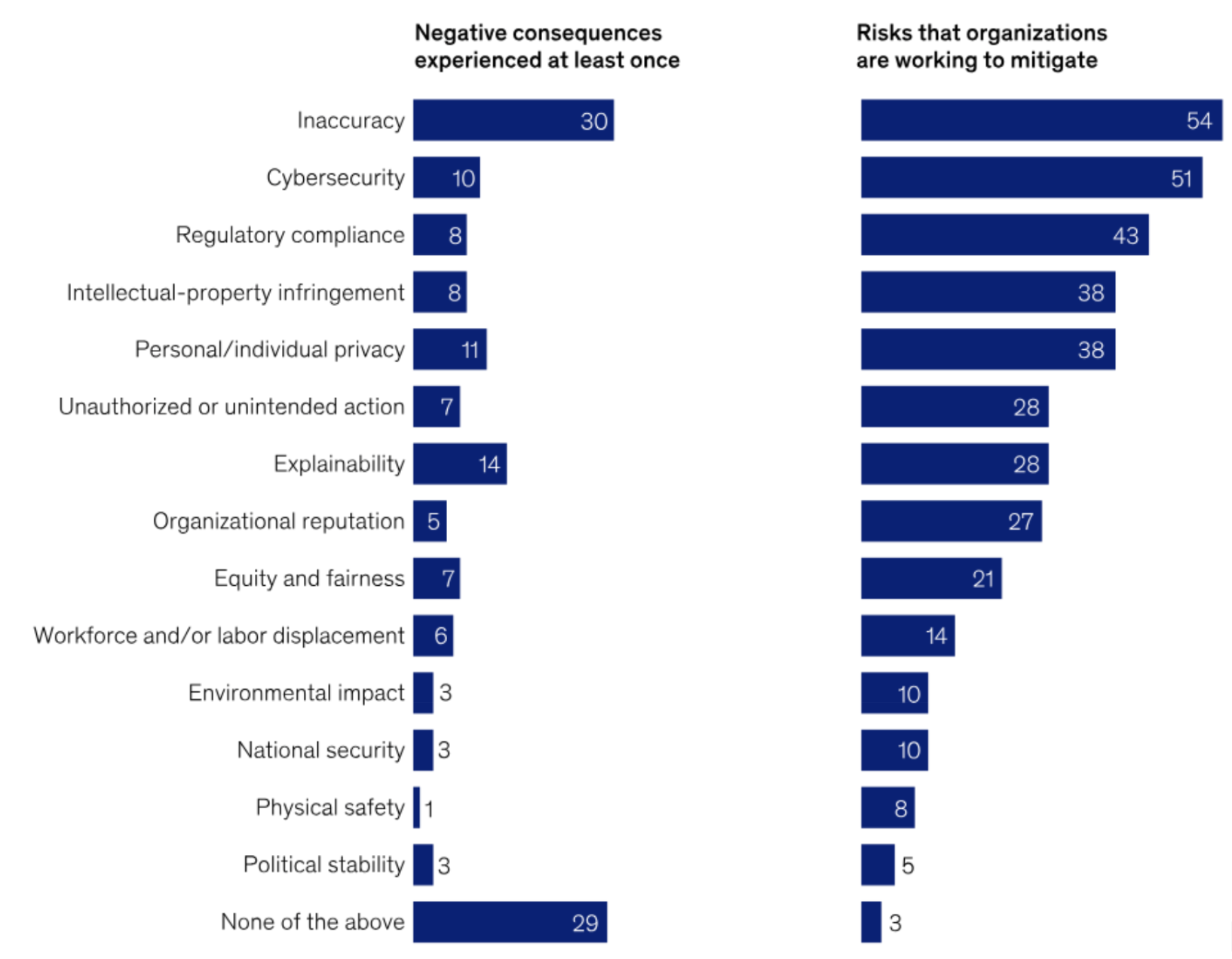
Once AI initiatives are implemented, organisations often face a range of issues that they need to mitigate, with inaccuracies and explainability emerging as the two factors associated with the most negative consequences. Inaccuracy risk is particularly acute for customer-facing or regulated applications, where errors carry reputational or compliance costs. Explainability, specifically the ability to understand and justify why an AI system produced a given output, matters both for internal trust and external accountability.
Figure 3: AI-related negative consequence and risk mitigation in the past year (% of respondents)
Source: McKinsey
Reliability and Architectural Considerations
In the study “Measuring Agents in Production” (December 2025) by researchers from UC Berkeley, Stanford University and IBM Research, 68% of production AI agents perform at most ten steps autonomously before human intervention. This is to manage reliability, computational time and costs. Additionally, 74% of teams rely on human-in-the-loop oversight or feedback to judge the agent’s answers. This is because it is difficult to automatically evaluate whether the AI is performing correctly for specialised business tasks, so companies still lean on users to review results.
Due to reliability and cost considerations, enterprises are increasingly deploying AI agents within deterministic workflow scaffolding rather than granting full autonomy. Most production systems fix the sequence of steps an agent must follow and limit model discretion to bounded stages A common example is an insurance agent that always moves through coverage lookup, medical-necessity review and risk checks in a fixed order, even though the model may still improvise within each subtask. This pattern is reflected in the Measuring Agents in Production study, which finds that 80% of real deployments use structured, stepwise flows. This approach improves predictability, auditability and cost efficiency by reducing variance, unnecessary model calls and failure loops. As a result, enterprises are typically deploying LLMs inside deterministic shells, particularly in standardised and regulated processes, rather than relying on free-form autonomous agents.
Despite current challenges and limitations, available evidence suggests AI agents are already delivering meaningful productivity benefits. In-depth interviews in the Measuring Agents in Production study reveal that organisations tolerate minutes-long execution times because agents still outperform human baselines on the tasks they replace. Among practitioners with deployed agents who evaluated alternatives, 82.6% preferred the agentic solutions for production deployment, indicating superior performance relative to non-agentic approaches. Consistent with this, McKinsey found that 39% of organisations using AI report some impact on EBIT at the enterprise level, suggesting that early productivity gains are beginning to translate into financial outcomes.
AI platform wars
“The CEOs are kind of getting the picture. Many of them have killed these proof-of-concept scenarios. One had 900 proof-of-concepts going on in the company and said it was uncontrollable, and they killed them all. And they went with ServiceNow.”
Bill McDermott, ServiceNow CEO, Q3 2025
Due to the challenges of building and implementing in-house agents, many organisations have now turned to their existing software vendors such as ServiceNow and Salesforce who offer out-of-the-box agents and AI platforms. These solutions require less setup, less in-house expertise and benefit from agents being tightly integrated with the workflows of the parent system.
ServiceNow
ServiceNow, which now calls itself the “AI Platform for business transformation,” offers a wide range of AI solutions to help optimise workflows across areas such as IT, CRM and HR. Not only does it let customers build their own agents, but it also has over 100 pre-packaged agentic workflows. Additionally, ServiceNow offers the AI Control Tower product, which provides visibility, governance, security and centralised control. Furthermore, its AI Agent Fabric product, a communication and integration layer, allows connections to third party AI agents and tools to enhance agentic workflow orchestration.
In its Q3 2025 (ended September) earnings call, ServiceNow management stated that its AI products are on track to exceed US$500 million for the full year. For FY2026 the company is targeting US$1 billion in AI product revenue, though it is aiming to surpass this target.
Salesforce
Similarly, Salesforce has also gone all-in on becoming a leading AI platform company. This transition underpinned its recent US$8 billion acquisition of the data cloud management company Informatica, as it sought to strengthen its data infrastructure to support agentic workflows. Salesforce also rebranded many of its core offerings with the Agentforce label, where Sales Cloud is now Agentforce Sales, Service Cloud is now Agentforce Service, and the platform layer was renamed to Agentforce 365 Platform.
According to reporting from Business Insider, Salesforce CEO Marc Benioff said customers no longer want to talk about “the cloud” and instead frame their needs primarily around AI agents, a shift Salesforce validated in pre-Dreamforce focus groups. The rebrand appears to be so significant that Benioff even told Business Insider he “would not be shocked” if Salesforce ultimately renamed the entire company to Agentforce.
During its annual Dreamforce conference in October 2025, Salesforce provided several examples of global enterprises already deploying its new AI capabilities in production. Case studies included Williams-Sonoma, Pandora, PepsiCo, FedEx and Dell.
The Williams-Sonoma case study demonstrated how Agentforce can power fully branded consumer-facing agents, launching “Olive,” an AI sous-chef, built in just 30 days. It provides personalised recipe guidance, tutorials and product-aware recommendations based on items a customer already owns.
In the PepsiCo case study, Salesforce showed how Agentforce enhanced sales, marketing and field operations by embedding agents directly into customer and employee workflows. Prospective retailers now receive personalised product recommendations and automated follow-up emails, while sellers use Slack-based insights to prepare for meetings and identify risks. Field technicians benefit from pre-work briefs, real-time troubleshooting and automatic post-work summaries, with Agentforce also highlighting bespoke upsell opportunities to drive incremental revenue.
The FedEx case study highlighted efficiency improvements when its customers ask sales reps complex international-shipping questions. Previously, when reps posed these queries to their chatbot they would often get back a 200-page tariff PDF that they would have to wade through to get an answer. Now however, it instead returns precise and complete shipping recommendations while governance rules mask sensitive data.
The case study also showed that when employees received a new laptop that was not properly set up (e.g. missing apps), they could simply describe this issue to Agentforce in Slack and have the device automatically configured without the need to raise an IT ticket.
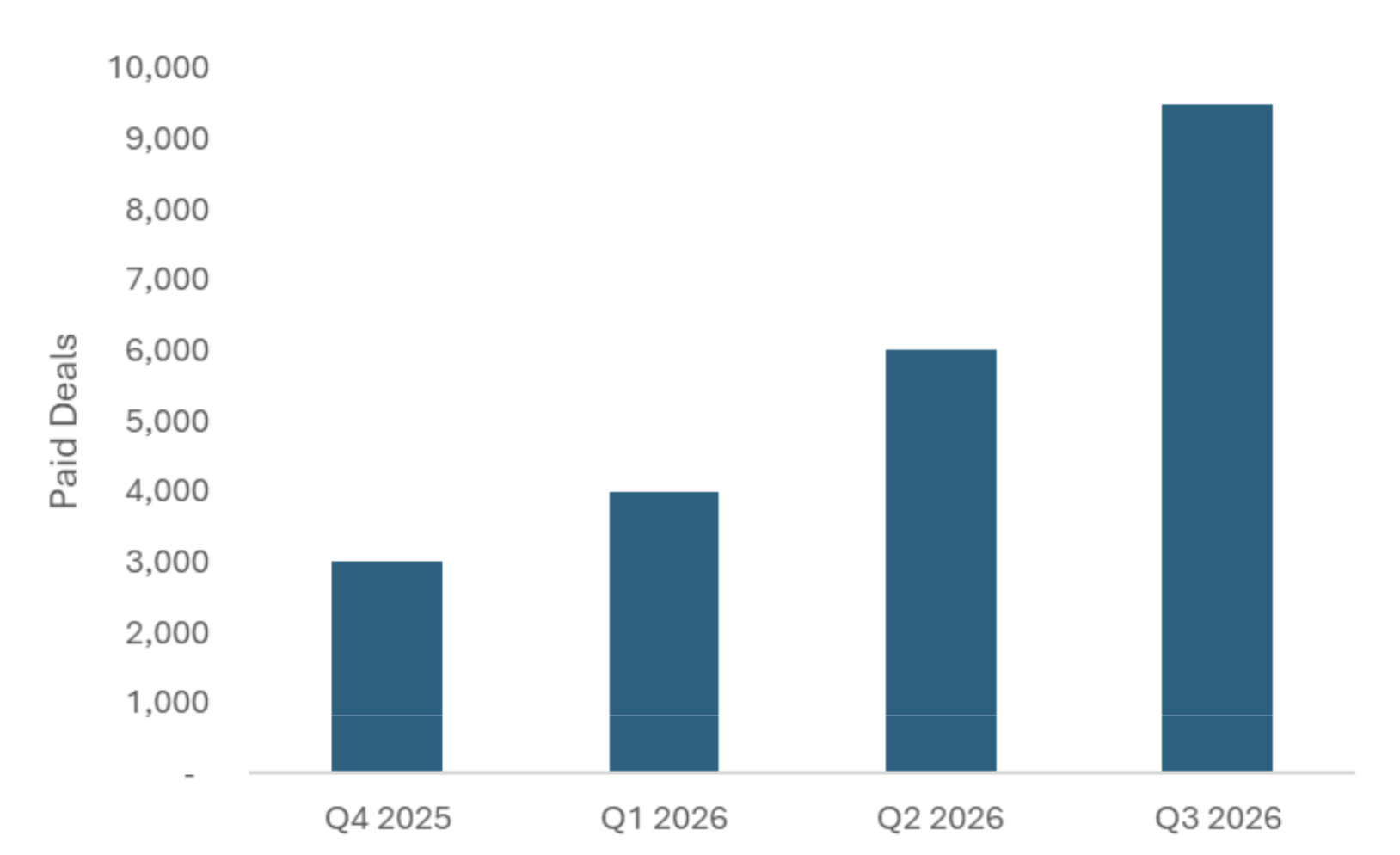
The early success of Salesforce’s AI products is reflected in its numbers. Agentforce ARR (annual recurring revenue) surpassed US$0.5 billion in its Q3 2026 (ended 31 October), growing 330% year-over-year with 9,500 paid deals. Agentforce accounts in production also grew 70% quarter-over-quarter and 50% of its Agentforce and Data 360 bookings came from existing customer expansion, indicating early product-market fit as customers continue to build on and expand these deployments rather than abandoning them.
Figure 4: Salesforce’s paid deals for Agentforce (Fiscal Year end January)
Source: Salesforce
AI platform competition
Looking ahead over the medium term, we expect demand for AI platforms embedded within existing enterprise software to remain strong, reflecting customer appetite for agentic capabilities within established workflows. However, given organisations often have a vast number of different software vendors, this is likely to result in organisations operating multiple AI platforms across different software ecosystems. For example, FedEx utilises both Salesforce’s and ServiceNow’s AI platforms in production.
However, the true unlock lies in enabling agents and workflows to operate seamlessly across the entire organisation rather than remaining confined to the parent ecosystems. This capability is increasingly a stated goal of leading platforms, and we are already seeing moves in this direction, for example through Salesforce’s integration with Microsoft Teams. Achieving this cross-enterprise orchestration would meaningfully strengthen platform positioning, stickiness and long-term value capture.
This prize is therefore driving intensifying competition. It is not only ServiceNow and Salesforce that are pursuing this role, but also a range of other players seeking to become the organising layer for enterprise AI, ranging from Google with Gemini Enterprise to platforms such as Dataiku and UiPath, each approaching the opportunity from a different angle. Microsoft, with its Copilot suite deeply integrated across Office 365 and Azure, represents perhaps the most formidable competitor given its existing enterprise footprint.
However, delivering true cross-enterprise orchestration remains difficult in practice. Each organisation has a unique application landscape, data architecture and workflow structure, and it is not yet clear whether any single platform will be able to integrate deeply enough across the full enterprise to meet most use cases. If platforms struggle to operate across the enterprise, companies may increasingly need to build custom in-house agents and agentic systems to bridge gaps to coordinate end-to-end workflows.
Sizing the opportunity
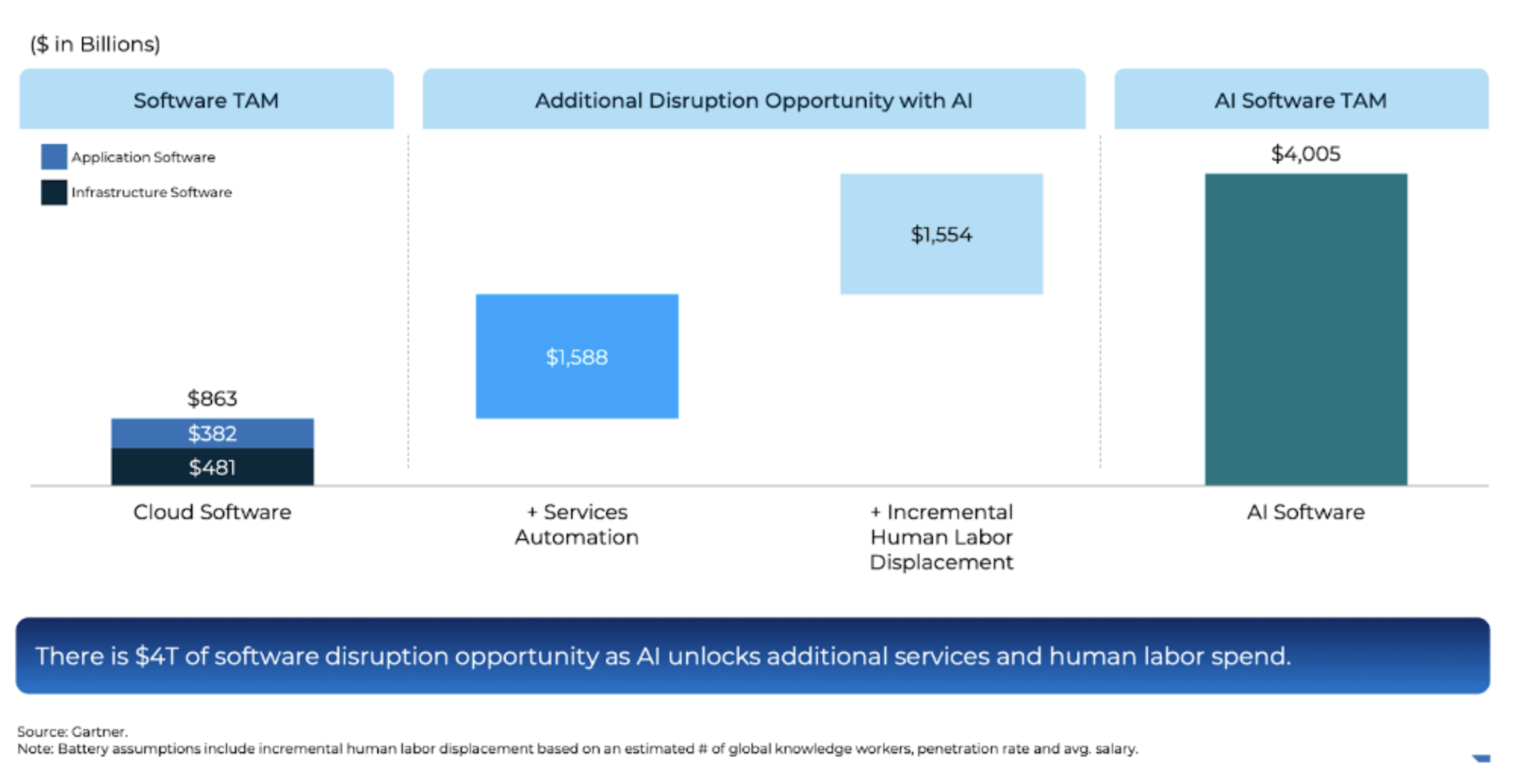
While precise market sizing for enterprise AI remains difficult given the early stage of adoption, the scale of the opportunity is clearly substantial. Battery Ventures estimates that AI could underpin a roughly US$4 trillion software opportunity by expanding traditional application and infrastructure markets while also unlocking incremental services automation and partial displacement of human labour.
Figure 5: The massive AI market opportunity
Source: Battery Ventures, State of the OpenCloud
Conclusion
The evidence points to early but tangible signs of value realisation in enterprise AI, even as adoption remains uneven and constrained by practical challenges. Many organisations remain in the experimentation and piloting phases, with limitations around reliability, integration, talent availability and human oversight persisting. There are, however, clear indications of productivity gains and, in some cases, early impacts on EBIT. That said, it remains too early to determine whether these gains will ultimately justify the substantial capital expenditures being made across the sector. Nevertheless, the progress to date is encouraging, particularly when viewed against historical precedent, as it took roughly 15 years before PCs drove widespread productivity improvements across the economy.
Looking ahead, we expect continued progress as multiple reinforcing factors improve. Advances in hardware and models should increase capability while lowering costs, while accumulated implementation know-how and more mature architectures should reduce execution risk. Together, these dynamics are likely to expand the set of economically viable use cases and support further deployment of both custom-built agents and AI platforms embedded within enterprise workflows.
The eventual structure of the enterprise AI landscape remains uncertain however, especially amid the intensifying “AI platform wars” as vendors vie for dominance in cross-enterprise orchestration. Over the long run, it is unclear whether organisations will persist with multiple AI platforms siloed across different software ecosystems, converge on a single governing platform, or lean more heavily on custom in-house agentic systems to achieve seamless integration. That said, we expect forward-thinking enterprises to increasingly pursue agentic workflows that span the entire organisation, unlocking deeper efficiencies and strategic advantages.
Overall, while still early in the cycle, the foundations for realising substantial value from enterprise AI are beginning to take shape.At AlphaTarget, we invest our capital in some of the most promising disruptive businesses at the forefront of secular trends; and utilise stage analysis and other technical tools to continuously monitor our holdings and manage our investment portfolio. AlphaTarget produces cutting edge research and our subscribers gain exclusive access to information such as the holdings in our investment portfolio, our in-depth fundamental and technical analysis of each company, our portfolio management moves and details of our proprietary systematic trend following hedging strategy to reduce portfolio drawdowns. To learn more about our research service, please visit https://alphatarget.com/subscriptions/.
“We are also on the cusp of something really tremendous with Optimus, which I think is likely to be, has the potential to be, the biggest product of all time.”
Elon Musk, Tesla CEO, Q3 2025
Introduction
Over recent years, humanoid robots have made tremendous progress driven by advances in hardware and AI. Dozens of companies have entered the space and several are now moving from proof of concept toward mass production. The goal is to build machines that can take on physical labour, performing the dull, dangerous and dirty tasks that humans would rather avoid, both in factories and in households. If this vision can be achieved, many founders and analysts alike expect that over the long run there will be billions of humanoids on the planet, becoming as ubiquitous as cars and smartphones.
Yet the path ahead remains full of challenges. Most notably, general robotics has not yet been solved. Although today’s humanoids can perform demonstrations that look impressive, from dancing to doing backflips, they still struggle with tasks humans find trivial such as folding clothes. They also lack the general adaptability needed to operate reliably in unfamiliar environments. Ultimately, the ability to carry out practical real-world tasks while adapting to changing conditions and requirements will determine how widespread and impactful these robots can become.
In this note we first discuss the benefits of general-purpose humanoids and compare them with specialised robots. We then profile three prominent players in the space: Tesla, 1X and Figure AI. Next we examine the challenges humanoids must overcome to become truly general-purpose and reach scale. Finally, we outline the size of the opportunity and discuss how the emerging humanoid market could evolve.
The case for humanoid robots
There has long been debate over why general-purpose humanoids are needed when specialised machines can often perform individual tasks better. We agree that in many cases specialised robots will be superior and they are not going away. However, many of the tasks that need to be performed are varied, intermittent and carried out in conditions that change from moment to moment. Humans are still far better suited to this kind of dynamic work and that is exactly the type of role a humanoid is designed to take on.
A useful comparison is the smartphone, which combines voice calls, photography, gaming, payments and email into one device rather than relying on separate specialised equipment. While dedicated equipment might outperform it in specific areas, most people prefer the convenience of a single, versatile device over carrying multiple specialised ones.
Versatility can also be a direct advantage for certain tasks. For example, a robot vacuum cannot move a chair to clean under a table, whereas a humanoid can. In such scenarios the general-purpose solution is not only more convenient but also more capable.
Compared to specialised robots, humanoids can also be produced in much higher volumes given the potential demand, benefiting from economies of scale through in manufacturing and supply chains. Greater scale also spreads R&D costs across more units, driving down overall unit costs.
The human form factor is also an advantage. Most physical environments are designed around human proportions, so humanoids can naturally operate equipment and move through spaces built for people. In addition, the human form factor is far easier to train. Humanoids can learn directly from human demonstrations, including motion capture data, which provides high-quality examples of how tasks should be performed. Other form factors lack a human equivalent to learn from, making training significantly more difficult.
Tesla – Optimus
“Optimus, I think, probably achieves five times the productivity of a person per year because it can operate twenty-four seven.”
Elon Musk, Tesla CEO, Q3 2025
Optimus is Tesla’s humanoid robot and today roams parts of the company’s headquarters unsupervised. Musk has said it can guide visitors through the building and already performs some tasks inside Tesla’s factories. Optimus 2.5 was also publicly showcased at the Tron premiere in October 2025 where it demonstrated Kung Fu.
Figure 1: Optimus 2.5 doing Kung Fu at the Tron premiere in October 2025

Source: Youtube – DPCcars
It is difficult to know exactly how Optimus compares with its peers, as the field is currently in a fog of war. Afterall, most humanoids are not yet deployed widely in the real world and companies in the sector remain highly secretive about their latest capabilities. Many demonstrations rely on varying levels of teleoperation, which makes it hard to assess what is truly autonomous. Musk has commented that at least one of Optimus’s Kung Fu demonstrations was AI-driven rather than teleoperated, although the limited transparency in the sector still makes broader comparisons challenging.
Despite this limited transparency, Tesla remains widely regarded as a frontrunner in the humanoid race. Early investors and industry veterans with inside access to multiple projects consistently rank Tesla highly on technical grounds, even though their visibility is still partial. Additionally, Tesla’s extensive real-world AI experience, strong electrical and mechanical engineering capabilities and considerable manufacturing scale give the company a credible path to solving the field’s twin challenges of intelligence and manufacturing. Tesla is also well capitalised and led by a founder with an exceptional track record of tackling hard problems and creating value.
Tesla is now working on Optimus 3, which Musk describes as a giant improvement over Optimus 2.5. He has said they will probably unveil a production prototype in Q1 2026 and that it will seem like a person in a robot suit with agility roughly equal to an agile human. Scale production is now aimed to start at the end of 2026, though it will take a while to ramp up production.
“Optimus at scale is the infinite money glitch.”
Elon Musk, Tesla CEO, Q3 2025
The medium and long-term targets are highly ambitious. Optimus 3 is aimed at reaching 1 million units per year before 2030 at a target cost of less than US$20,000. Optimus 4 is planned to reach 10 million units annually with production starting in 2027. Optimus 5 is planned to reach 50-100 million units annually with production starting in 2028. Musk expects that humanoids will eventually account for 80% of Tesla’s value in the long run.
1X – Neo
A dark horse in this space is 1X, which was founded in Norway in 2014 and later relocated its headquarters to Palo Alto. In 2023 it raised US$23.5 million in a Series A2 round led by OpenAI, followed by a US$100 million Series B in 2024. It is now reportedly seeking a further US$1 billion, according to The Information.
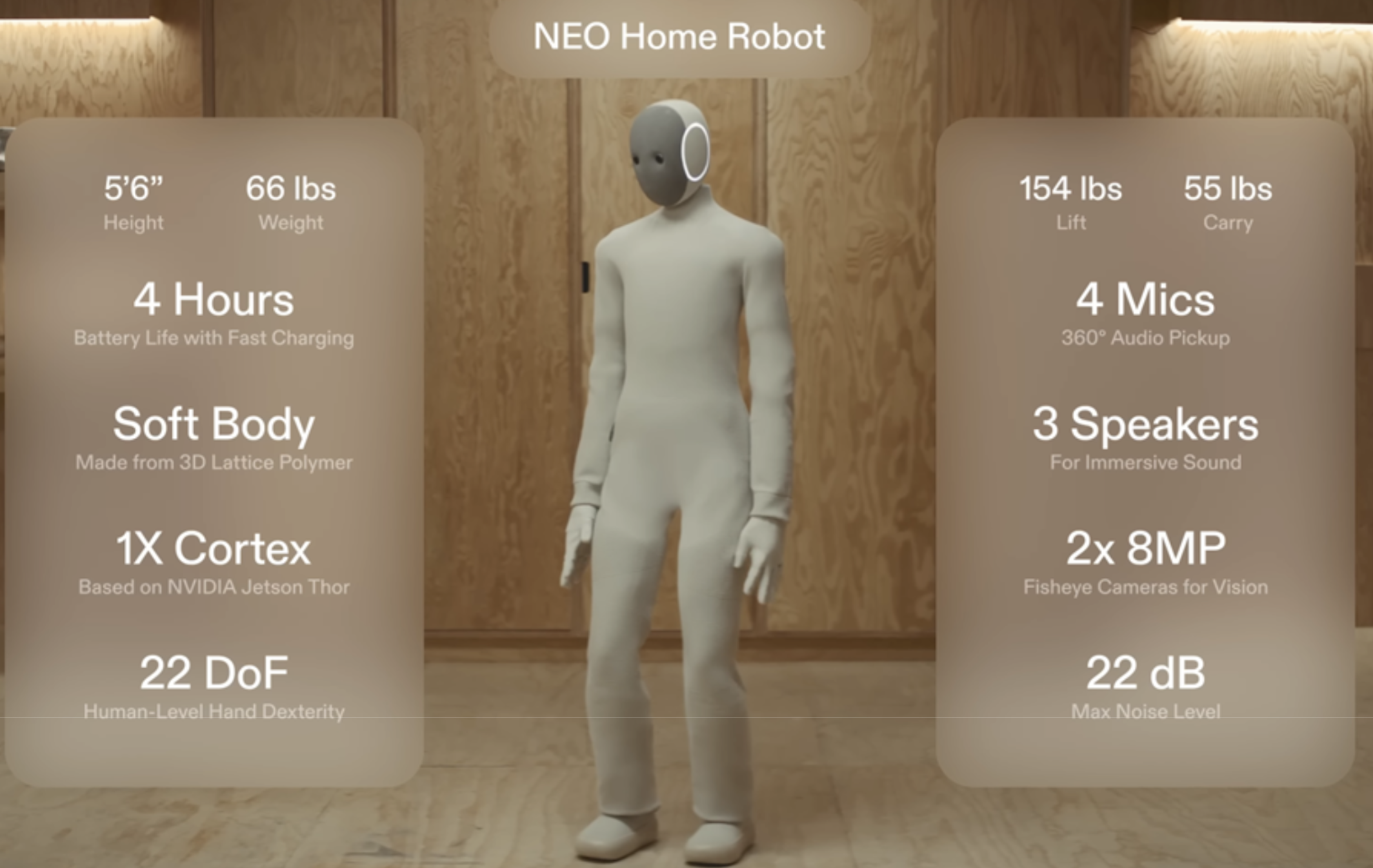
Figure 2: Neo Home Robot by 1X
Source: 1X
1X gained considerable attention in October 2025 when it announced early-access pre-orders for its home robot, Neo. This is a lightweight humanoid designed to help with chores and act as a companion, allowing users to ask questions such as where they last left their keys. US deliveries are set for 2026, with early access priced at US$20,000 or US$499 per month.
Unlike most competitors, which target more industrial settings, 1X’s focus on households presents greater safety challenges and far more environmental complexity. The company’s rationale for this, however, is that it believes consumer products scale much faster and that the variety of environments will deliver richer data, helping Neo improve more quickly.
Neo’s design centres on safety and lightness. Its finger strength matches that of a human, which is by design, because if it was excessively strong it would lose sensitivity. Instead of using traditional gear-based mechanisms commonly found in most robots, 1X has developed a proprietary actuation system called Tendon Drive, which uses high-torque motors pulling synthetic tendons inspired by biological muscles. This patented system enables smooth, quiet and safe movements while keeping the robot lightweight. It also makes the robot simpler and cheaper to produce, which has enabled 1X to already be able to manufacture Neo at an affordable cost.
Coinciding with the Neo launch announcement, the Wall Street Journal released a video interview with CEO Bernt Øyvind Børnich, showing Neo performing basic home tasks. It took around one minute to fetch a glass of water and roughly five minutes to load three items into a dishwasher. However, all demonstrations were revealed to have been conducted using teleoperations, where a human was in the loop helping the robot operate and make decisions. The video triggered an online backlash, as many felt the announcement was overhyped given Neo was not yet capable of acting autonomously.
“So when you get your Neo in 2026, it will do most of the things in your home autonomously. The quality of that work will vary and will improve quite fast as we get data.”
Bernt Øyvind Børnich, 1X CEO, October 2025 (WSJ)
Børnich explained however that the model shipping in 2026 will be more advanced than the one shown in the interview and mostly autonomous. Nevertheless, it will still rely to some degree on teleoperation or assistance from the owner’s voice commands for more challenging tasks. This will enable the robot to learn. Børnich reiterated that the version shipping in 2026 is meant for early adopters who understand the product is not perfect but insisted it will quickly become very useful. He has also noted that the Neo unit currently in his own home can autonomously retrieve a Coke from the fridge successfully around 50% of the time.
By 2027, 1X aims to ship 100,000 units, by which time Børnich expects Neo to be fully autonomous with no human in the loop. By 2028, he expects shipments to reach 1 million units, which is even more ambitious than Tesla’s target for Optimus 3.
Figure AI – Figure
Despite being founded in 2022, US-based Figure AI is already considered one of the frontrunners in the humanoid race. In September 2025, it raised over US$1 billion in a Series C round at a US$39 billion valuation with backers such as Nvidia, Qualcomm and Salesforce.
Figure 3: Evolution of Figure humanoids (Dreamforce 2025)

Source: Salesforce – Dreamforce 2025
Figure has also secured a notable commercial agreement. In January 2024 it signed a deal with BMW to bring its robots into automotive production. Reporting has been mixed on how much useful work the robots have actually been doing since the announcement. However, CEO Brett Adcock recently said that a robot has been operating autonomously for 10-hour shifts over the past five months and has now reached operational readiness.
Adcock had initially planned to focus on commercial/industrial applications before tackling domestic use. Over the past year however, his view has shifted and he now sees the home as a solvable challenge within a few years, possibly by 2026. He also insists they will not go to market using “silly” teleoperations like his competitors. Adcock also emphasised that adding a consumer focus will not come at the expense of their commercial efforts.
Currently, the company is on its third humanoid iteration, Figure 03, which was revealed in October 2025. In a Time profile, they witnessed Figure 03 successfully load items into a dishwasher but struggled with folding T-shirts. However, handling clothes and towels is one of the harder challenges for humanoids, given that fabric changes form upon interaction.
Unlike its predecessors, which were experimental prototypes, Figure 03 is engineered with cost and high-volume manufacturing in mind. Figure’s dedicated manufacturing facility, BotQ, will initially be able to produce around 12,000 robots annually, with a goal of producing 100,000 units in total over the next four years.
Challenges ahead
“You have to … be able to like just talk to it and have it do anything you’d want it to do in unseen locations. That problem is not solved. That problem is 10 times, 50 times, 100 times harder than making a humanoid robot.”
Brett Adcock, Figure AI CEO, October 2025 (Nvidia GTC)
Despite humanoids seeing tremendous progress in recent years, major challenges remain. One persistent issue is the supply chain, as many of the components needed to build an advanced humanoid simply did not exist. This includes powerful motors, specialised sensors and more broadly, components with the durability to withstand continuous operation for many years.
Because a broader ecosystem has never really formed, companies have had to develop and manufacture a large portion of components themselves, forcing heavy vertical integration across the industry. As a result, humanoid companies are effectively building their own supply chains from scratch, a constraint that is likely to weigh on the industry for some time.
A further challenge is building a useful robotic hand and forearm. Several founders have highlighted that the hand is the hardest part of the humanoid to design because humans rely on them for almost every task and they require a huge range of precise, coordinated movements. Without a truly capable hand, even advanced humanoids will struggle with a wide range of basic tasks.
Beyond hardware, humanoid robots also face regulatory uncertainty, particularly for domestic applications. Governments will need to establish safety standards, liability frameworks and potentially certification processes before widespread home deployment can occur. Data privacy and cybersecurity present further concerns as robots with cameras, microphones and internet connectivity operating in homes could become targets for hacking or surveillance, raising questions that manufacturers have yet to fully address publicly.
Perhaps the most significant challenge, however, is developing general-purpose robotic systems. Adcock views this as the primary bottleneck, far outweighing manufacturing constraints. A key limitation today is the scarcity of high-quality real-world data for training, which companies are now trying to address in different ways. Figure plans to allocate much of its recent US$1 billion funding to hiring humans for first-person video data collection, while 1X intends to gather much of its data from its early-access Neos shipping in 2026.
However, experts question whether feeding models more data alone will suffice. Meta’s Chief AI Scientist and renowned ML expert, Yann LeCun, has warned that current approaches may excel at specific tasks but fall short of true generality (the ability to handle open-ended tasks and unfamiliar situations) without fundamental breakthroughs:
“The big secret of the industry is that none of those companies has any idea how to make those robots smart enough to be useful. Or I should say, smart enough to be generally useful.”
Yann LeCun, Meta Chief AI Scientist, October 2025 (MIT)
Legendary programmer John Carmack echoes this scepticism:
“I am more skeptical than a lot of people in the tech space about the near term utility of humanoid robots. Long term, driven by AGI, sure, they are going to be an enormous economic engine, but business plans that have them making a dent in the next five years seem unlikely.”
John Carmack, November 2024 (X)
The founders themselves remain more optimistic. Musk has highlighted a potential breakthrough threshold that he thinks Tesla can achieve, where Optimus would learn new tasks simply by watching YouTube or how-to videos, much like a human. Meanwhile, Adcock and Børnich believe fully autonomous general-purpose humanoids are just two years away. Time will tell whether more data can overcome today’s limits, or if progress stalls until deeper AI breakthroughs arrive.
The humanoid market
“There will be more humanoids on the planet than there are people. There’s absolutely no doubt about that. At least everyone wants a humanoid, but you want way more than that.”
Bernt Øyvind Børnich, 1X CEO, October 2025 (The Casey Adams Show)
CEOs of humanoid companies forecast massive TAMs, expecting billions of units in the long run. Adcock sees this as a roughly US$40 trillion opportunity, essentially all the labour in the current global economy. These companies attribute this scale to broad adoption across many sectors, from industry to the home, driven by the promise of cheap, flexible labour. Demand will also be supported by the ageing population, as labour shortages intensify and humanoids are needed to assist with elderly care.
Yet ubiquity will take time. Even if general-purpose humanoids arrive tomorrow, creating the infrastructure to manufacture billions of units will be challenging and likely encounter multiple issues that need to be solved. This includes potential regulatory hurdles and component shortages (e.g. chips). Additionally, most consumers currently cannot afford a US$20,000 robot and therefore prices would need to come down or income per capita would need to rise substantially.
Morgan Stanley estimates that by 2050 there will be nearly 1 billion humanoids, with 90% in industrial and commercial use cases, representing a US$4.7 trillion market.
Figure 4: Long-term forecast of humanoid revenue

Source: Morgan Stanley Research
This is similar to Bank of America’s forecast, which expects just over 1 billion humanoids by 2050 and 3 billion by 2060. However, unlike Morgan Stanley, it expects household robots to make up the majority of units. This reflects the uncertainty of how the industry will evolve.
Figure 5: Long-term forecast of humanoid units

Source: Bank of America Research
“What matters is shipping a product at scale that can generate the data to increase intelligence and reduce cost. That’s who wins in my mind. Like who’s the first through a million robots in market? That’s a big marker that will help determine like the leader.”
Brett Adcock, Figure AI CEO, November 2025 (WTF Online – Nikhil Kamath)
What also remains unclear is the future market structure, whether it will be fragmented or dominated by a few players. Many factors will shape the outcome, though one key factor could be a data moat. Adcock has argued that humanoid robotics could become a natural monopoly, as each additional robot deployed generates real-world data that improves all others. This creates a powerful flywheel: the leader in deployed units gains a growing data advantage, enabling smarter robots, driving more sales and widening the gap with competitors.
Yet this outcome is not guaranteed, as it depends on whether additional data continues to yield meaningful improvements or eventually flattens out. Future models may also require less data to learn, which could reduce the advantage of scale.
“We are not in a race against China… it doesn’t matter if China makes a million humanoid robots tomorrow. They just don’t work very well to be frank.”
Brett Adcock, Figure AI CEO, November 2025 (WTF Online – Nikhil Kamath)
Geographic leadership is also debated. Many have argued that China will have a distinct advantage due to its manufacturing capacity. Adcock downplays this, arguing that Chinese humanoids are nowhere near Figure’s capabilities and that manufacturing is not the main bottleneck. He also argues that manufacturing robots will be significantly easier than manufacturing cars as he sees humanoids as being more akin to consumer electronics products.
However, Tesla’s own well-documented manufacturing challenges with vehicles, despite Musk’s expertise, and acknowledging the complex nature of humanoid systems, suggests that scaling production to millions of units annually may prove more difficult than Adcock anticipates, particularly given the need for vertical integration across novel supply chains.
Ultimately, we see humanoid robots becoming a multi-trillion-dollar market, but forecasting unit volumes or market share with any precision remains difficult given the uncertainty around future AI breakthroughs. However, much of the current fog of war should begin to lift in 2026 as companies move from prototypes into mass production and robots start appearing more frequently in real-world settings. At that point, we will gain a clearer sense of how the market is likely to evolve.
Conclusion
Humanoid robotics stands on the brink of shifting from science fiction to economic reality. The abundance of cheap labour would be transformative to the global economy, substantially reducing the cost of goods and services, with some like Musk believing it could even abolish poverty. Yet the path ahead remains steep and uncharted. True general-purpose autonomy is still unsolved and the manufacturing challenge will be immense. However, the companies leading this charge are well capitalised and technically formidable. Over the next five to ten years, humanoid robotics will likely be one of the most exciting fields in technology, with rapid iteration and fierce competition that could ultimately give rise to the next generation of economic giants.
At AlphaTarget, we invest our capital in the most promising disruptive businesses at the forefront of secular trends; and utilise stage analysis and other technical tools to continuously monitor our holdings and manage our investment portfolio. AlphaTarget produces cutting-edge research and our subscribers gain exclusive access to information such as the holdings in our investment portfolio, our in-depth fundamental and technical analysis of each company, our portfolio management moves and details of our proprietary systematic trend following hedging strategy to reduce portfolio drawdowns. To learn more about our research service, please visit alphatarget.com/subscriptions/.
In 2025, the autonomous vehicle (AV) race accelerated sharply. Waymo’s weekly rides increased more than fivefold in just under a year, putting it neck and neck with China’s Apollo Go in cumulative autonomous miles. Meanwhile, Tesla launched its robotaxi pilot mid-year and is currently gearing up for mass production of its Cybercab, targeting 2 million units annually.
In our previous note, Driving Towards Autonomy (2024), we provided a primer on the autonomous vehicle space. This report builds on that foundation, examining key developments over the past year. We explore the surge in autonomous ride-hailing, expanding partnerships, unit economics and why we believe the AV sector is now at an inflection point.
Autonomous ride-hailing surge
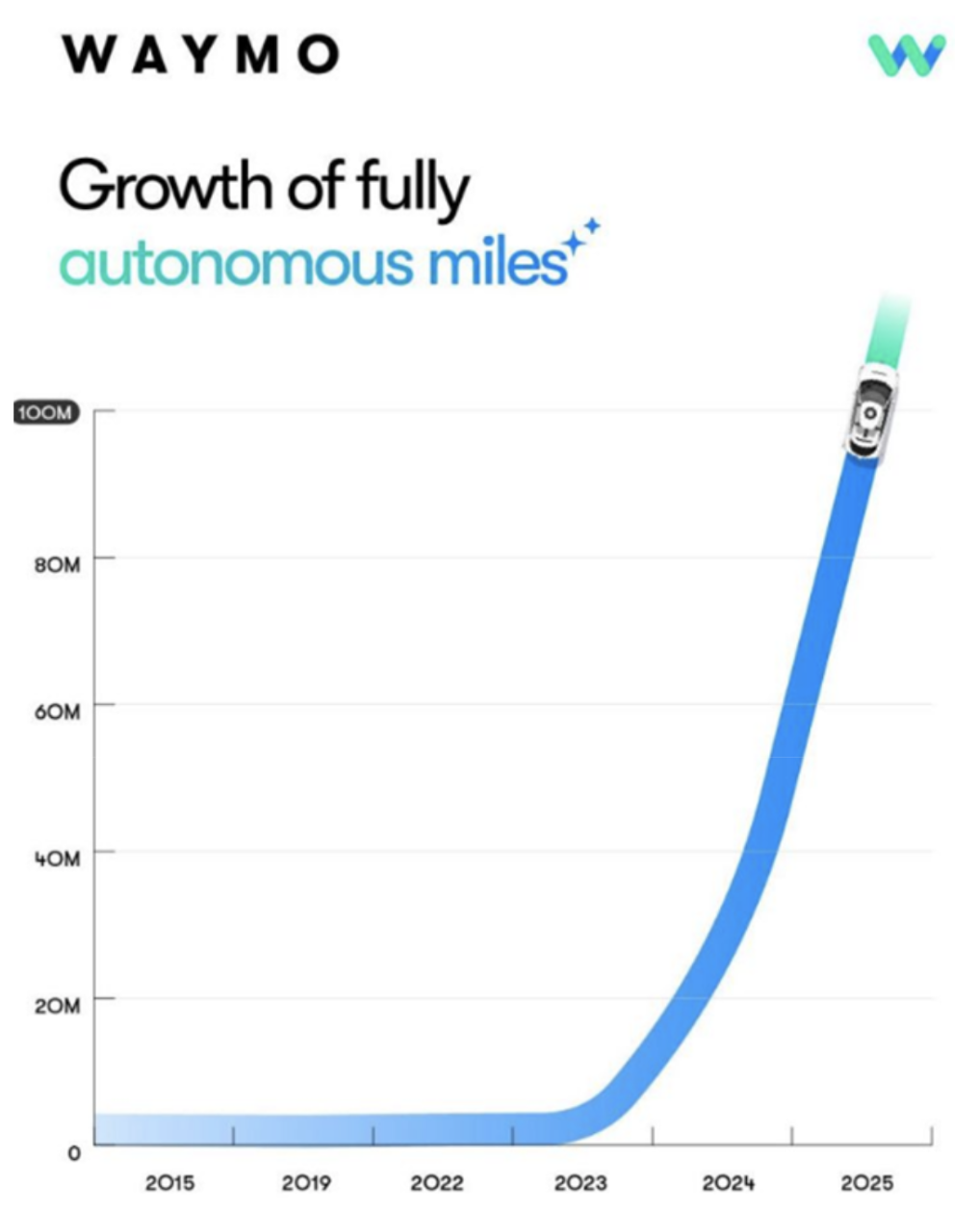
Ride-hailing has seen strong momentum over the last 12 months. Waymo’s cumulative autonomous miles reached 100 million in July 2025 (Figure A), supported by more than 250,000 trips per week across five major US cities and a fleet of over 1,500 vehicles.
Figure A. Waymo’s cumulative autonomous miles
Source: Waymo, X
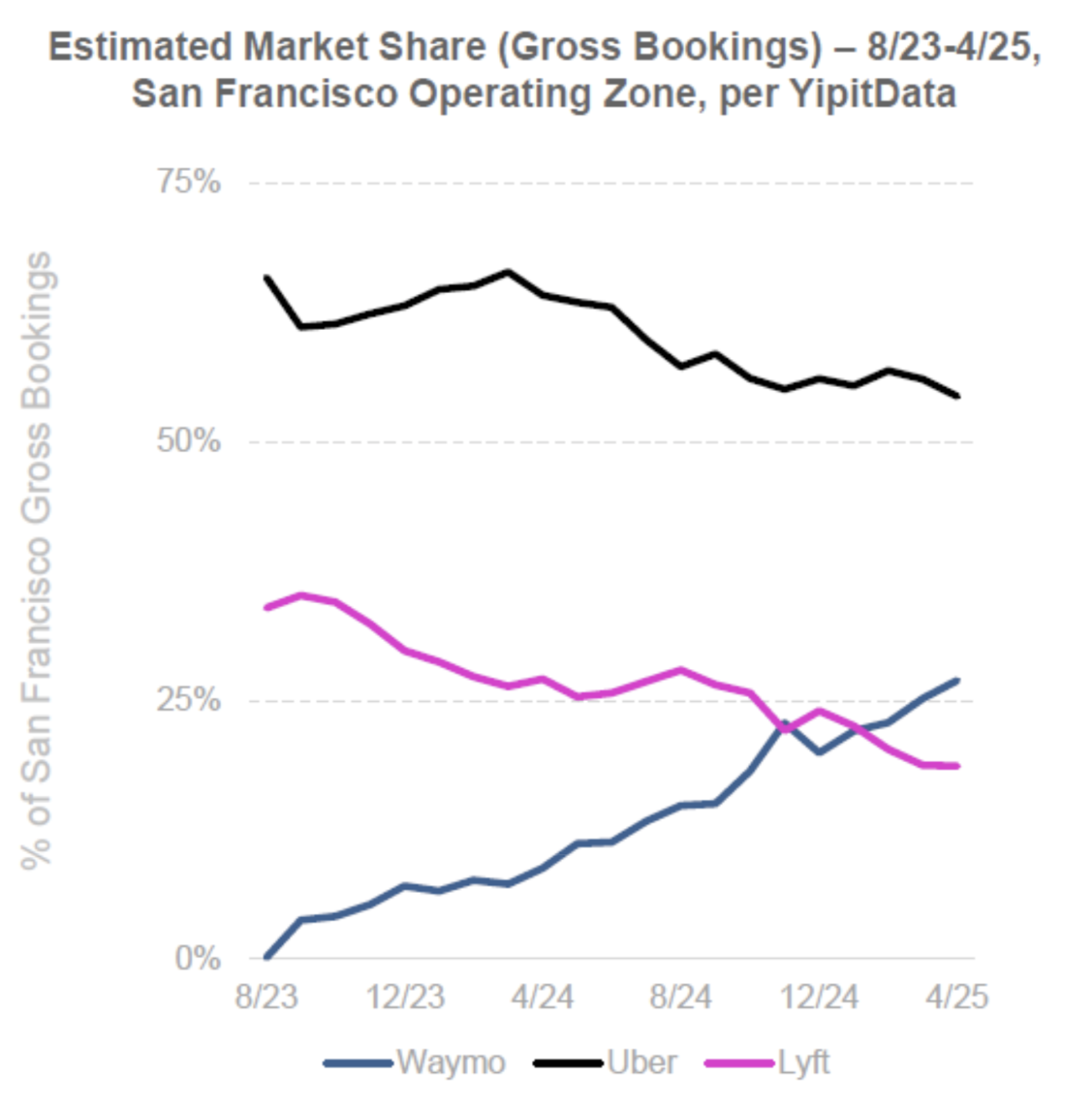
Waymo has also taken market share from other ride hailing services, surpassing Lyft in San Francisco in late 2024 (Figure B). Waymo now plans to add an additional 2,000 Jaguar I-PACE vehicles in 2026 and expand its services to more cities. Additionally, their new integration plant in Mesa, announced in May 2025, is expected to be capable of building tens of thousands of fully autonomous Waymo vehicles per year when fully operational.
Figure B. Waymo market share versus competitors in San Francisco
Source: Bond, Trends – Artificial Intelligence 2025
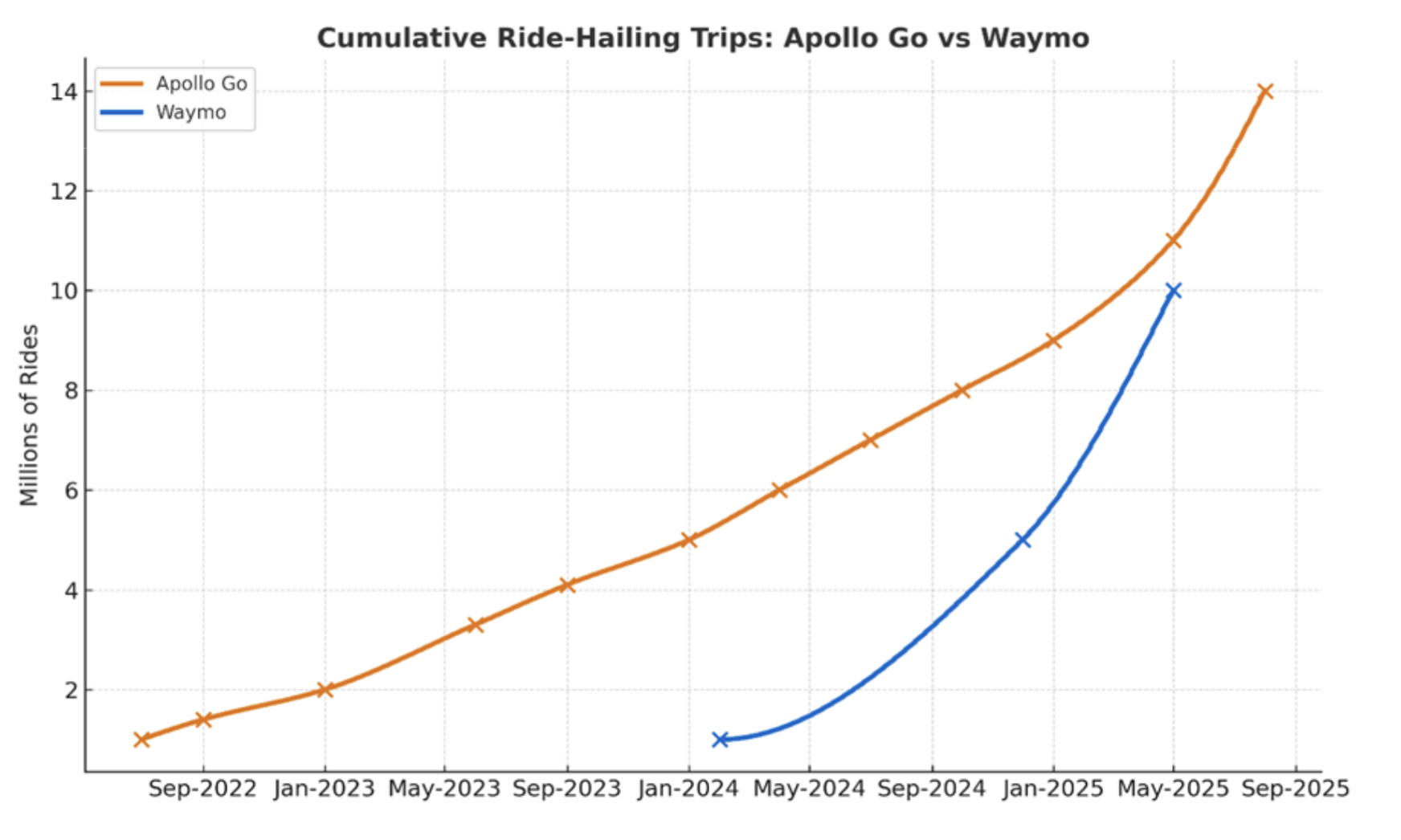
Chinese autonomous mobility companies have also made strong progress, led by Baidu’s Apollo Go, often described as the Waymo of China. As of May 2025, Apollo Go had completed 11 million cumulative ride-hailing trips, slightly ahead of Waymo’s 10 million at the same time (Figure C). In Q2 2025 alone it delivered 2.2 million rides, representing 148% year-on-year growth. Since February 2025, Apollo Go has been operating fully driverless across China with no safety drivers and now serves 16 cities globally.
Figure C. Ride-Hailing Trips: Apollo Go versus Waymo
Sources: Waymo, Baidu, AlphaTarget
Technology, safety and scaling
Two main architectures have emerged in the autonomous race. Waymo, along with most peers, have adopted a multi-sensor fusion approach, typically combining cameras, LiDAR and radar with high-definition (HD) maps built in advance for each city. These detailed maps (lanes, signs, kerbs, crossings), which can provide centimeter-level accuracy, enable the vehicle to localise precisely. Typically, these services run in geo-fenced areas with precise mapping and good network coverage, with the latter facilitating remote tele-operation as required.
Tesla, by contrast, uses primarily cameras with an end-to-end neural-network approach and does not use HD maps for localisation. Note that both approaches use maps for navigation and routing, but Waymo and similar architectures depend on pre-built HD maps to precisely localise the vehicle and validate its sensor-based perception, while Tesla’s system determines position and driving decisions directly from camera feeds, supplemented by a microphone for detecting emergency sirens.
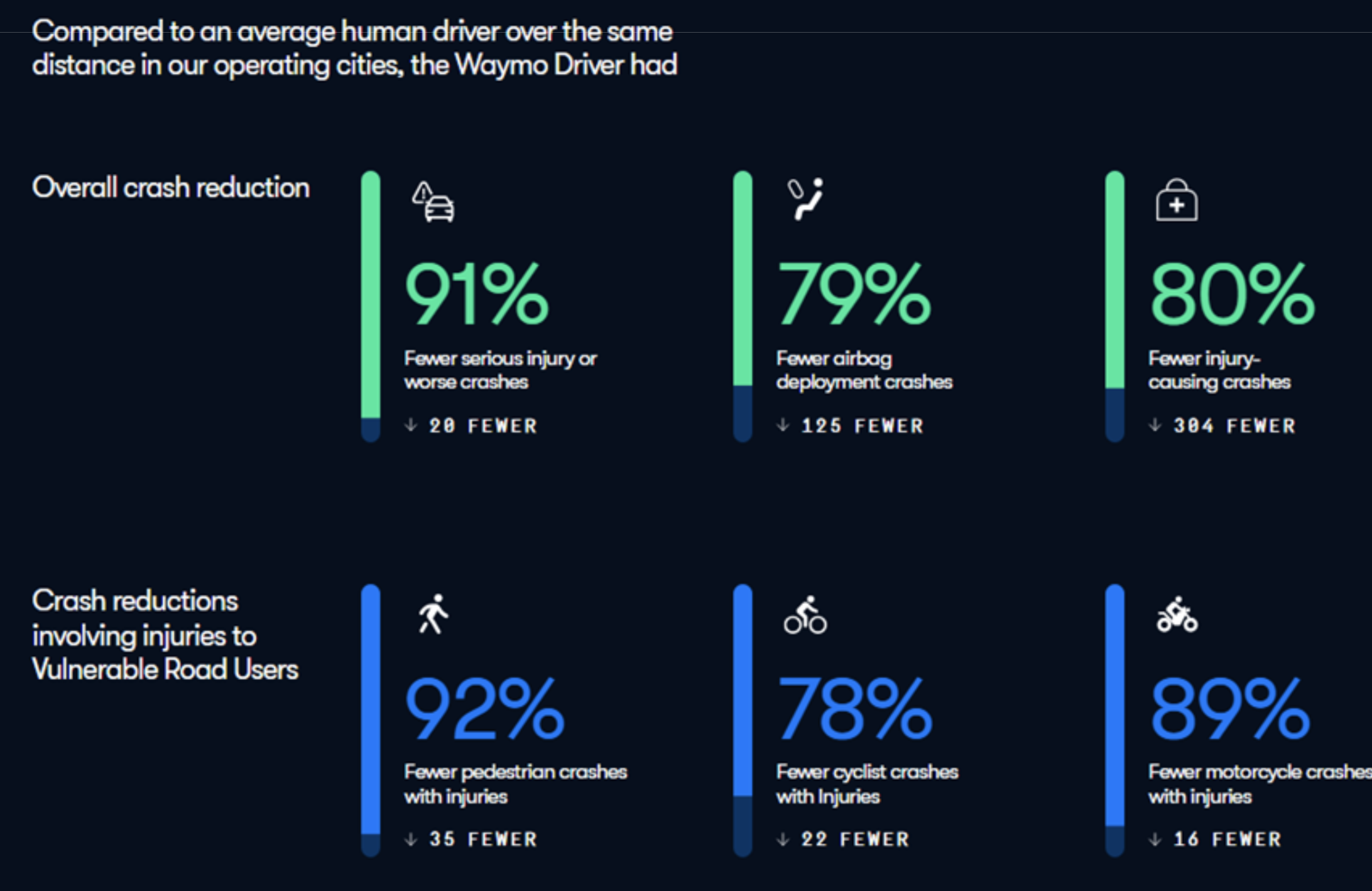
Waymo’s approach offers strong redundancy and precise localisation, which underpins proven commercial deployments. Waymo has also published data showing its vehicles are safer than the average human driver across several key metrics in the areas where it operates, with ‘91% fewer serious injury or worse crashes’ (Figure D). According to a TIME article in June 2025, Waymo’s Director of Field Safety, Matthew Schwall, believes the company’s autonomous vehicles are technically capable of operating safely in any American town, but widespread rollout depends on building local infrastructure and public trust.
Figure D. Waymo safety data
Source: Waymo
However, Waymo’s vehicles are still far from perfect drivers. There have been numerous reports of unpredictable behaviour, such as unexpectedly stopping in traffic. A Reuters article in August 2025 highlighted a Waymo driving into a flood and the passenger had to find a way out. Police said if the person had died, it could have led to a “serious criminal incident”. This highlights that the technology still needs refinement and has not quite yet reached the performance levels needed for widespread deployment. Additionally, the need to map out each new territory in incredible detail before autonomous operations has raised questions about its ability to scale at a meaningful pace. That said, Waymo is making progress on this front, with their 6th generation vehicle “on track to begin operating without a human behind the wheel in about half the time”.
“Once we can make it basically work in a few cities in America, we can make it work anywhere in America. Once we can make it work in a few cities in China, we can make it work anywhere in China.”
Elon Musk, Tesla CEO (Q1 2025)
One of the benefits of Tesla’s approach is that fewer sensor types simplify hardware and lower costs. The approach is also more generalisable because it does not require detailed mapping before it expands to a new city. Tesla has taken the route of rolling out its autonomous technology as an Advanced Driver Assistance System. Thus, Tesla’s customers are able to use its Full Self Driving (Supervised) solution and report back on interventions, which allows the company to iteratively improve its generalised autonomy solution. Tesla thus also has orders of magnitude more data than other autonomous mobility players given its large existing fleet, allowing it to capture a long-tail of scenarios. Its vertical integration also means it can iterate and optimise faster.
“LiDAR is a fool’s errand, and anyone relying on LiDAR is doomed”
Elon Musk, Tesla CEO (April 2019)
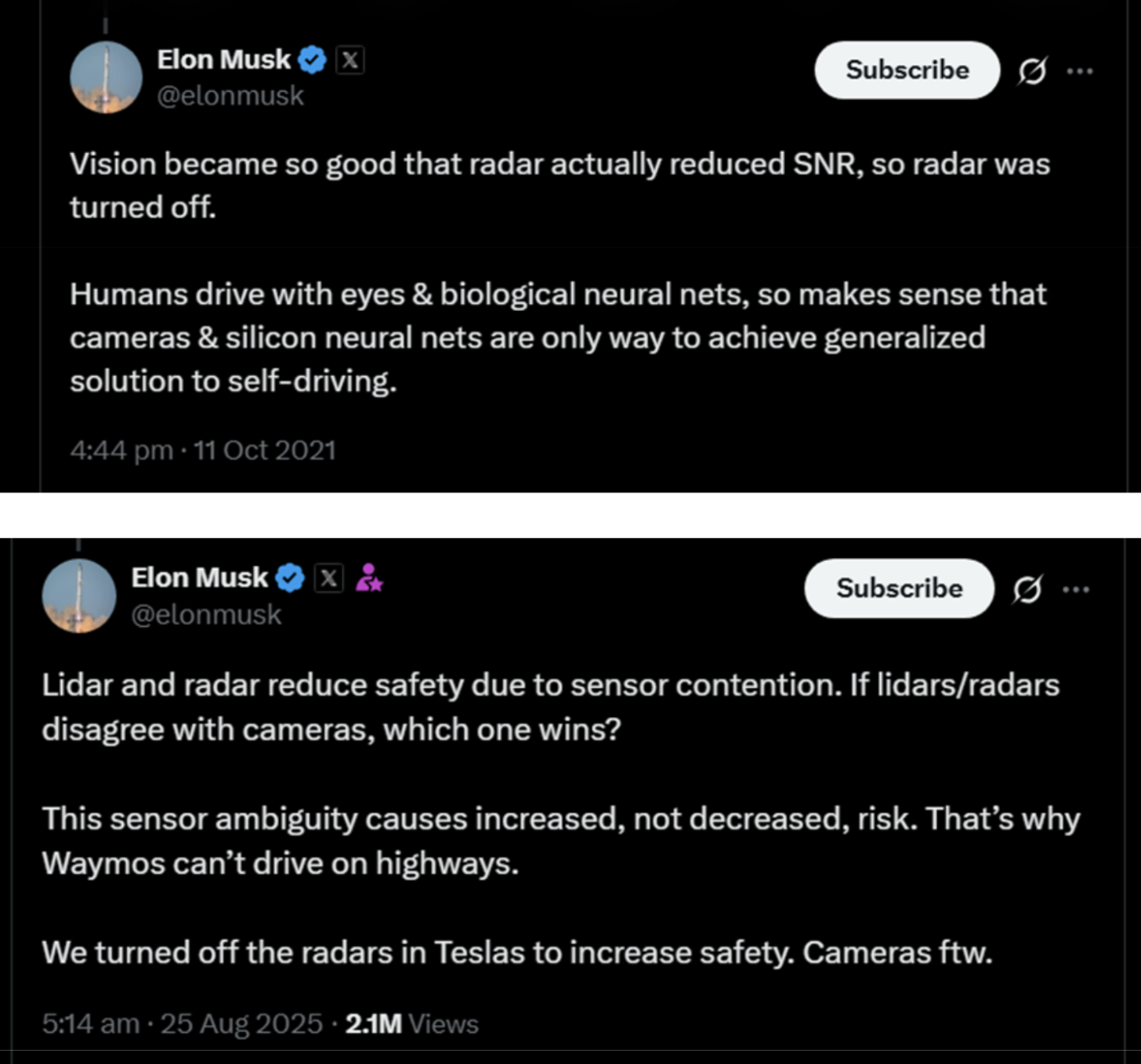
Many, however, question whether a camera-only system can meet the safety threshold for driverless operations. Musk argues that a multi-sensor approach increases complexity, potentially reducing signal-to-noise ratio (Figure E). Tesla’s “photons to control” approach utilises raw camera feeds, with their high dynamic range providing rich visual information, for both model training and inference at run-time.
Figure E. Elon Musk’s posts on autonomous technology
Source: X
In June 2025, Tesla soft-launched its robotaxi service in Austin, with many riders reporting that the vehicles felt smoother than Waymos (e.g. fewer instances of phantom braking). However, the rollout is at a very small scale and by invitation only, so it is likely that participants were to some extent biased. Additionally, there were safety monitors in the passenger seat, though Musk has said these will be removed by the end of the year.
Musk has also outlined exceptionally ambitious scaling targets. On the Tesla Q2 2025 earnings call, he stated that he expects the number of autonomous vehicles in operation to grow at a hyper-exponential rate and projected that Tesla would offer autonomous ride-hailing to half the US population by the end of the year. He has also previously said that its new Cybercab vehicle, designed for ride-hailing, is targeted for volume production in 2026, targeting 2 million units per year and potentially 4 million at full scale. These targets illustrate the scale of Tesla’s ambition relative to its peers, who generally speak in terms of thousands of units rather than millions.
Currently, the jury is still out on which approach will ultimately prove superior. Tesla must demonstrate it can safely operate its robotaxis without safety monitors and show it can scale meaningfully, even if not fully to its most ambitious targets. Meanwhile, Waymo will need to refine its technology to reduce occasional unpredictable behaviour and improve the efficiency of scaling operations over time. Both companies face critical milestones and the path to broad autonomous adoption will hinge on how well each can meet these challenges.
Expansion via partnerships
“Leveraging our partners’ local market presence, we can accelerate market entry across different continents and achieve faster deployment while maintaining a cost-efficient asset-light business model.”
Robin Yanhong Li, Baidu CEO (Q2 2025)
To accelerate deployment, autonomous driving companies are increasingly forming partnerships with established ride-hailing services and automotive players. In the US, Waymo continues to collaborate with both Uber and Lyft across multiple cities, integrating its autonomous vehicles directly into their ride-hailing apps. In Japan, Waymo announced a partnership in late 2024 with taxi platform GO and operator Nihon Kotsu, where vehicles will initially be manually driven in Tokyo to refine local performance before autonomous operations begin. Waymo has also expanded its OEM relationships, including with Hyundai, whose IONIQ 5 SUV will join the Waymo One fleet and Toyota, with which it is co-developing technologies to enhance both personally owned vehicles and future fleet models.
Similarly, Apollo GO has also struck a range of partnerships to further expand its operations. For instance, in August 2025 it partnered with Lyft to deploy autonomous rides across Europe, with initial deployments planned for Germany and the UK in 2026, pending regulatory approval. The agreement sees the fleet scaling to thousands of vehicles in the following years, with Apollo Go providing the vehicles and comprehensive technical support and Lyft owning the operational value chain. It also struck a similar deal with Uber in July 2025 for a range of markets outside of the US and mainland China. Initial target markets are Asia and the Middle East, with Dubai emerging as a key hub given its goal for at least 25% of all trips to be driverless by 2030.
These partnerships with ride-hailing platforms allow autonomous driving companies to focus on their core expertise while leveraging partners’ established user bases and operational capabilities. This creates natural synergies and removes the need for autonomous mobility players to spend heavily and compete on customer acquisition. Going forward, we would expect these types of partnerships to continue and become a standard go-to-market channel.
Chinese autonomous players are also increasingly looking to shift to an asset-light approach, choosing not to own the vehicles themselves. This model reduces capital intensity and transfers fleet management to partners better equipped to maximise utilisation and minimise operating costs, which should ultimately enable more efficient scaling.
The road to profitability
“Looking into the longer-term, we see a clear path to profitability as hardware and labour costs keep coming down and our growing operational scale brings more efficiencies.”
Robin Yanhong Li, Baidu CEO (Q1 2025)
A key question for the autonomous vehicle industry is if and when robotaxi operations can achieve profitability. While removing the human driver eliminates a major cost, the high expense of autonomous hardware and ongoing operating overheads, including the need for tele-operators, have historically made positive unit economics difficult to achieve.
A Wall Street Journal analysis in December 2024 estimated the cost of a Waymo vehicle at roughly US$125,000, comprising about US$50,000 for the Jaguar I-PACE base car and the remainder for autonomous components, including LiDAR, cameras, radar and external audio receivers (EARs). Assuming US$15–20 billion in capital investment and a fleet of 20,000 vehicles, the analysis suggested a breakeven period of around 10 years.
“With 13 cameras, 4 LiDAR, 6 radar and an array of external audio receivers (EARs), our new sensor suite is optimised for greater performance at a significantly reduced cost, without compromising safety.”
Satish Jeyachandran, Vice President of Engineering Waymo (August 2024)
Although Waymo faces less pressure to cut costs given its parent Alphabet has significant resources, cost reductions have been an important focus. When it announced its 6th generation Waymo Driver in August 2024, cost optimisation was a key highlight. Additionally, its partnership with Hyundai, adding the more affordable IONIQ 5 relative to the Jaguar I-PACE, suggests a focus on improving unit economics.
“RT6 is now running at a meaningful scale across multiple cities. And its unit cost is below $30,000, far better than anyone else on the planet.”
Robin Yanhong Li, Baidu CEO (Q1 2025)
In contrast, Baidu’s Apollo Go has achieved meaningfully lower vehicle costs and already reached positive unit economics in China, despite significantly lower average fares. In our discussions with another Chinese autonomous player, they have also seen significant cost reductions in recent times on multiple fronts. For instance, the hardware has become much more affordable, especially since they were able to move from expensive mechanical LiDAR to the more affordable solid-state and semi-solid state LiDAR. Additionally, as the AV industry continues to expand, the supply chain has benefitted from economies of scale, driving down costs. Operating expenses have also fallen through more efficient algorithms that consume less power and by reducing remote safety supervision to one operator per 30 vehicles.
This provider estimated total daily costs of around RMB300 (US$42) for its next generation vehicle, including OPEX and depreciation (Figure F). With taxi drivers in Chinese markets earning up to RMB600 (US$82) per day and autonomous fleets capable of continuous operation, they too appear well positioned to achieve positive unit economics. As fleets scale, fixed overheads should become an even smaller share of total costs, paving the way for profitability at the organisational level.
Figure F. Autonomous vehicle unit cost for a Chinese autonomous mobility company

Source: Chinese autonomous mobility company
Tesla’s Cybercab is also set to be highly cost effective. Musk has stated the cost was expected to be below $30k, with no pedals, steering wheel or driver dashboard. It is designed for a “gentle ride”, with lower top end speed and more efficient tires than its other models, optimised fully for cost per mile, estimated at around $0.3-$0.4.
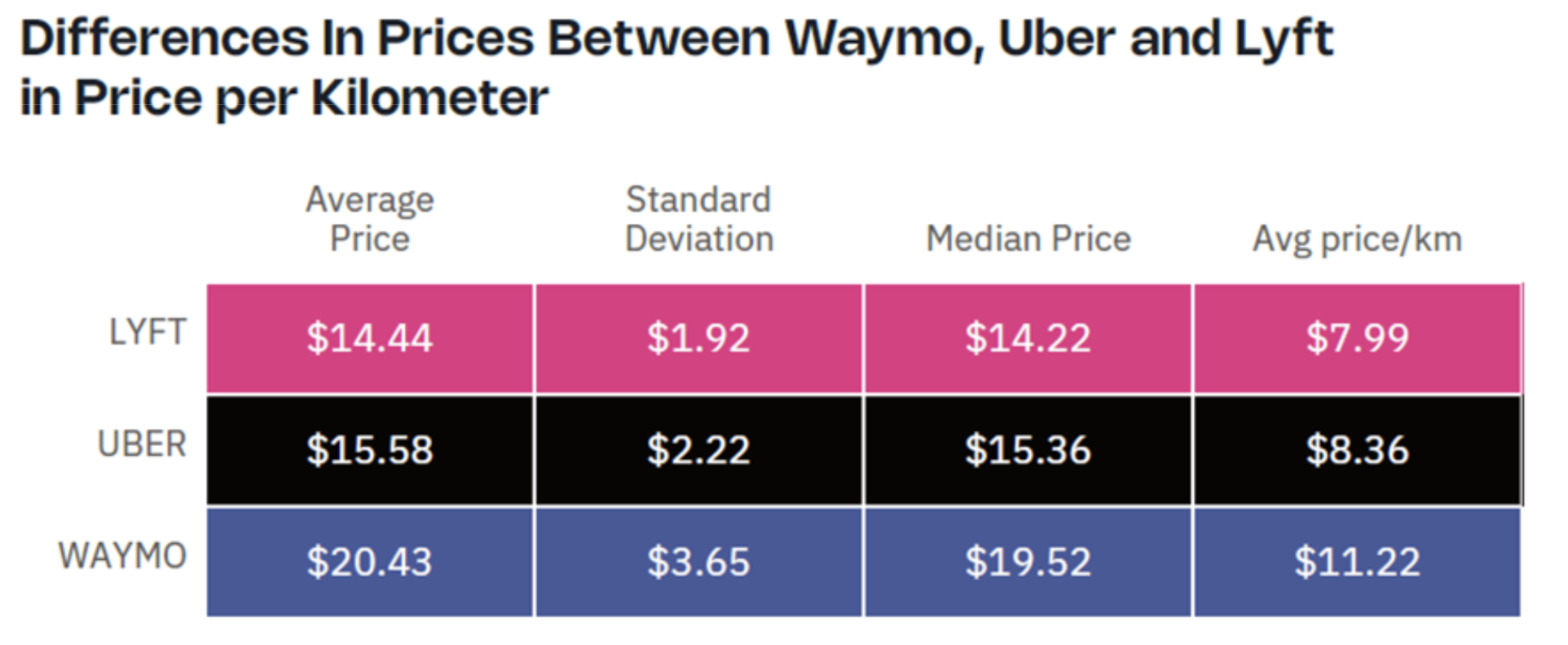
While vehicle costs are falling, early market data shows strong willingness to pay. A study by Obi found that Waymo rides were priced roughly 30–40% higher than competing services (Figure G). Among surveyed riders who had taken a Waymo, 70.2% said they preferred it, 16.7% were indifferent and 13.2% favoured traditional ride-hailing apps.
Figure G. Price comparison between Waymo and other ride-hailing apps
Source: Obi, The Roach Ahead: Pricing Insights On Waymo, Uber and Lyft
Notes: n: 88,998, Dates: 25 March – 25 April 2025, Place: San Francisco
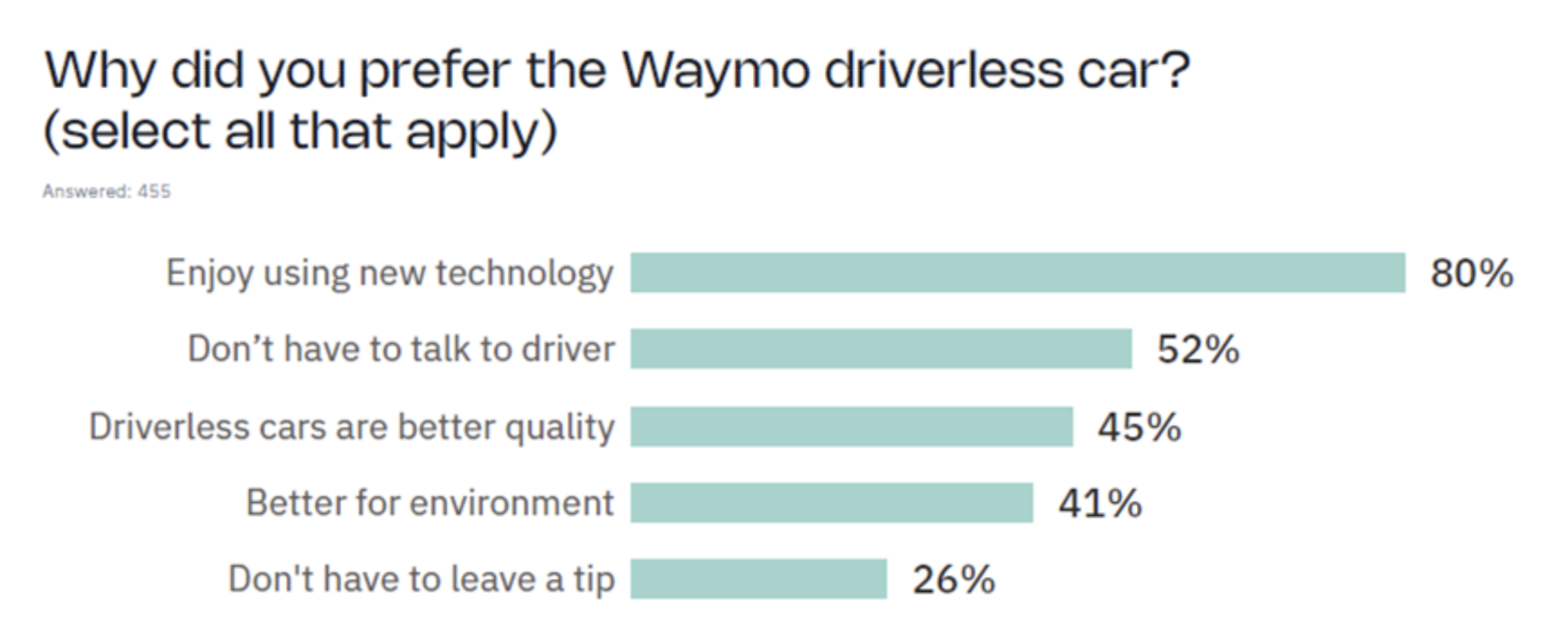
When respondents were asked why they preferred the Waymo, 52% of respondents said it was because they did not need to speak to the driver (Figure H). It is also likely that some riders feel safer without a human driver, though that was not an option on the questionnaire. We assume these factors can to some extent explain its growing market share and its ability to command a premium.
Figure H. Survey for why riders preferred Waymo
Source: Obi, The Roach Ahead: Pricing Insights On Waymo, Uber and Lyft
“We are moving towards a future where taking a robotaxi will be half the cost of taking a taxi today.”
Robin Yanhong Li, Baidu CEO (July 2022)
Although riders are currently willing to pay a premium, we do not expect elevated pricing to persist. In the long run, we would expect fares to fall materially below current ride-hailing rates as cost savings from removing human labour and using purpose-built vehicles are competed away. However, lower prices should drive significantly higher adoption and utilisation rates, as autonomous services become more accessible to a broader segment of consumers.
We still expect healthy margins over time, however. We do not anticipate the autonomous driving market to resemble today’s car industry with over 100 brands and structurally low profitability. Once leading players achieve scale, accumulate large amounts of proprietary driving data and demonstrate superior safety performance, barriers to entry should rise sharply, limiting competition and supporting healthy margins. At the same time, we do not foresee monopoly-like outcomes, as large national governments are unlikely to allow a single foreign operator to dominate domestic mobility infrastructure and are expected to support local champions.
Sizing the opportunity
Autonomous vehicles will potentially impact multiple trillion-dollar markets including transportation, logistics and urban infrastructure. This potential stems from fundamental changes to cost structures and asset utilisation across these sectors, although the early stage of the technology makes precise market sizing challenging.
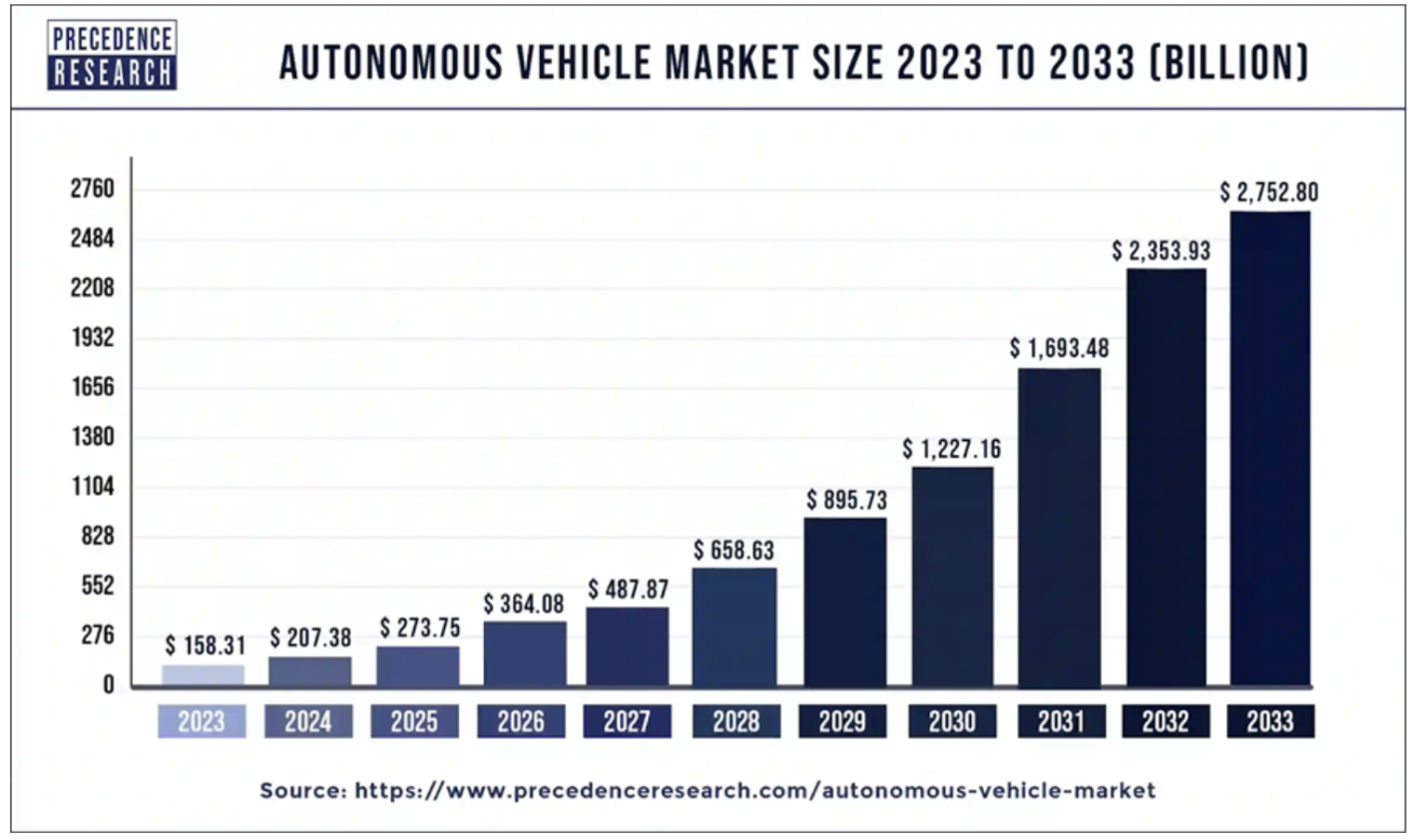
Since autonomous technologies are still in the very early stages of their rollout, the estimates for total addressable market (TAM) vary significantly across forecasts. For instance, according to Fortune Business Insights, the global autonomous vehicle market was valued at just over US$1.9 trillion in 2023 and is expected to grow to US$13.6 trillion by 2030 (representing a CAGR of 32.3%)! On the other end of the spectrum, Precedence Research has a relatively conservative estimate for the Autonomous Vehicle Market at US$158.3 billion in 2023, set to grow to US$2.75 trillion by 2033 (Figure I).
Figure I: Autonomous Vehicle Market Size, 2023 to 2033
Source: Precedence Research
Conclusion
The autonomous vehicle (AV) market remains nascent, with leading robotaxi fleets currently numbering around 1,000–1,500 vehicles and most new partnerships involving only a few thousand units. This is orders of magnitude smaller than the global vehicle total, estimated at 1.6 billion. However, growth is accelerating as technology advances, regulatory support increases and partnerships proliferate across regions. Crucially, we see emerging positive unit economics as a catalyst, giving companies the confidence and economic capacity to scale more aggressively. We therefore believe the industry is now at an inflection point and we would not be surprised to see fleet sizes doubling or tripling annually for many years to come.
At AlphaTarget, we invest our capital in the most promising disruptive businesses at the forefront of secular trends; and utilise stage analysis and other technical tools to continuously monitor our holdings and manage our investment portfolio. AlphaTarget produces cutting-edge research and our subscribers gain exclusive access to information such as the holdings in our investment portfolio, our in-depth fundamental and technical analysis of each company, our portfolio management moves and details of our proprietary systematic trend following hedging strategy to reduce portfolio drawdowns. To learn more about our research service, please visit alphatarget.com/subscriptions/.
“[T]he larger driver of our everyday activity is the fact that the software industry is completely changing with AI. It feels like the AI era of the past two years just makes the SaaS era feel like sleeping days.”
Ivan Zhao, Notion CEO (11 August 2025, The Verge)
“It’s been eight of the most exciting months, I think, of my career.”
Marc Benioff, Salesforce CEO (29 August 2025, The Logan Bartlett Show)
An agentic software future
The current artificial intelligence (AI) revolution has ignited widespread debate about its transformative potential across industries, with software playing a central and pivotal role in these changes. Many observers express concerns that AI could disrupt the very foundations of software as we know it, rendering the current software paradigm obsolete. This fear stems from the belief that AI’s generative capabilities could automate code generation to the point where bespoke applications are created with ease, bypassing the need for ongoing subscriptions to SaaS platforms. Additionally, some industry experts foresee a future where traditional software becomes redundant, as instead of interacting with a range of siloed software applications, users will interact with an agentic interface through which they can express their intent and have agents work in the background to obtain the desired outcome.
“I think the notion that business applications exist, that’s probably where they’ll all collapse, right, in the agent era.”
Satya Nadella, Microsoft CEO (12 December 2024, BG2)
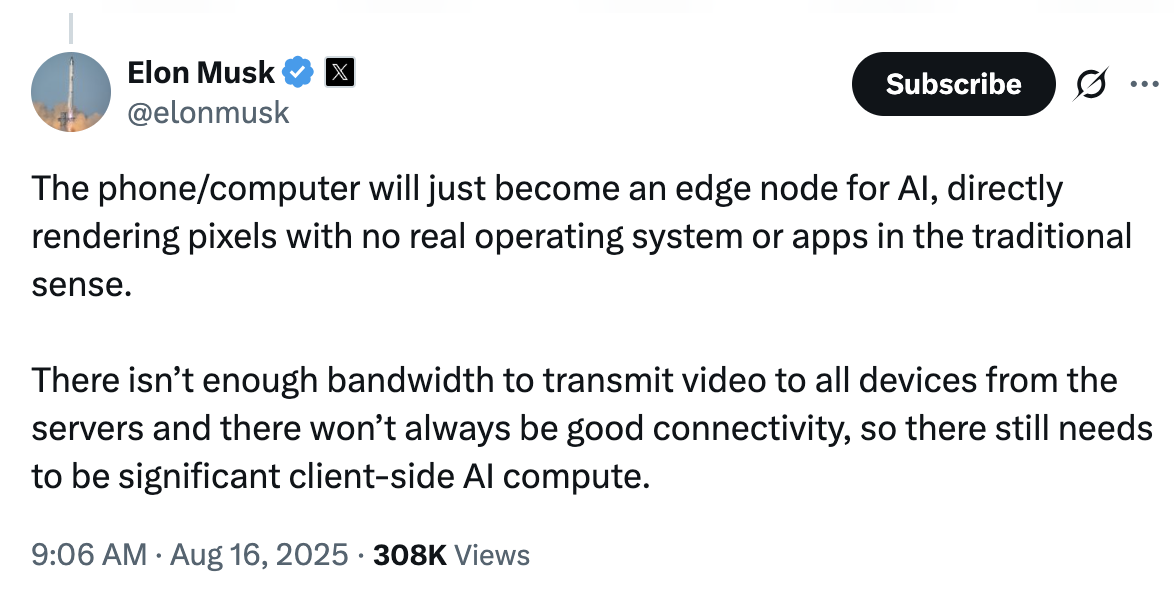
High-profile voices have amplified these fears. In a recent social media post (Figure A), Musk suggested that phones and computers would effectively become edge nodes for AI, directly rendering pixels without the need for a traditional operating system or conventional apps. In that same exchange, he agreed with Replit’s CEO, Amjad Masad, who commented that AI could generate apps on demand, with agents eating traditional apps. Replit itself exemplifies this shift: its vibe coding (i.e., “rapid prototyping”) tool allows users to build and deploy apps in a fraction of the time compared to traditional software development, collapsing traditional coding barriers and enabling anyone to be a software developer.
Figure A: Elon Musk’s post on X
Source: X
We believe the AI revolution will significantly impact existing software, but that does not necessarily mean the demise of established software vendors. Presently, vibe coding tools excel at code generation and prototyping, yet have fallen short in delivering fully polished, production-ready products. We suspect that time will come too, but even then, incumbents possess moats that cannot easily be overcome in the short run. These include network effects, deeply embedded workflows and troves of user data. For instance, CRM is not just a tool but a living ecosystem of customer relationships and integrations that vibe coding cannot simply replicate. However, existing software will have to evolve significantly to meet user expectations if it is to stay relevant in the long run.
In an August 2025 report, Gartner forecasts the future evolution of AI in enterprise software, as shown below (Figure B). Although timelines are highly uncertain, we think this forecast provides a good outline of the many steps (and hurdles) and time taken before we get to a world where agentic software is mainstream.
· Stage 1. By the end of 2025, the majority of enterprise apps will have embedded AI assistants to simplify tasks and enhance user productivity. AI assistants are generally human triggered.
· Stage 2. By 2026, 40% of enterprise apps will incorporate task-specific AI agents capable of handling complex, end-to-end processes independently, such as automating cybersecurity responses or other specialised functions.
· Stage 3. By 2027, one-third of agentic AI implementations will have different agents collaborating within individual applications, combining diverse skills to manage intricate tasks.
· Stage 4. By 2028, there will be AI agent ecosystems that collaborate across multiple apps and business functions. One-third of user interactions will occur through agentic front ends.
· Stage 5. By 2029, at least 50% of knowledge workers will be able to create AI agents on demand.
Figure B: Gartner’s forecast for agentic AI in enterprise apps
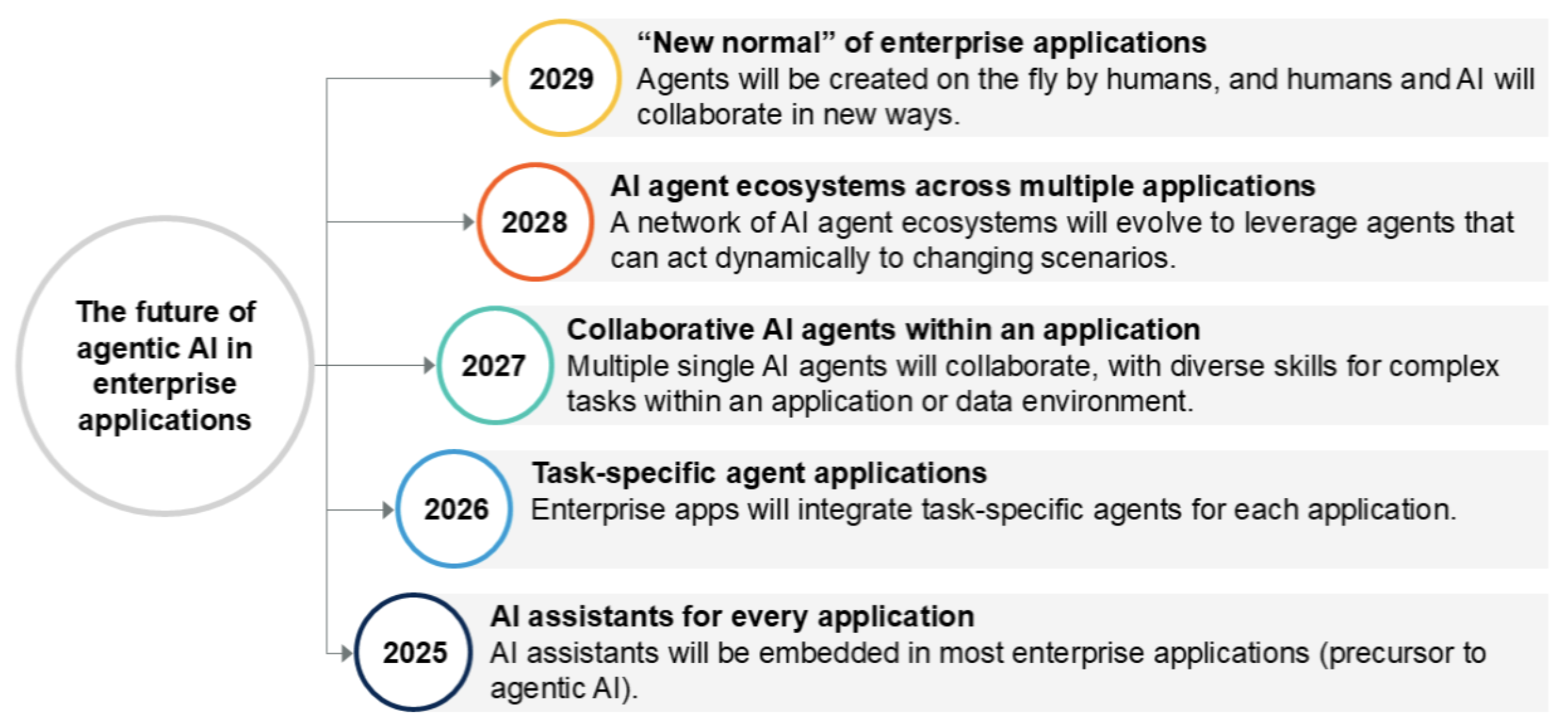
Source: Gartner (August 2025)
An example of this agentic evolution is the introduction of Salesforce’s Agentforce, which it launched in September 2024. This AI-powered autonomous agent platform connects to enterprise data and handles tasks across sales, service, marketing and commerce. Agentforce has seen rapid adoption, with over 12,500 deals closed by July 2025, of which 6,000 were paid. Below is an illustration of its enterprise stack (Figure C), composed of a data layer (Data Cloud), a core application layer (Customer 360) and the agentic layer (Agentforce) which orchestrates work on top. We think this is a good illustration of where the enterprise stack is heading, though we acknowledge that there will likely be variations across different companies and industries. A key challenge for incumbent companies like Salesforce however will be adapting these innovations around legacy systems rather than building AI-native solutions from scratch.
Figure C: Salesforce’s Agentforce
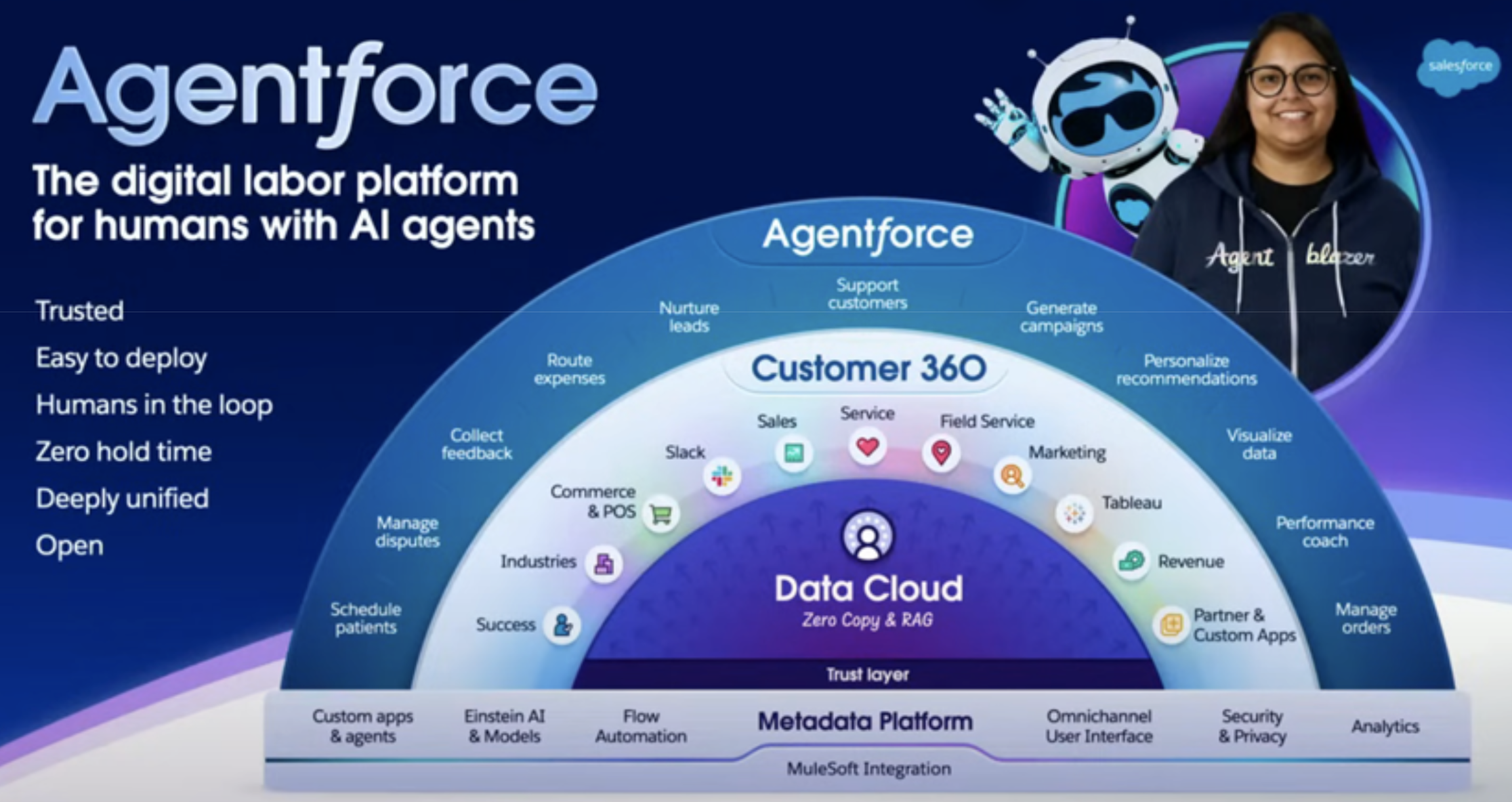
Source: Salesforce
The fruits of thy labour
“[T]he overall addressable market went from software to software plus labour, which is 10 times bigger.”
Yamini Rangan, HubSpot CEO (5 May 2025, Grit)
It is important to note that the rise of AI is not just a challenge for software vendors to overcome in order to stay relevant, but also a significant opportunity. Those who innovate early and integrate AI capabilities into their products can offer more advanced services, effectively monetising the additional value they create. In other words, the leaders in this AI-driven evolution can potentially charge for the extra “intelligent” work their software does, creating significant new revenue streams.
At the same time, there is an open question about how much of this value will be captured by the software vendors relative to the infrastructure and model providers e.g. Microsoft and OpenAI, who supply the inference capabilities. Although inference is getting cheaper, with some estimating it is becoming 10x cheaper per year, the amount of inference needed per task is also growing extremely quickly, especially as models become more advanced and do more work. In an article by The Wall Street Journal, they provided an estimate of tokens needed per task below, showing how inference requirements increase drastically with task complexity.
• Basic chatbot Q&A: 50 to 500 tokens
• Short document summary: 200 to 6,000 tokens
• Basic code assistance: 500 to 2,000 tokens
• Writing complex code: 20,000 to 100,000+ tokens
• Legal document analysis: 75,000 to 250,000+ tokens
• Multi-step agent workflow: 100,000 to one million+ tokens
The article also commented on how this is impacting margins: Ivan Zhao, CEO of productivity software company Notion, said his business had a gross margin of 90% two years ago, fairly standard for SaaS companies. However, approximately 10 percentage points of that margin now goes to the AI companies that power its latest offerings.
It is difficult to forecast the long-term margin impact of inference on SaaS companies, as it will depend on several factors. These include the market dominance of hardware and model providers, which determine their pricing power. Another determinant of inference costs will be the extent to which hardware and software efficiencies improve relative to inference demand. However, if the history of traditional cloud computing by big tech is any guide, inference providers are likely to capture a healthy share of the economics.
Still, we think innovative software vendors will see more upside than downside. They will be able to offer significantly more value to their clients by automating work and reducing labour costs, value that can be monetised at a strong premium. Additionally, as agent-driven systems become embedded in everyday workflows, almost like training an employee who learns a company’s specific needs, vendors could become much harder to dislodge, strengthening their moats. This, in turn, should allow them to raise prices and improve margins. ServiceNow, for instance, exemplifies this opportunity, with the company’s NowAssist AI products commanding 20%+ price premiums over standard offerings, while driving significant revenue growth.
Monetisation revamp
As software increasingly performs work through AI inference, software companies will also need to restructure their monetisation models. SaaS companies will need to shift away from their reliance on seat-based revenue towards usage-based revenue to align monetisation with value delivered. However, this transition is fraught with challenges. Seat-based pricing is more straightforward, scaling with user count. Usage-based models, however, introduce unpredictability, as costs fluctuate with consumption, making forecasting difficult for customers and businesses. It requires real-time systems to track potentially unbounded spend, unlike monthly batch processes. Complex discount structures for enterprise contracts add further intricacy, and data must be stored accurately and accessibly to maintain financial integrity and future pricing flexibility.
Operationally, incentive structures will transform. Sales teams must prioritise high-usage clients over seat counts, necessitating new compensation models. Product teams need to focus on unlocking use cases that drive usage, requiring agility to adapt to evolving customer needs. This transformation demands top-down leadership from the CEO to align sales, product, and finance teams. The right pricing model is still being figured out, with no universal solution yet, and we expect this will take time as AI models and hardware continue to rapidly improve. As seen with Salesforce’s Agentforce, it has reportedly changed its pricing model three times in a single year, reflecting rapid experimentation to find the optimal approach.
Despite challenges, usage-based pricing offers immense opportunity. By aligning monetisation with usage, companies achieve better product-market fit, capturing more value as customers derive greater benefit, fostering a flywheel of growth and innovation.
The agentic organisations
“I am on a mission to make Salesforce an agentic enterprise.”
Marc Benioff, Salesforce CEO (29 August 2025, The Logan Bartlett Show)
In addition to evolving their products and monetisation models, software vendors will also need to rethink their organisational structures. As Marc Benioff from Salesforce highlighted, it’s not just about making the product agent-driven, but about making the entire organisation agent-driven. In a recent podcast, he mentioned reducing Salesforce’s support staff from around 9,000 to 5,000 thanks to AI agents, reducing costs substantially.
Likewise with sales, AI agents are reshaping how leads are managed and converted. Benioff explained that Salesforce had accumulated over 100 million uncontacted leads over 26 years due to insufficient human resources. However, now agents call back every person who calls them, handling more than 10,000 leads weekly, engaging in conversations and funnelling them into their pipeline. This highlights how agents are not just helping cut costs, but also helping grow revenues more efficiently. We imagine there will be many more use cases where agents will enhance efficiencies significantly. We therefore see significant upside potential for companies that can transform themselves to become more agent driven.
Sizing the opportunity
Cutting-edge software firm Palantir estimates it will be able to grow its revenue by 10x over the next 5 years, while simultaneously reducing headcount. This is a testament to the potential efficiency gains of AI. Although most firms will likely not be as operationally efficient as Palantir, we believe the potential for software to automate services and displace human labour will still lead to a substantial TAM expansion. According to Battery Ventures’ 2024 State of the OpenCloud report, the AI software TAM is worth approximatley US$4 trillion (Figure D).
Figure D: The AI Software Market Opportunity
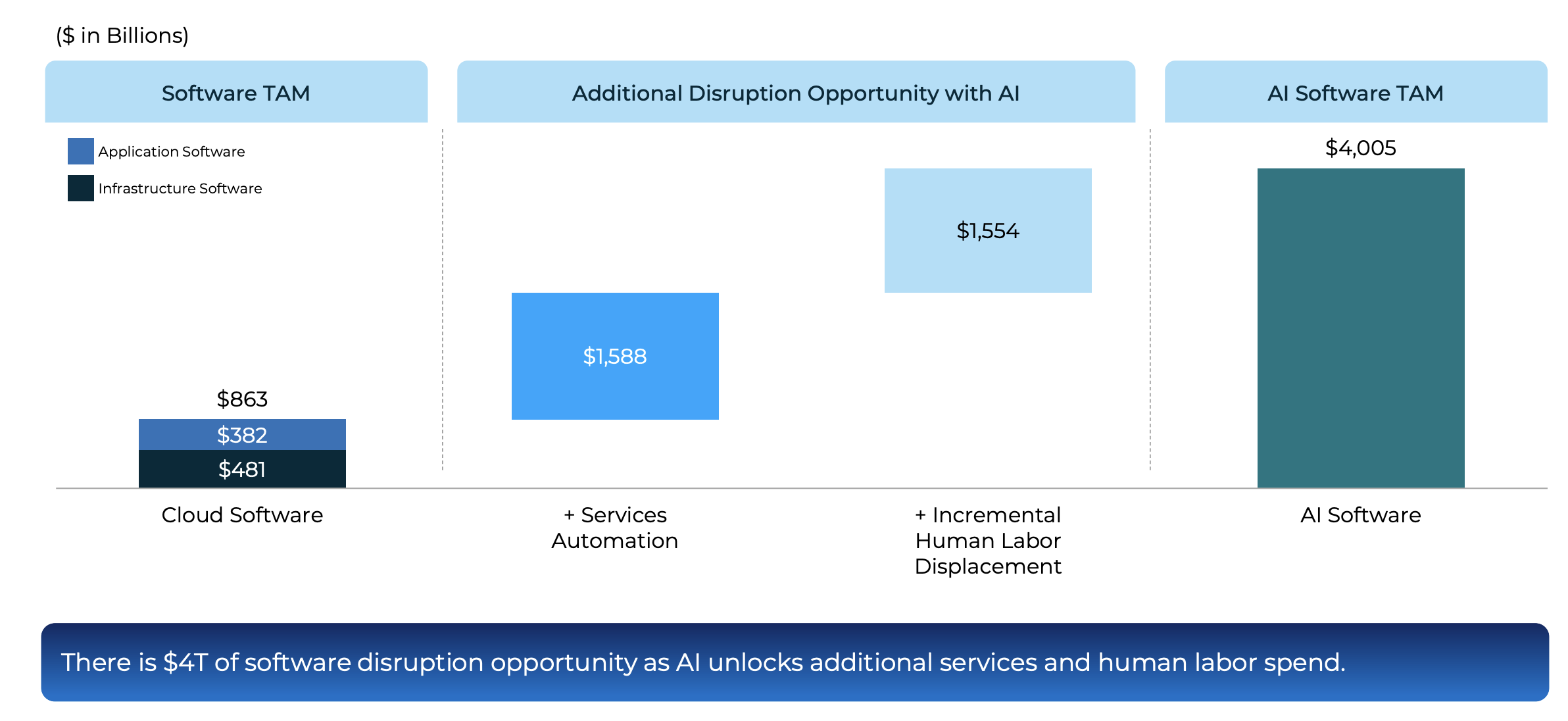
Source: Battery Ventures, State of the OpenCloud Nov 2024
Conclusion
The current AI paradigm poses one of the greatest challenges the software industry has faced, forcing vendors to rethink many aspects of their business. Yet it also represents a powerful accelerant. Vendors could see substantial revenue uplifts by monetising the intelligent work their software performs, while also capturing significant operational efficiencies within their own organisations. Existing moats give incumbents valuable time to adapt, and as software evolves from being a critical tool to performing critical workflows, these moats may in fact deepen, making vendors harder to displace. However, Darwinism will take effect. The winners will be those agile enough to adapt quickly and embrace AI holistically, not just at the product level, but across their entire organisations.
In our view, companies that are already geared towards usage-based pricing models, will naturally benefit in this evolving AI landscape. We believe usage will rise as AI performs more tasks and we are already seeing signs of strong growth for software infrastructure companies, where usage based revenue models are native. Seat-based models on the other hand may face headwinds as businesses become more efficient and may as a consequence see less seat growth. We are therefore more cautious on vendors that remain seat-based without a clear path to transition toward usage-based models, particularly where their products have limited potential to perform meaningful work that could be monetised.
Additionally, we have a preference for infrastructure software businesses with deeply embedded workflows. Such companies are less easily disrupted than application software vendors and have more breathing room to evolve without immediate competitive threats. We also see cybersecurity as a particularly promising area. As companies expand their AI capabilities, their attack surfaces and vulnerabilities will grow. This will create more demand for advanced cybersecurity solutions. With adversaries also leveraging AI, cybersecurity firms that can help clients secure these new environments are well-positioned to benefit.
At AlphaTarget, we invest our capital in some of the most promising disruptive businesses at the forefront of secular trends; and utilise stage analysis and other technical tools to continuously monitor our holdings and manage our investment portfolio. AlphaTarget produces cutting-edge research and our subscribers gain exclusive access to information such as the holdings in our investment portfolio, our in-depth fundamental and technical analysis of each company, our portfolio management moves and details of our proprietary systematic trend following hedging strategy to reduce portfolio drawdowns. To learn more about our research service, please visit alphatarget.com/subscriptions/.
Quantum computing is emerging as the next frontier in technology and it has the potential to solve problems that today’s computers cannot touch; transforming industries from cryptography to drug discovery. Yet, despite billions invested and headlines touting breakthroughs, practical quantum advantage remains years away. Investors should watch this space carefully but resist the temptation to chase the hype.
This article breaks down the key components of the quantum computing ecosystem, from processors and infrastructure to software and real-world use cases, exploring how investors and business leaders can participate in its growth. We cover the main hardware technologies, supporting infrastructure providers, early commercial applications, current public investment opportunities, risks to watch and some principles for investing in the space.
Understanding quantum computing
Quantum computing is an emerging field in computer science and engineering that leverages the principles of quantum mechanics to tackle problems that exceed the capabilities of even the most powerful classical computers. The field of quantum computing includes a range of disciplines, including quantum hardware and quantum algorithms.
Classical computers, from smartphones to supercomputers, process information using bits (i.e., they are in one of the two states ‘1’ or ‘0’). These computers handle tasks by manipulating bits through logical operations, often in parallel across multiple processors to speed up computations. However, their performance is limited by the need to evaluate solutions step-by-step for complex problems, such as factoring large numbers or simulating chemical reactions.
Quantum computers use quantum bits (qubits), which differ fundamentally from classical bits. Due to a property called superposition, a qubit can represent 0, 1, or a combination of both states simultaneously. This enables quantum computers to process multiple potential solutions at once. Additionally, qubits can be entangled, meaning the state of one qubit is linked to another, allowing coordinated computations that classical systems cannot replicate. These properties make quantum computers potentially far faster for certain tasks such as cryptography, molecular modelling or risk analysis, though they are not universally superior and require specialised algorithms to outperform classical systems.
Google’s Quantum AI Lab
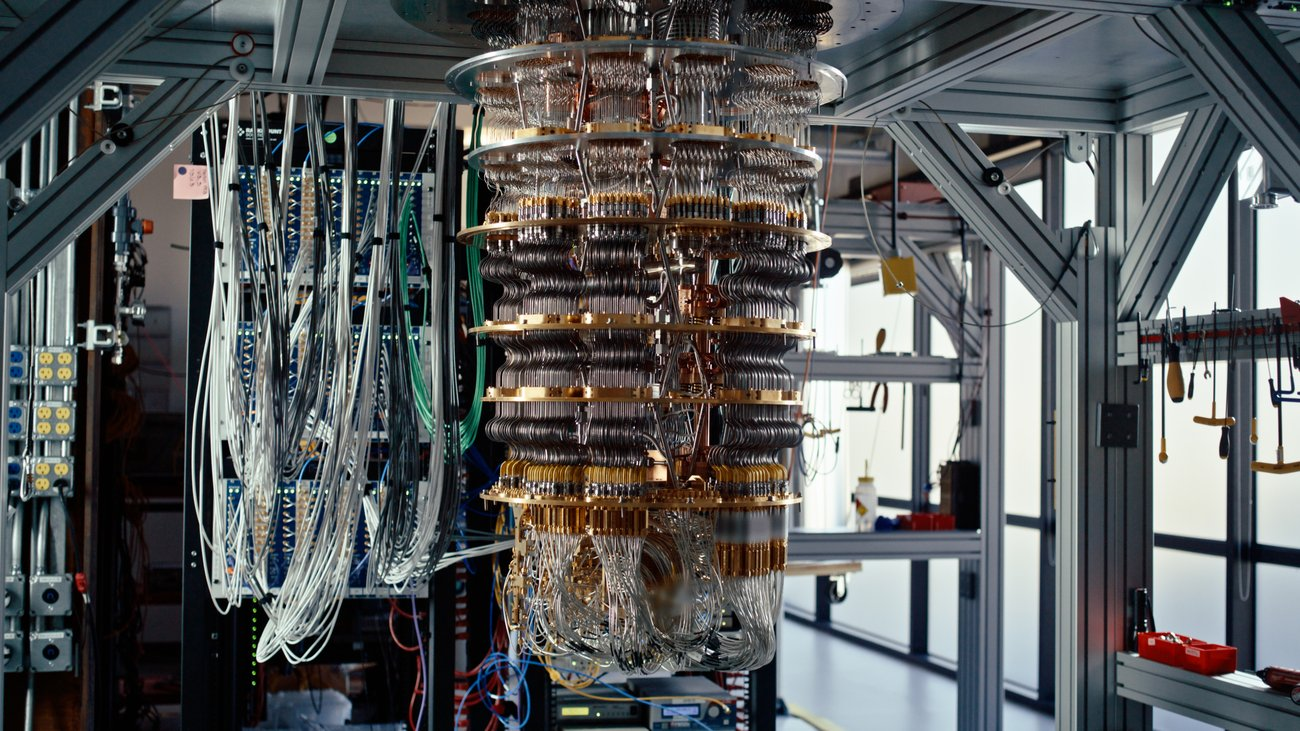
Source: Google
Hardware: The core engine
As discussed above, qubits are at the heart of the quantum computing revolution. Unlike bits that are binary, qubits operate using quantum superposition and entanglement, allowing them to represent multiple states simultaneously. A key challenge is that qubits are extraordinarily fragile; the slightest vibration, temperature change, or electromagnetic interference causes “decoherence” (i.e., the qubit loses its quantum properties).
Currently, three main approaches compete to build stable qubits:
- Superconducting qubits (used by IBM, Google, Rigetti): Rely on superconducting circuits at millikelvin (extremely cold) temperatures. Benefits include fast gate speeds and integration with CMOS-compatible fabrication, but they suffer from decoherence (losing quantum properties within microseconds) and scaling issues.
- Trapped ion qubits (IonQ, Quantinuum): Leverage ions suspended in electromagnetic fields. Highly accurate with longer coherence times, but gate speeds are slower and hardware is more difficult to scale.
- Photonic qubits (PsiQuantum, Xanadu): Use photons as carriers of quantum information, promising scalability and room-temperature operation, though achieving reliable operation remains a challenge.
The modalities have different commercial prospects and timelines to scale. Investors should view this like the early days of semiconductors, with multiple competing technologies and no clear winner yet. Rather than focus on one approach, a prudent approach might be to consider companies with strong IP portfolios and proprietary fabrication capabilities. Partnerships with national labs or hyperscalers (e.g., Microsoft + Quantinuum) signal credibility. Furthermore, as discussed in the next section, the picks and shovels of this area might also be worth further investigation.
More than just chips
Quantum computing systems are extremely delicate, and their operation requires a complete redesign of the computing stack. That includes:
- Cryogenic refrigeration: Dilution refrigerators are essential for superconducting qubits, often operating below 15 millikelvin. Bluefors and Oxford Instruments dominate this niche, offering high-margin components with little competition.
- Control and readout electronics: Precise microwave pulses must control each qubit, which requires specialised signal generators and converters. Keysight and Zurich Instruments provide these critical components.
- Quantum interconnects: Low-loss coaxial cables, optical fibre links for photonic setups, and waveguides are all part of the infrastructure.
- Quantum-safe networking: Emerging players are enabling quantum key distribution (QKD) and post-quantum cryptographic protocols to secure classical systems against quantum decryption threats.
- Quantum cloud platforms: Big tech now offers quantum hardware via the cloud. IBM Quantum, Amazon Braket, and Azure Quantum act as intermediaries for enterprises to experiment, without capital-intensive ownership. This “quantum-as-a-service” model generates recurring revenue and lowers barriers to adoption.
Infrastructure suppliers (cryogenics, control hardware and packaging) are cash-flow positive and may see inorganic acquisition from hyperscalers or defence contractors.
Emerging use cases
Quantum computing is poised to augment classical computing by addressing specific use cases more efficiently.
In finance, current risk models can analyse thousands of scenarios. Quantum computers could analyse millions simultaneously, transforming option pricing, arbitrage strategies, risk analytics, and Monte Carlo simulations. For instance, JPMorgan Chase estimated that quantum computers could accelerate Monte Carlo simulations used in derivative pricing models by 1,000 times. Early pilots with banks show promising results.
In pharmaceuticals, quantum computing’s potential to model protein folding, ligand binding, and drug target interactions is expanding rapidly, with partnerships such as Roche collaborating with quantum computing firm Cambridge Quantum. Materials science benefits from quantum-powered molecular simulations that accelerate the discovery of new catalysts, with Chevron and BASF actively investing in this space.
The energy sector looks to quantum computing to optimise power grids, simulate fusion processes, and advance battery chemistry. These efforts are strongly supported by government initiatives focused on achieving net-zero carbon emissions.
Logistics applications include vehicle routing, warehouse optimisation, and scheduling, leveraging hybrid quantum-classical solvers that are gaining traction in the industry.
Finally, cybersecurity is emerging as a critical area for quantum computing technology, focusing on post-quantum cryptography, quantum key distribution, and secure authentication to counteract future quantum decryption threats. This is driven by evolving NIST (National Institute of Standards and Technology) standards and increasing national security interests.
Firms with pilot projects or co-innovation partnerships in these domains are best positioned to capture early revenues, especially those nearing quantum computing advantage in their use cases.
Themes & opportunities
The quantum computing stack is broad, opening up multiple avenues of capital allocation:
- Quantum Computing Hardware Companies: Publicly listed companies include IonQ (IONQ), Rigetti (RGTI), and D-Wave (QBTS). In this space, one ought to monitor product roadmaps versus hype.
- Infrastructure and Tooling Suppliers: Cryogenics (Bluefors), microwave components (Keysight), dilution refrigerators (Janis Research), and control systems (Zurich Instruments). These firms are typically overlooked but benefit from early-stage adoption and defence applications.
- Quantum-as-a-Service (QaaS) Providers: Microsoft Azure Quantum, Amazon Braket, and IBM Cloud are developing pay-as-you-go pricing models. They offer recurring SaaS-style revenue with high customer switching costs.
- Quantum Computing Middleware & Software Tooling: SDKs like Qiskit (IBM), Cirq (Google), and tket (Quantinuum). Compilers, noise mitigation tools, and quantum optimisers are early bets with parallels to early AI tooling stacks.
- Application-Level Startups: While mostly private, those that go public or get acquired will benefit from early proven vertical quantum computing advantage.
The key players
Quantum computing is still in its early innings as a commercial industry, but a handful of companies already exist in the public markets, either as pure plays or through broader technology portfolios. For investors, these companies represent a mix of long-term potential, near-term uncertainty and varying levels of exposure to quantum computing.
IonQ (NYSE: IONQ)
IonQ was the first quantum computing company to go public via a SPAC in 2021 and remains one of the few true “pure plays.” It develops trapped-ion quantum processors, known for longer coherence times and high gate fidelity. IonQ offers hardware access via AWS, Azure, and Google Cloud. It is starting to generate revenue (US$43 million TTM) through quantum-as-a-service and research contracts. Its market capitalisation is US$9.8 billion, reflecting high expectations.
Rigetti Computing (Nasdaq: RGTI)
Rigetti develops superconducting quantum processors and hybrid classical-quantum systems. It builds its own hardware and cloud platform, aiming for vertical integration. Despite operational challenges, it has secured government contracts and research partnerships. TTM revenue is US$9 million and its market capitalisation is US$3.3 billion, reflecting high expectations.
D-Wave Quantum (NYSE: QBTS)
D-Wave focuses on quantum annealing, a specific type of quantum computing best suited to optimisation problems. Its technology is deployed commercially in logistics and manufacturing and is accessible via its Leap cloud platform. TTM revenue is US$21 million and its market capitalisation is US$4.9 billion, reflecting high expectations.
Arqit Quantum (Nasdaq: ARQQ)
Arqit focuses on quantum-safe encryption and security via its QuantumCloud platform. It operates at the intersection of quantum computing and enterprise security, appealing to investors interested in post-quantum cryptography. Revenue is still tiny and the market capitalisation is US$545 million.
Honeywell (Nasdaq: HON)
Though not a pure quantum computing play, Honeywell owns Quantinuum (from Honeywell Quantum Solutions and Cambridge Quantum). Quantinuum develops trapped-ion systems and middleware/encryption tools, offering indirect quantum computing exposure.
IBM (NYSE: IBM)
IBM is a pioneer in quantum computing R&D, offering superconducting qubit systems via IBM Quantum and an open-source software development kit (Qiskit). Its roadmap targets scaling to thousands of qubits and integrating quantum computing with cloud services.
Alphabet (Nasdaq: GOOGL)
Google’s Quantum AI group has made landmark achievements, including controversial but significant quantum computing supremacy claims. For instance, the company’s 105-qubit Willow chip (unveiled in December 2024) is said to perform a random circuit sampling task in under five minutes, which Alphabet estimates would take a supercomputer 10 septillion (10^25) years. Critics argue the task lacks practical use and classical algorithms may close the gap. While experimental, Google’s quantum computing efforts are part of its broader innovation portfolio.
NVIDIA (Nasdaq: NVDA)
Not a quantum computing hardware company but an enabler through GPU-based quantum simulators and hybrid classical-quantum infrastructure like cuQuantum. NVIDIA represents a “picks and shovels” investment in the quantum computing ecosystem.
Challenges & risks
Even though quantum computing appears to have a long growth runway, investors must approach this area with realistic expectations:
- Scalability limits: Many architectures remain under 100 qubits; fault-tolerant systems require thousands.
- Error correction overhead: Surface code error correction demands 1,000+ physical qubits per logical qubit.
- Hardware fragility: Qubits are sensitive to noise, vibrations, and temperature fluctuations.
- IP uncertainty: Overlapping patents and licensing disputes may slow innovation.
- Geopolitical tension: Quantum computing is a national security priority for the US, China, EU, and UK. Export controls and regulations could impact deals.
- Time-to-profitability: Many firms may take 5–10 years before they generate meaningful cash flows and profits.
In our view, in many ways quantum computing is similar to biotechnology, with potentially highly binary outcomes and long timelines.
Sizing the opportunity
Beyond the technology and individual companies, the potential growth of the quantum computing opportunity demands attention. As shown in Figure A, Precedence Research projects that the quantum computing market will reach US$16.22 billion by 2034 from US$1.44 billion today, representing a compound annual growth rate (CAGR) of 31%. North America accounted for US$1.1 billion in 2024, and is expected to expand at a CAGR of 31% during the forecast period.
Figure A: Quantum Computing – long growth runway
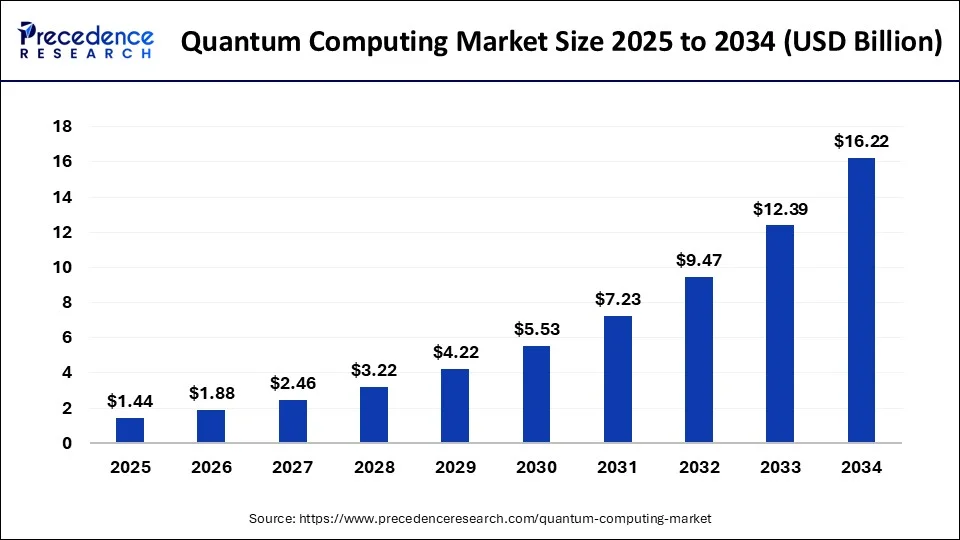
Source: Precedence Research
Over the longer term, McKinsey & Company estimates that the quantum computing market could be worth US$45 billion to US$131 billion by 2040.
This opportunity spans multiple sectors. In pharmaceuticals, quantum modelling may significantly accelerate drug discovery and personalised medicine, unlocking billions in R&D productivity. In finance, faster and more accurate risk modelling, arbitrage, and portfolio optimisation are poised for major transformation. In materials science and energy, the simulation of atomic structures and chemical reactions could lead to breakthroughs in battery technology, sustainable fuels, and next-generation industrial catalysts.
Adjacent markets like quantum-safe cybersecurity, cloud-delivered QaaS platforms, and hybrid high-performance computing infrastructure further broaden the potential. In addition, government investment, including multibillion-dollar national quantum computing initiatives across the U.S., China, EU, and others, provides a baseline of funding that de-risks early-stage development.
For investors, this means that quantum computing could turn out to be a platform shift on par with classical computing, cloud and AI; opening the door to high returns for those who time the inflection point correctly.
Conclusion
Quantum computing stands at the threshold of reshaping global industries, from finance and pharmaceuticals to energy and logistics. The real economic opportunity lies not just in building quantum computers, but in constructing the infrastructure and software that enable scale. The best investments will combine long-term vision with near-term validation, and reward those who position capital accordingly.
Key considerations for investors include recognising that infrastructure returns often come early; while hardware may take years to generate meaningful ROI, companies providing essential tools, cryogenics, and quantum-as-a-service platforms are already producing cash flow. Valuing quantum computing companies requires a hybrid approach, measuring technical milestones such as qubit count and fidelity, intellectual property strength, customer pilots, and partnership depth alongside traditional fundamental metrics. Mid-layer enablers like refrigeration, signal control, and middleware SDKs appear to be underpriced, offering “picks and shovels” opportunities with less hype but stronger customer entrenchment.
This market is akin to investing in AI infrastructure circa 2015, as it is still in the pre-explosion phase. Just as Nvidia and TSMC capitalised on the AI boom by supplying foundational infrastructure, quantum computing infrastructure players may also drive the next wave of computational transformation.
At AlphaTarget, we invest our capital in some of the most promising disruptive businesses at the forefront of secular trends; and utilise stage analysis and other technical tools to continuously monitor our holdings and manage our investment portfolio. AlphaTarget produces cutting-edge research and our subscribers gain exclusive access to information such as the holdings in our investment portfolio, our in-depth fundamental and technical analysis of each company, our portfolio management moves and details of our proprietary systematic trend following hedging strategy to reduce portfolio drawdowns. To learn more about our research service, please visit alphatarget.com/subscriptions/.