
Introduction
“The war games say we’re gonna run out of munitions in eight days in a fight with China.”
Palmer Luckey, Co-founder of Anduril, May 2025 (60 Minutes)
For decades, Western defence procurement optimised for technological superiority: exquisite aircraft, ships and missiles, built in small numbers over long development cycles by an ever-smaller group of giant contractors. The war in Ukraine has exposed the limits of that approach. Drones costing a few hundred dollars destroy multimillion-dollar vehicles, designs are revised within weeks as countermeasures evolve, and sustained combat power depends on how fast weapons can be produced, updated and replaced. This new dimension of warfare is not what the old model was designed for.
This mismatch has created an opening for a new guard of defence-technology companies that operate more like commercial technology businesses, designing their products, factories and supply chains for speed, affordability and scale. The new guard is also scaling into powerful tailwinds. Global military spending is rising, Europe is rearming, and Washington has requested a US$1.5 trillion defence budget for fiscal 2027, up from the roughly US$1 trillion enacted for 2026. This follows the 2025 White House executive order, which called for rapid reform of America's "antiquated" defence acquisition processes with an emphasis on speed and flexibility. Most of the new guard remains private today, but as these tailwinds help the sector mature, we expect a wave of IPOs in the coming years that will attract significant investor interest.
In this note, we first examine how warfare is changing and what that means for technology, affordability and procurement. We then take a closer look at Anduril, a leader in this space, as well as Saronic, to illustrate how the new guard is built from the ground up for this new era. Finally, we assess the size of the opportunity.
The Demands of Modern Warfare
Western defence procurement was shaped by the Cold War strategy of using technological superiority to offset the Soviet Union’s numerical advantage. Over time, this contributed to a focus on “exquisite” systems. These highly sophisticated platforms were designed to maximise performance, but typically came with high costs, development cycles that could stretch over a decade and small production runs.
By the middle of the 2010s, however, two challenges facing the defence sector were becoming clearer. One concerned access to commercial technology. Much of the expertise in software, artificial intelligence and autonomy was concentrated in technology companies that were unwilling to work with the military, making it harder for the traditional defence sector to keep pace with commercial innovation. Palmer Luckey, co-founder of Anduril, described this divide as the “national divorce” between the technology industry and the national-security apparatus. The second challenge concerned building systems for scale. Militaries increasingly needed larger numbers of lower-cost, modular and interoperable systems that could be readily upgraded.
The war in Ukraine brought these challenges into much sharper focus. Defending against relatively inexpensive drones could require interceptors costing around US$1 million. Meanwhile, Ukraine’s drone production rose from several thousand units in 2022 to four million in 2025, as high rates of use and attrition made production capacity and stockpile depth part of combat power. In July 2025, the Pentagon acknowledged that US forces lacked the quantities of low-cost drones required for modern warfare and directed the military to treat small drones as cheap, replaceable and consumable systems, closer to munitions than high-end aircraft.
Figure 1: Iranian-made drones being used by Russia (2023)
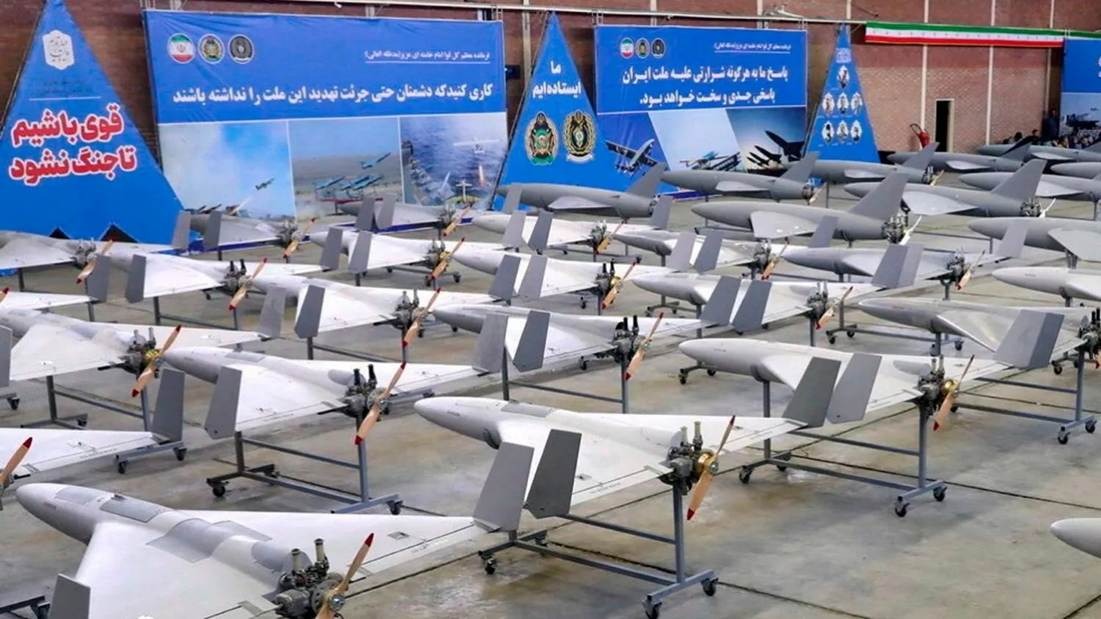
Source: ABC News
Producing affordable mass requires redesigning supply chains, not simply building larger factories. Weapons designed for production at scale need common components, commercial manufacturing methods and broad supplier bases; one bespoke part with a long lead time can otherwise constrain an entire production line. Weapons must also become smarter. Their effectiveness depends not only on physical performance but on how well they interpret sensor data, communicate with other systems and respond to changing conditions. Artificial intelligence can combine sensor data, help operators identify potential threats and coordinate uncrewed systems, while software updates can improve capabilities after the hardware has been deployed.
“Never have battlefield outcomes been more susceptible to rapid technological innovation. Our entire acquisition model must adapt to product life cycles measured in weeks and days.”
Maj. Gen. Curtis Taylor, U.S. Army, December 2025 (Army University Press)
The systems must also be able to adapt. In Ukraine, drone designs can be revised within weeks as each side develops new tactics, jamming techniques and other countermeasures. Modular, open architectures allow software, sensors and payloads to be changed without redesigning the whole platform. Modularity therefore reconciles the standardisation required for mass production with the need for continued adaptation, allowing systems to be manufactured at scale without permanently freezing their capabilities.
“Why would a company propose a $1 million solution when they could propose a $100 million solution?”
Palmer Luckey, Co-founder of Anduril, March 2026 (60 Minutes Australia)
“If it’s more expensive, you get more profit. If it is less reliable, you get more profit.”
Brian Schimpf, Co-founder and CEO of Anduril, January 2025 (a16z Podcast)
A further obstacle to producing affordable mass has been the way defence programmes are procured. Some contracts are fixed-price, but complex development programmes have often used cost-plus contracts, which reimburse contractors’ costs and add a fee based on the programme’s estimated cost. Higher estimated costs can therefore support larger fees, leaving the industry with limited incentive to invest in reducing costs. Consolidation has compounded the problem by weakening competitive pressure, with the number of major defence primes falling from 51 after the Cold War to just five today.
These structural weaknesses have, however, created an opening for a new guard of defence-technology companies, sometimes called neo-primes. They are developing systems suited to this kind of warfare: strike and reconnaissance drones, counter-drone systems, crewless surface and underwater vessels, autonomous aircraft, low-cost missiles and the AI software that connects them. As important as what they build is how they build it: designing for affordability from the outset, setting up factories and supply chains to produce at scale. Anduril has been at the forefront of this shift, alongside a widening field that includes Saronic, Castelion, Shield AI, Neros, Epirus and Skydio (Figure 2). Incumbent primes are responding through partnerships, selective acquisitions and their own efforts to deliver affordable mass, leaving the competitive landscape fluid.
Figure 2: Overview of selected new-guard companies
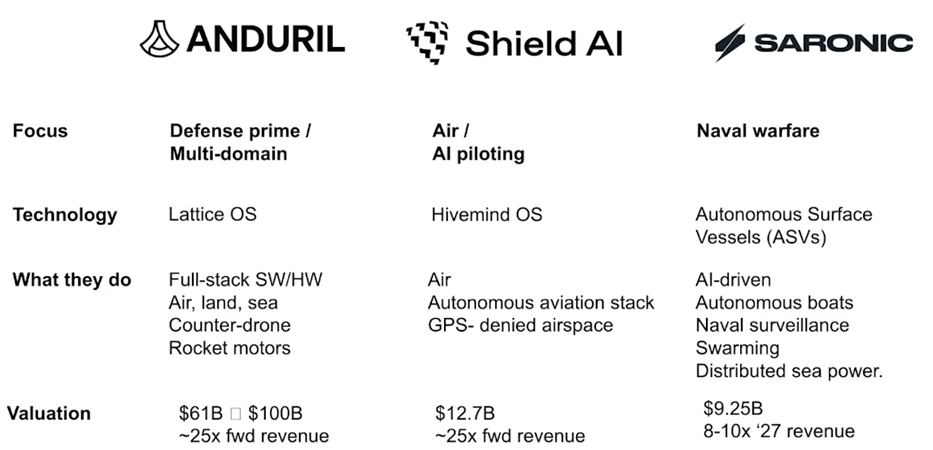
Source: Practical Venture Capital
Anduril – Leading the Charge
“Remember that when we started Anduril, there hadn't been a significant new defence company of any size for 30 years.”
Palmer Luckey, Co-founder of Anduril, March 2026 (60 Minutes Australia)
At 19, Palmer Luckey founded the virtual-reality company Oculus, which Facebook later acquired in 2014 for approximately US$2 billion. During his time in Silicon Valley, he became concerned about what he saw as a divide between the technology industry and national security. Traditional defence primes, he believed, were good at iterating on existing systems but ill-equipped to build weapon systems around autonomy and artificial intelligence. He responded in 2017 by co-founding Anduril, a defence company built around precisely those technologies, with a mission to transform US and allied military capabilities.
Beyond technology, Anduril’s business model was another important early differentiator. It positioned itself as a defence product company rather than a traditional contractor. Instead of waiting for the government to define and fund a bespoke development programme, Anduril anticipates military needs and uses its own capital to develop products and build production capacity before securing orders, then competes to sell the finished systems. Compared with conventional cost-plus programmes, this creates stronger incentives to reduce costs and development times, while leaving Anduril to absorb the losses when it backs the wrong product.
Anduril’s first product was an autonomous surveillance tower that could spot threats at a distance without requiring a person to watch a screen. It has since expanded across air, land and sea, with products spanning counter-drone defence, autonomous aircraft, missiles and undersea systems. It has also developed working prototypes of subterranean systems. At the centre of the portfolio is Anduril’s core product, Lattice, its AI-powered software platform. It fuses data from sensors into a single real-time model and serves as both the connective layer and command-and-control backbone across the portfolio, linking Anduril’s products with government and third-party systems.
Within its portfolio, Fury, Anduril’s semi-autonomous fighter aircraft, provides a concrete example of how the company can now compete directly with traditional defence primes for major programmes (Figure 3). In June 2026, the US Air Force selected Fury as one of two aircraft for full-scale manufacturing, with Anduril reportedly beating proposals from Boeing, Lockheed Martin and Northrop Grumman. Anduril says the award made it the first new company to win a US fighter-aircraft programme since the 1970s, following a 26-month progression from prototype award to production contract that it describes as the fastest for a fighter aircraft in more than 50 years.
Figure 3: Anduril’s Autonomous Air Vehicle – Fury
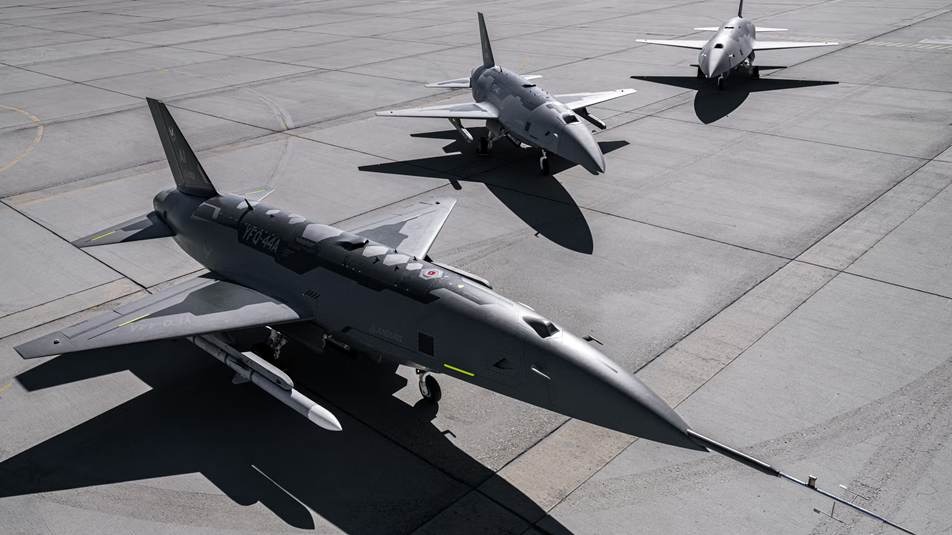
Source: Anduril
In 2025, Anduril generated US$2.2 billion of revenue, more than double the previous year. In March 2026, the US Army awarded it a 10-year enterprise agreement with a ceiling of US$20 billion, streamlining procurement by consolidating more than 120 separate procurement actions into a single framework. Anduril projects to reach US$4.3 billion for 2026, though it is expected to generate a loss of more than US$1 billion, according to The Information. Earlier in 2026, Luckey said that Anduril’s mature products generate margins of approximately 40% despite selling for roughly one-tenth of competitors’ prices. However, they remain unprofitable because they reinvest all the cash generated into R&D. In May 2026, the company raised US$5 billion at a US$61 billion valuation. It was later reported in July that the company was seeking a new financing round at a ~US$100 billion valuation.
Ultimately, Anduril plans to go public. Luckey has argued that the company cannot win a programme on the scale of the F-35 while remaining private. In March 2026, Anduril President Matthew Steckman also said that becoming public was important because public companies command greater trust within the US national-security apparatus. However, he estimated that an IPO was still a couple of years away because only around a quarter of Anduril’s 20 products were in rate production and generating cash for the business.
Saronic – Revitalising US Shipbuilding
"The United States can build 100,000 gross tons of ships every year… the Chinese… can build 23 million gross tons. So they can outbuild the US 230 to 1."
Dino Mavrookas, Co-founder and CEO of Saronic, August 2026 (All-In Podcast)
The United States currently builds fewer than five large commercial ships a year, down from over 70 in 1975. A single Chinese state shipbuilder, CSSC, delivered more than 250 in 2024. The gap is not just a commercial issue, but also a defence issue, because shipbuilding capacity is redirected towards naval production in wartime. The US Navy's own fleet, at around 290 ships, also sits below the 355-ship target Congress set in the 2018 defence bill.
Saronic was founded in 2022 to address this gap by building unmanned surface vehicles for defence and commercial maritime applications. Among its co-founders are CEO Dino Mavrookas, a former Navy SEAL who later worked in private equity, and CTO Vibhav Altekar, an early Anduril engineer. Saronic has raised about US$2.5 billion in total, including a US$1.75 billion round led by Kleiner Perkins in March 2026 that valued the company at US$9.25 billion.
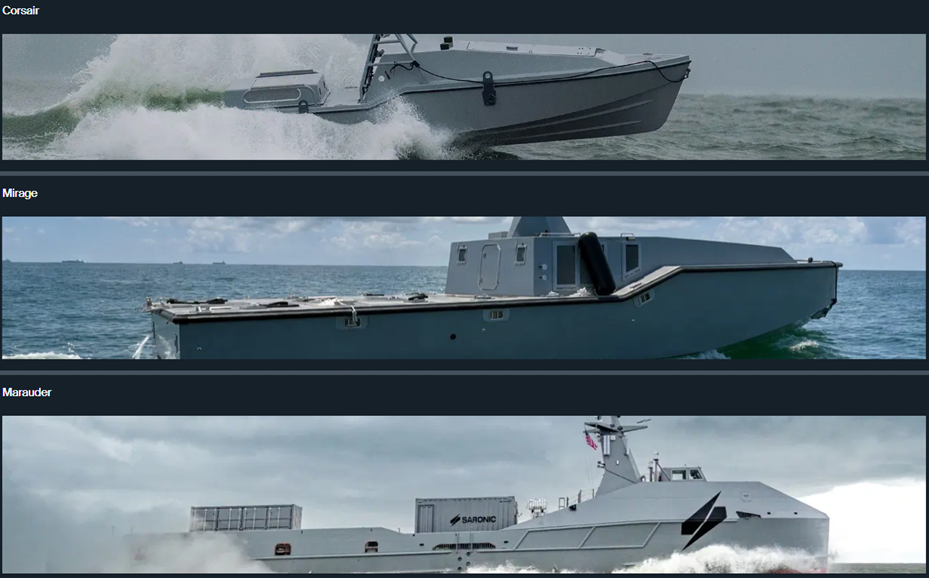
Figure 4: Saronic’s Autonomous Vessels
Source: Saronic
Saronic’s vessels can operate autonomously or under remote human supervision and can be configured for surveillance, logistics or strike missions (FIgure 4). Its flagship product is Corsair, a 24-foot autonomous speedboat that the company says its Austin factory can produce at a rate of 2,000 per year. In 2025, the Navy signed a US$392 million production agreement with Saronic, reportedly for Corsair vessels. In June 2026, a Navy-operated Corsair made headlines when it located and picked up the two crew members of a US Army Apache helicopter downed near the Strait of Hormuz. Saronic described the operation as the first known at-sea rescue by an autonomous boat.
“Because we’re building for software and autonomy rather than putting people on the ship, we can strip 90% of the complexity out of the ship itself.”
Dino Mavrookas, Co-founder and CEO of Saronic, March 2026 (McKinsey)
By building boats that do not need to cater for a crew, there are a range of benefits. The boat becomes simpler to build, as dedicated features designed for humans such as doors, stairs, plumbing and displays are no longer needed. Additionally, the boat does not need to be designed around human safety. This simplicity can significantly reduce costs while allowing designers to prioritise speed, range and firepower over crew accommodation. Mavrookas argues that, relative to cost, his Marauders can put significantly more firepower to sea than a $3 billion Destroyer. Simplicity also accelerates product timelines, with Saronic going from prototype to serial production of its Corsairs in under a year.
"When you look at the overall Department of War's budget, 1% goes to autonomous systems. That's not nearly enough. Make that 5%."
Dino Mavrookas, Co-founder and CEO of Saronic, August 2026 (All-In Podcast)
To expand production beyond its existing sites in Austin and Louisiana, Saronic announced in July 2026 that it would build Port Alpha, a next-generation shipyard in Brownsville, Texas. The company plans to invest more than US$3 billion in the site, which it says will use software-defined production methods to build vessels at scale and strengthen US shipbuilding capacity. Saronic expects construction to begin in 2026 and operations to start in 2028, with the project expected to create up to 10,000 direct jobs. The initial Port Alpha facility is designed to build vessels up to 850 feet long, while a future expansion could support ships longer than 1,200 feet. By comparison, the largest vessel in Saronic’s current product range is its 180-foot Marauder. Saronic says Port Alpha is intended to build both commercial and military vessels.
Market sizing
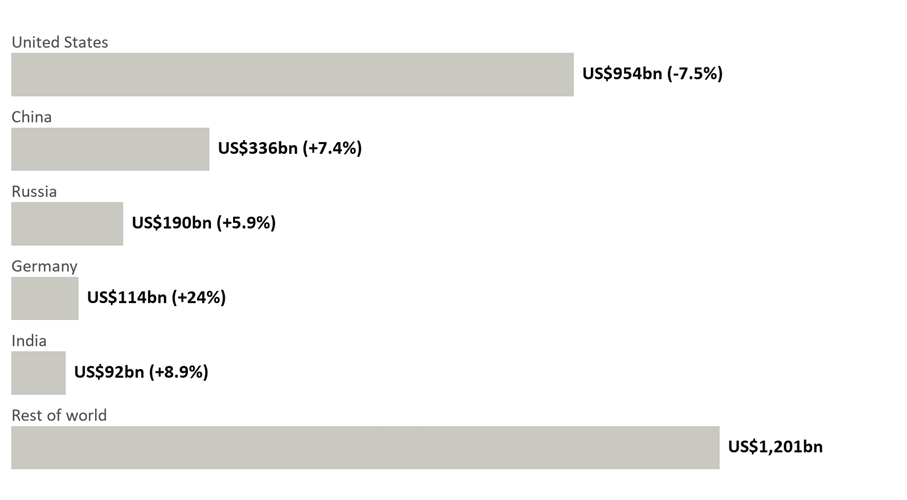
Although some new guard companies also pursue commercial opportunities, defence budgets principally define the market. According to SIPRI, global military spending reached US$2,887 billion in 2025, up 2.9% in real terms year-over-year. This represented 2.5% of global GDP, the highest share since 2009. The US remained the largest spender at US$954 billion, representing about a third of the global total, followed by China at US$336 billion (Figure 5). Europe was the main contributor to the increase in global spending, with expenditure across the region rising 14% in 2025 to US$864 billion, including a 24% increase in Germany. This reflected both the war in Ukraine and broader rearmament among European NATO members amid pressure from Washington to shoulder more of the defence burden. NATO members have pledged to invest 5% of GDP annually in defence by 2035. That rearmament is already visible in order books. Raytheon booked more than US$10 billion of international awards in the first half of 2026, more than double the figure in the same period a year earlier, including more than US$7 billion from European customers. International programmes now account for 48% of its backlog.
Figure 5: World military spending, 2025
Source: SIPRI (April 2026)
Note: Percentages are real-terms changes versus 2024.
The new guard is also gaining traction in international markets. Anduril has disclosed a US$1.1 billion Australian award for the Ghost Shark submarine programme and has agreed with Poland’s PGZ to build its Barracuda missiles locally. Even so, the US remains the new guard’s largest market, and Washington sets the pace. For fiscal 2027, the administration has requested congressional approval for a US$1.5 trillion defence budget, up from roughly US$1 trillion enacted for 2026. About half of this, or US$756.8 billion, is investment funding for buying and developing weapons, comprising US$413.1 billion for procurement and US$343.7 billion for research and development. The department describes this nearly 75% year-over-year increase as historic. The stated priorities behind this funding align closely with the new guard’s focus: advancing high-tech capabilities and autonomous systems, rebuilding weapon stockpiles, revitalising US shipbuilding and expanding the defence industrial base.
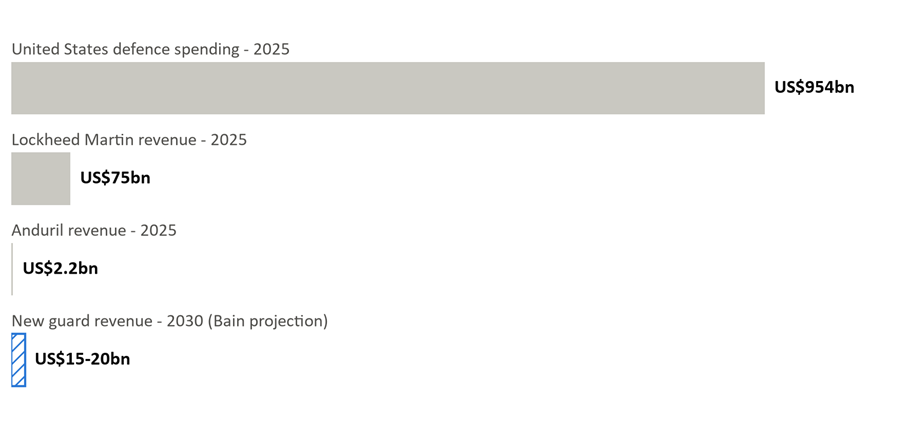
A large share of the funds has typically flowed to the incumbents. For context, Lockheed Martin booked US$75 billion of sales in 2025, compared to Anduril's US$2.2 billion (Figure 6). A September 2025 Bain & Company report estimated, based on valuations at the time, that the new guard’s market share would rise from about 1% to 5-7% by 2030, equivalent to roughly US$15-20 billion of annual revenue. Although any such projection is highly speculative, and traditional primes are likely to retain a substantial share of spending, at current growth rates and with the tailwinds we have described, we think this target should not be difficult to achieve.
Figure 6: The new guard's projected 2030 revenue versus the 2025 market
Source: SIPRI (April 2026), Lockheed Martin, Anduril, Bain & Company (September 2025).
Conclusion
Modern warfare is creating demand for systems that are smarter, cheaper and available in far greater numbers. The new guard has seized this opportunity and is now benefiting from rising budgets and procurement reforms that prioritise speed and flexibility. The new guard has already made the incumbent primes dance, a sign of its growing influence, but also a warning that the incumbents will not surrender market share without a fight. Defence procurement also remains difficult for newcomers to navigate, particularly in programmes that may support only one winner. Execution risk around scale-up, software performance in contested environments and capital intensity remains material. Nevertheless, Anduril and Saronic have shown that new entrants can win major contracts and reach meaningful scale, offering an early glimpse of how some of today’s challengers could become the primes of tomorrow.
At AlphaTarget, we invest our capital in some of the most promising disruptive businesses at the forefront of secular trends; and utilise stage analysis and other technical tools to continuously monitor our holdings and manage our investment portfolio. AlphaTarget produces cutting edge research and our subscribers gain exclusive access to information such as the holdings in our investment portfolio, our in-depth fundamental and technical analysis of each company, our portfolio management moves and details of our proprietary systematic trend following hedging strategy to reduce portfolio drawdowns. To learn more about our research service, please visit https://alphatarget.com/subscriptions/.