Introduction
“Whoever has presence on the edge is going to win. The edge is where the humans are.”
Cristiano Amon, CEO of Qualcomm, January 2026 (Time)
The AI boom has largely centred on the data centre, where the largest and most powerful models are trained and run using vast amounts of computing power. Yet a growing share of AI is now executing directly on the devices that people and machines use every day such as phones, laptops, cars, cameras, industrial sensors and robots.This is edge AI: running inference (and increasingly lighter forms of reasoning) locally rather than sending every request to the cloud.
Edge devices cannot match the raw scale of a data centre. However, many useful tasks require only modest compute, and these tasks can benefit from lower latency, stronger privacy and lower costs provided by edge AI. Two technical advances have made this shift practical: smaller, more efficient models that fit within the memory and power budgets of real devices, and steadily more capable on-device hardware (especially neural processing units and unified-memory architectures).
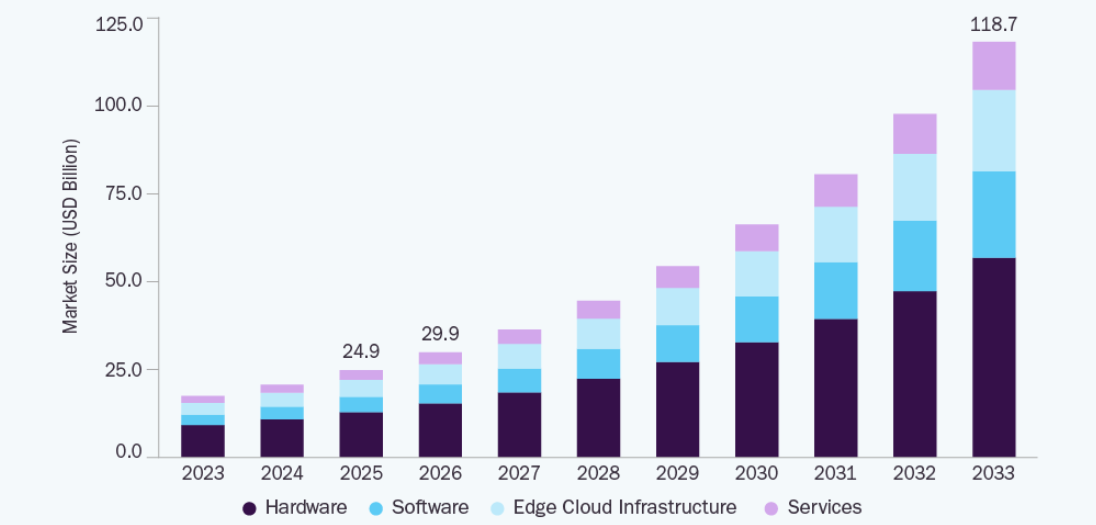
The result is an expanding set of workloads that can live at the edge, creating opportunities across semiconductors, software and device makers. Against this backdrop, the global edge AI market is projected to grow from roughly US$30 billion in 2026 to US$119 billion by 2033.
In this note, we first outline the benefits and use cases of edge AI before examining developments in both hardware and models. We then take a closer look at Qualcomm, one of the leading players in the market, and consider its growth ambitions across handsets, automotive and IoT. We also highlight other listed companies with exposure to the theme before finally discussing the size of the opportunity.
The case for edge AI
Running models locally brings several benefits. The first is speed, as data does not need to make a round trip to a data centre. This is critical in applications such as self-driving cars, which must react within milliseconds to changing road conditions, and humanoid robots, which must adjust their grip on malleable objects in real time. Reducing dependence on a data centre can also improve safety and reliability, as devices can continue operating if their internet connection is lost during an outage or when a machine enters a dead zone. Edge AI can also reduce costs by limiting networking and cloud-processing requirements, while keeping data on the device can improve privacy.
Long before the current wave of interest, AI workloads were already running locally on everyday devices. In 2017, smartphone makers began adding dedicated AI hardware, with Huawei and Apple each introducing their first neural processing units (NPUs). NPUs are small, highly power-efficient accelerators designed for the repetitive calculations used by AI (in contrast to the larger, more powerful and more general-purpose GPUs). NPUs have since worked quietly in the background on tasks such as facial recognition, speech transcription and organising photographs based on their content. Edge AI has also extended far beyond the smartphone. Security cameras classify what they see locally, factory sensors monitor motor vibrations to identify potential failures and inspection drones use onboard vision AI to avoid obstacles their human pilots miss while examining power lines. Over time, the range and complexity of these workloads have grown, allowing devices to perform increasingly sophisticated tasks locally.
Edge AI proliferation
Two of the main drivers of edge AI progress have been improvements in hardware and models. When Apple introduced its first Neural Engine (NPU) in the A11 Bionic chip in 2017, it could perform up to 600 billion operations per second. By 2024, the Neural Engine in the M4 chip was capable of 38 trillion operations per second, over 60 times the A11 Bionic’s figure. As far as we know, Apple has not disclosed comparable Neural Engine figures for the more recent A19 Pro or M5, though both added a Neural Accelerator to each GPU core, with the M5 delivering over 4x the peak GPU compute of the M4.
“Our models provide the quality of frontier LLMs on specialized applications but with LFMs, which are up to 1,000 times smaller.”
Ramin Hasani, Liquid AI CEO and Co-founder, January 2026 (McKinsey)
Models are also advancing alongside the hardware, with smaller models becoming increasingly capable. Liquid AI, an MIT spin-out that raised US$250 million in December 2024 with AMD among its backers, is one of the companies pioneering device-native foundation models. It calls its models Liquid Foundation Models (LFMs), which are essentially a form of small language models (SLMs). Liquid says its differentiator is that efficiency is built into its models from the ground up, rather than achieved solely by compressing massive LLMs into a smaller footprint. Its models are designed around the memory, processing and power limits of real devices, bringing reasoning, vision and speech to phones, vehicles and embedded systems. Liquid says its 1.2-billion-parameter reasoning model delivers the fastest inference and best quality in its size class while fitting within 900 MB of memory on a phone. Its smallest model can run on a Raspberry Pi 5. Liquid AI and Mercedes-Benz announced a multi-year partnership in April 2026 to bring speech, language understanding and reasoning onto the vehicle’s own hardware in North America, with a first production deployment for advanced speech technology targeted as early as the second half of 2026.
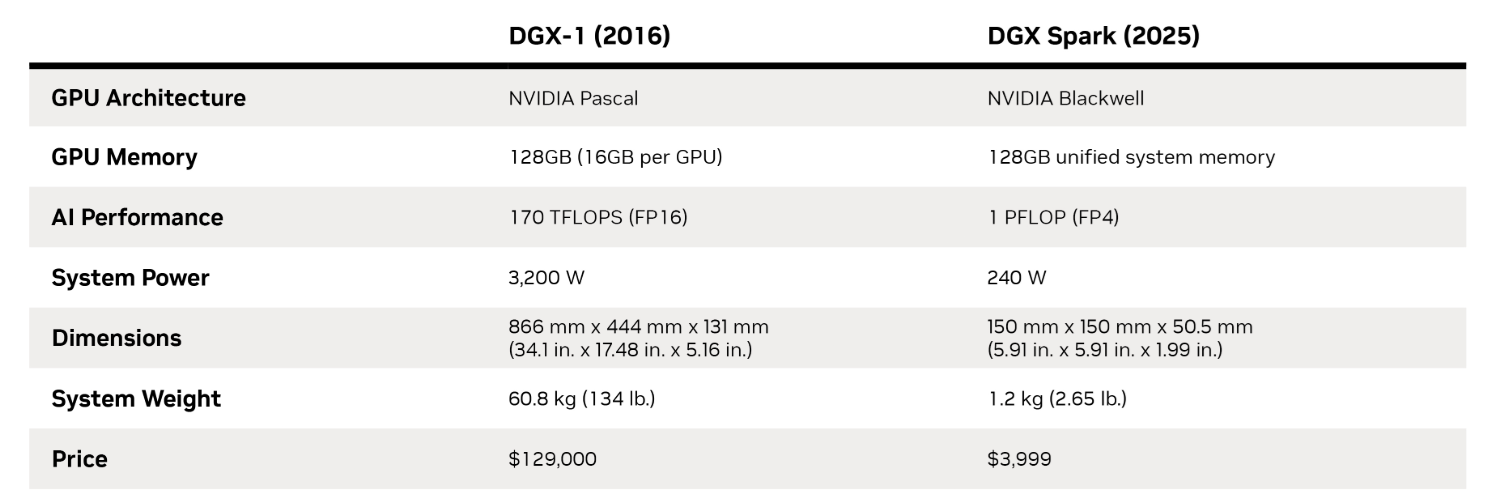
Edge AI has also become far more prevalent on personal computers, with broadly capable models, including large language models (LLMs), now running locally. An unlikely hero of this shift has been Apple's Mac mini, given its low cost and Apple's unified memory design. Running a language model is above all a memory problem, as the entire model must sit in memory the chip can access. On a conventional PC, the CPU uses system RAM, while the discrete GPU has its own onboard memory, which is faster but usually much smaller. The GPU works most efficiently on data held in its own memory, so anything sitting in system RAM generally must first be copied across a narrower connection. Apple's unified memory removes this split entirely: the CPU and GPU draw on one shared pool, allowing the GPU to access far more memory than most consumer graphics cards contain. Large unified-memory configurations therefore enable computers to run larger and more capable models locally. The industry is now building for this shift deliberately. NVIDIA's DGX Spark, launched in October 2025, is a palm-sized machine built on the same architectural idea. It has 128 GB of unified memory and can run models of up to 200 billion parameters locally (Figure 1).
Figure1: Evolution of AI computing: Nvidia DGX-1 to DGX Spark
Source: Nvidia
We have also seen OpenAI lay the groundwork for a move towards the edge. In 2025, OpenAI acquired io, a device start-up co-founded by former Apple design chief Jony Ive, for ~US$6.5 billion. Bloomberg reported in July 2026 that its first product will be a portable, screen-free smart speaker with a camera and sensors, designed to act as a ChatGPT companion in the home. OpenAI’s job listings indicate an edge strategy, with roles for an inference technical lead focused on on-device transformers and an SoC architect developing custom AI silicon for edge deployments. Reuters reported in December 2025 that its earliest devices will be cloud-based, with more capable local inference likely to follow in later products. According to a court filing, OpenAI does not expect its first hardware device to ship before the end of February 2027.
Qualcomm
“We find ourselves at this inflection point, and as this matures, we see a massive edge content upgrade cycle hit us.”
Nakul Duggal, Qualcomm Executive Vice President, June 2026 (Investor Day)
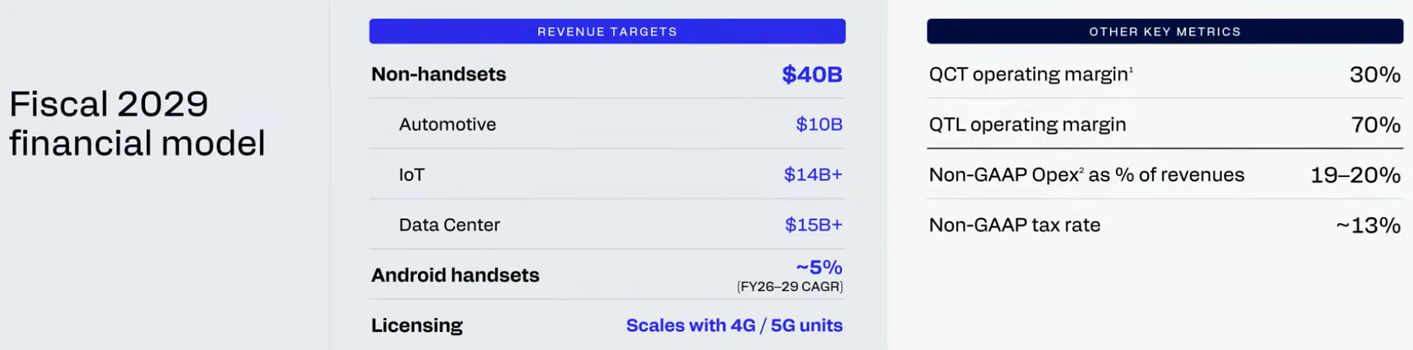
One of the largest semiconductor players in the edge AI space is Qualcomm. Its handset segment generated US$27.8 billion in FY25, accounting for 63% of company revenue. This segment is underpinned by its Snapdragon platform used in Android devices, which combine a CPU, GPU and NPU. However, its growth expectations for Android handsets are modest. At its June 2026 Investor Day, Qualcomm forecast a 5% CAGR through FY29, though this assumed no uplift from AI and no improvement in the memory market, two areas management identified as potential sources of upside.
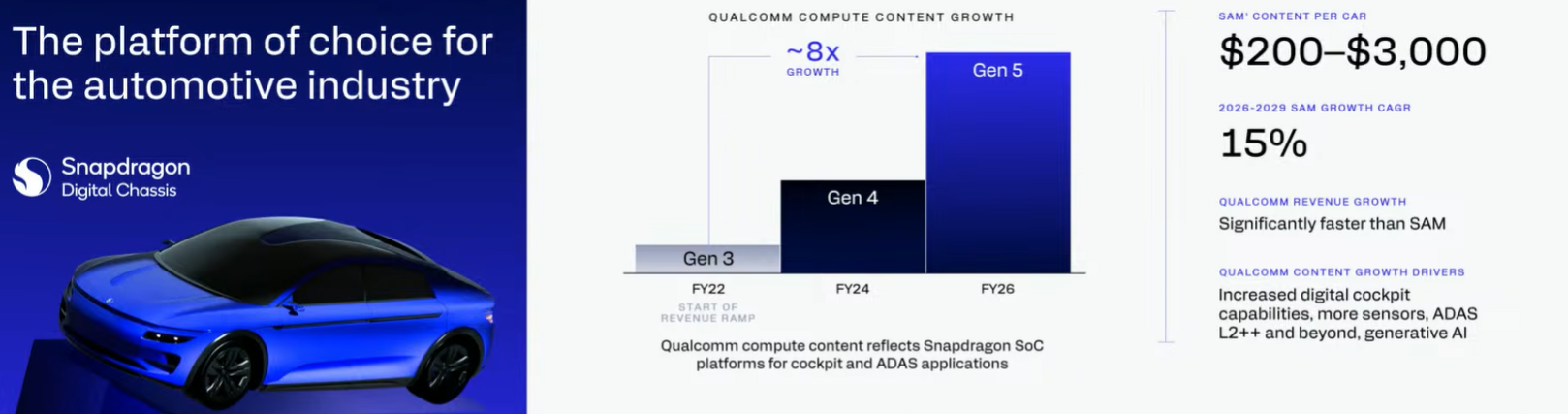
By contrast, it expects much stronger growth from its other segments. In automotive, Qualcomm’s compute content per vehicle grew 8x between FY22 and FY26 and management expects demand to continue to remain robust (Figure 2). This will be driven by richer digital cockpit capabilities, more sensors, higher levels of driver assistance and autonomy (robotaxis), and generative AI. Automotive revenue reached US$4.0 billion in FY25 and is forecast to reach US$10 billion by FY29, representing a 26% CAGR, supported by a US$65 billion design-win pipeline.
Figure 2: Qualcomm’s Automotive Platform
Source: Qualcomm Investor Day 2026
“When I have glasses that I’m wearing all the time, the amount of information [gathered] is going to be so much bigger, that whoever is present at the edge is actually going to have a better model over time.”
Cristiano Amon, CEO of Qualcomm, January 2026 (Time)
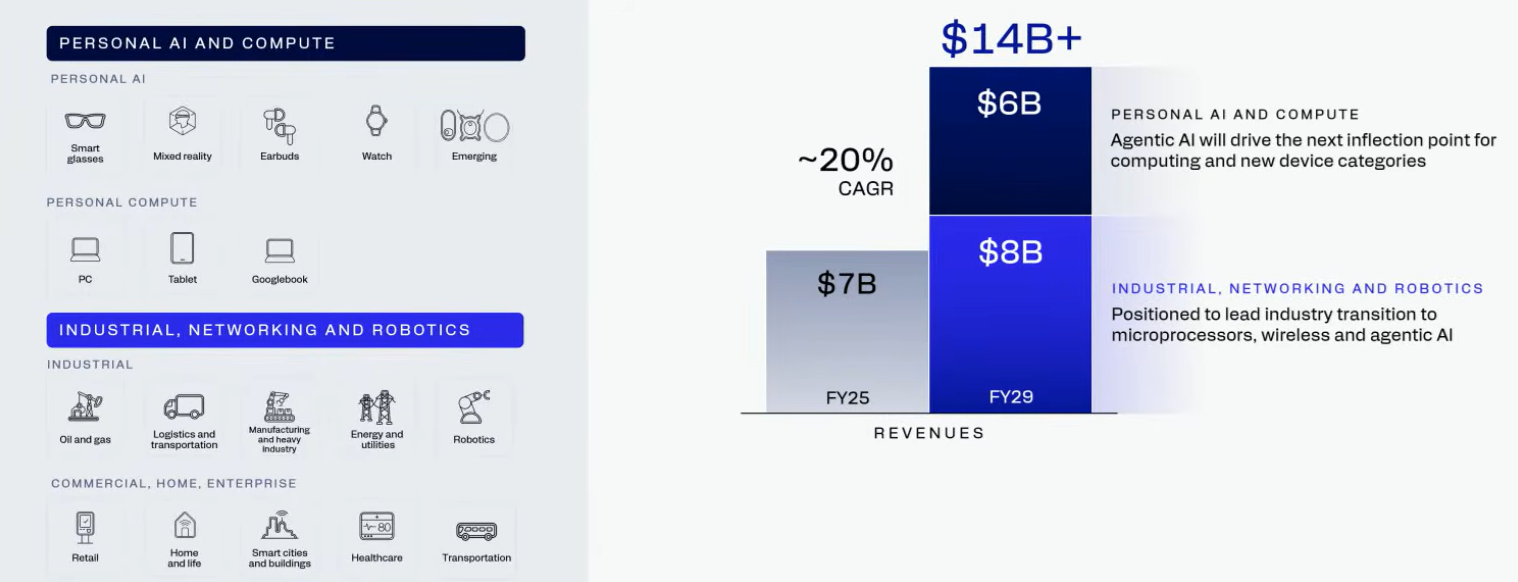
Qualcomm’s IoT revenue is also expected to grow strongly, from US$6.6 billion in FY25 to more than US$14 billion by FY29, representing a 20% CAGR (Figure 3). Qualcomm splits IoT into two buckets. Personal AI and Compute, which includes devices such as smart glasses and PCs, is forecast to reach US$6 billion by FY29. Industrial, Networking and Robotics, which serves sectors such as oil and gas and utilities, is forecast to reach US$8 billion.
Figure 3: Qualcomm IoT Revenue Growth Forecast
Source: Qualcomm Investor Day 2026
Finally, it is worth noting that Qualcomm has announced its entry into the AI data centre market, where it is betting that performance per watt, a key advantage in its devices business, will carry over. This is not its first attempt: its Centriq server CPUs were discontinued within roughly a year of launch, and its earlier Cloud AI 100 inference accelerators found limited commercial traction. Nevertheless, Qualcomm forecasts revenue from data centres will exceed US$15 billion by FY29 (Figure 4), broadly comparable to its forecast for its IoT segment. The move underlines that the future is not a choice between the edge and the data centre, as Qualcomm expects both to grow meaningfully, with some workloads best run locally and others in the cloud.
Figure 4: Qualcomm revenue targets for FY29
Source: Qualcomm Investor day 2026
Other listed companies with edge AI exposure
There are many other listed companies that offer direct or indirect exposure to edge AI. The examples below are not exhaustive but illustrate the range of companies participating in the theme.
- Semtech. Provides high-performance semiconductors for data centre networking, IoT connectivity and cellular infrastructure. Its long-range, low-power wireless platform, LoRa, provides connectivity for edge AI in IoT applications.
- Synaptics. Provides embedded compute, wireless connectivity and multimodal sensing solutions. In June 2026, it was announced that Onsemi would acquire the company at an enterprise valuation of ~US$7 billion.
- Ambiq Micro. Provides ultra-low-power chips that run AI on battery-powered devices such as smartwatches, healthcare monitors and sensors.
- Mobileye. Provides the chips and software for driver assistance and autonomous driving.
Market sizing
According to Grand View Research, the global edge AI market was valued at US$24.9 billion in 2025. Hardware accounted for the largest share at 51.8%, while North America was the largest regional market with a 36% share. By end use, consumer electronics held the largest share, driven by AI chips embedded in smartphones, wearables and smart home devices. The market is forecast to grow from US$29.9 billion in 2026 to US$118.7 billion by 2033, a CAGR of 21.7% (Figure 5), driven by the expansion of connected devices, demand for real-time processing, AI-enabled automation and an increasing focus on data privacy.
Figure 5: Edge AI market forecast
Source: Grand View Research
Conclusion
We expect the future of AI to be hybrid. Data centres will still be required for the most demanding workloads, such as frontier-model training and scientific discovery, and benefit from the higher utilisation that comes with scale. Edge AI, on the other hand, brings intelligence closer to where data is generated and decisions are made. The balance between the two will depend on the economics and technical requirements of each workload and will keep shifting as models and hardware improve. Edge AI will not replace the data centre, but it will continue to expand what can be done without one.
At AlphaTarget, we invest our capital in some of the most promising disruptive businesses at the forefront of secular trends; and utilise stage analysis and other technical tools to continuously monitor our holdings and manage our investment portfolio. AlphaTarget produces cutting edge research and our subscribers gain exclusive access to information such as the holdings in our investment portfolio, our in-depth fundamental and technical analysis of each company, our portfolio management moves and details of our proprietary systematic trend following hedging strategy to reduce portfolio drawdowns. To learn more about our research service, please visit https://alphatarget.com/subscriptions/.