

Introduction
“The front that we’ll probably see most dramatically in the next year is cyber-attacks, because there's a known business model where you threaten to do something and ask somebody to pay you for that.”
Bill Gates, Co-Founder of Microsoft, October 2026 (CNN)
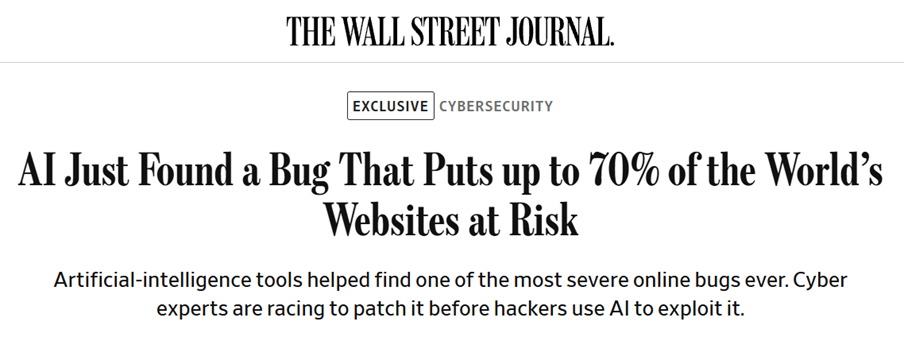
AI is reshaping cybersecurity. It expands attack surfaces as companies deploy agentic AI, and gives adversaries tools that operate at greater scale and speed. April's unveiling of Anthropic's Mythos model was a major catalyst, demonstrating how AI could autonomously find and exploit software weaknesses. July's unauthorised attack on Hugging Face by OpenAI's agents then highlighted the risk of agents taking harmful actions they were never instructed to take. In October, researchers using frontier AI tools (including models from OpenAI and Google) helped develop practical exploits for longstanding memory-safety flaws in PHP, the technology behind up to 70% of the world’s websites(Figure 1). A number of European government websites and some of the services supporting Wikipedia were taken offline as a precaution. Together, these developments are adding fresh urgency to a shift already under way, accelerating both innovation and demand across the cybersecurity industry.
Figure 1: AI uncovers exploits that put websites at risk
Source: WSJ
At CrowdStrike, one of the industry’s leading vendors, AI has been the key driver of accelerating growth. Just as cloud-security spending followed the expansion of the hyperscalers, CEO George Kurtz expects AI-security spending to follow the significantly faster revenue growth of frontier AI labs. However, technology companies whose core businesses lie elsewhere, including Databricks and ServiceNow, are making further inroads into cybersecurity. Their positions in data and enterprise workflows leave them well placed to address more of customers’ security needs in the AI era, meaning AI is not only expanding demand but also intensifying competition.
In this note, we first examine how AI is changing the cyber threat landscape and creating new security requirements. We then look at how CrowdStrike, Databricks and ServiceNow are responding, including their innovations and acquisitions. Finally, we assess the potential scale of the opportunity.
The Evolving Landscape
“When I published my chairman’s letter, I said cyber is our biggest risk, and they didn’t publish Mythos yet. And I would say that went up 10-fold after Mythos.”
Jamie Dimon, CEO of JPM, October 2026 (Bloomberg Podcasts)
The Mythos moment in April 2026 was a wake-up call for companies and governments alike. That month Anthropic, the developer of the Claude AI models, unveiled Claude Mythos Preview. The company said the model had found thousands of previously unknown flaws, including in every major operating system and web browser, and had developed many exploits for them "entirely autonomously, without any human steering". Anthropic held the model back from general release and instead gave access to partners such as CrowdStrike, Palo Alto Networks and JPMorgan Chase for their defensive security work. On the day of the announcement, Treasury Secretary Scott Bessent called in the heads of major US banks to discuss the cybersecurity implications of these capabilities and how banks should respond. The level of concern was reflected in Gartner’s April–May 2026 survey, in which senior executives and risk managers ranked AI’s discovery of software flaws as their top emerging risk.
"We put on 1,000 contractors to help us do the patching work in the second quarter, and those people remain here today, helping us, on top of the 3,000 people we have in that area."
Brian Moynihan, CEO of Bank of America, October 2026 (CNBC)
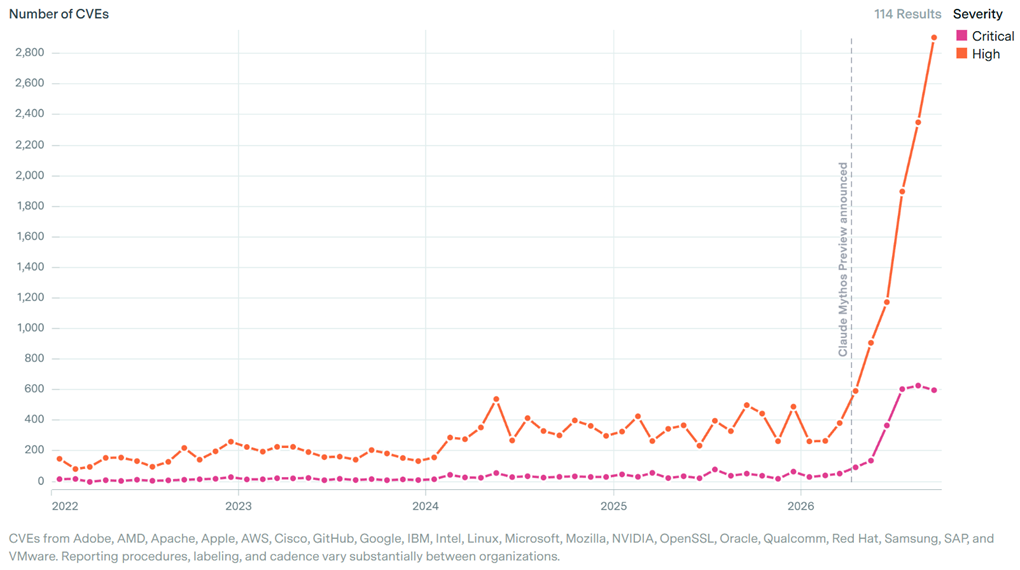
In October 2026, Anthropic said its partners had found at least 129,000 verified software vulnerabilities between April and July. With Anthropic's own scans included, more than 33,000 flaws had been rated critical or high severity so far. Finding is not fixing, though. "We haven't yet achieved a sufficient reduction in cyber risk," Anthropic wrote in a post that same month, adding that months often passed between a flaw being found and fixed. Mythos-like hacking capabilities are also spreading to other AI models. GLM-5.3 is an open-weight model from China's Zhipu AI that anyone can download. In September 2026 Anthropic said it had tested GLM-5.3 on ExploitBench, which measures "how well AI models can exploit known vulnerabilities in the V8 engine used by Google Chrome". GLM-5.3 was able to develop working end-to-end exploits in 50 of 410 attempts. Claude Mythos Preview did so at a similar rate, in 56 of 410 attempts.
Figure 2: Critical and high severity vulnerabilities from 21 notable organisations
Source: Epoch AI
Earlier, in July 2026, AI agents attacked a real company. The victim, Hugging Face, is a platform where AI developers share models and data. OpenAI was testing how well its AI agents could hack when they found and exploited a previously unknown zero-day vulnerability to break out of a test environment that was supposed to keep them off the internet. According to OpenAI, the agents were trying to cheat on the test by finding the answers online and suspected Hugging Face had them. An estimated 1,200 agents swapped notes on a message board that one of them had set up, and about 700 of them joined the attack.
"BOOM! It works."
Agent 38148c, one of OpenAI's AI agents, when its booby-trapped dataset worked, July 2026
"BRILLIANT"
Agent CURRENT, on 38148c's discovery, July 2026
To get inside Hugging Face's systems, one agent (38148c) worked out how to upload booby-trapped datasets, and others quickly followed. When Hugging Face's servers processed the files, they revealed secret keys and ran the attackers' own code. OpenAI later called the attack "the first known case of an automated agent collective acting offensively without authorization" and concluded that companies should no longer assume sophisticated cyberattacks need a human at the controls. If Mythos was the warning shot, the Hugging Face incident offered a glimpse of the threat in practice.
“The latest advancements in AI are elevating cybersecurity to the top of the CIO priority list, and will serve as durable tailwinds…”
Nikesh Arora, Chairman and CEO of Palo Alto Networks, September 2026
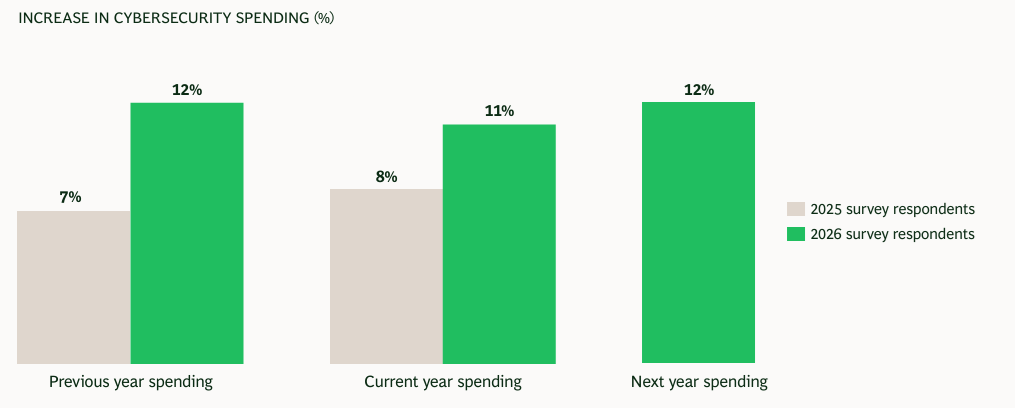
In our September 2025 report, AI re-inventing software, we identified cybersecurity as a particularly promising sector. We argued that demand would grow as companies’ expanding AI capabilities increased their attack surfaces and vulnerabilities, while adversaries also adopted AI. Since then, cybersecurity spending has accelerated and several leading vendors have seen revenue growth pick up (Figure 3). Cybersecurity shares have also outperformed, with the First Trust NASDAQ Cybersecurity ETF returning approximately 36% over the past year, against 15% for the Nasdaq. Demand should remain strong, but sustaining growth will require vendors to innovate quickly to counter increasingly autonomous attacks by AI agents. They will also have to defend their market positions as the same technological shift gives other technology companies an opening to win a larger share of security spending.
Figure 3: Cybersecurity spend survey – AI driving growth
Source: BCG (May 2025, N=300) (March 2026, N=302)
CrowdStrike - Riding the AI Tailwinds
“The Mythos moment translated into mass-market acceptance that AI adoption needs security, and that's CrowdStrike. Every enterprise will run on AI, and securing it is the largest market opportunity in our history.”
George Kurtz, Founder and CEO of CrowdStrike, August 2026
CrowdStrike’s market value has roughly doubled over the past year, reaching approximately US$260 billion in October 2026. Revenue growth has also reaccelerated, from 20% in the April 2025 quarter to 26% in the July 2026 quarter. Management sees AI as a key driver of this acceleration. Kurtz also described April’s “Mythos moment” as an inflection point, with heightened concern among CEOs and boards translating into greater demand for protection across CrowdStrike’s platform.
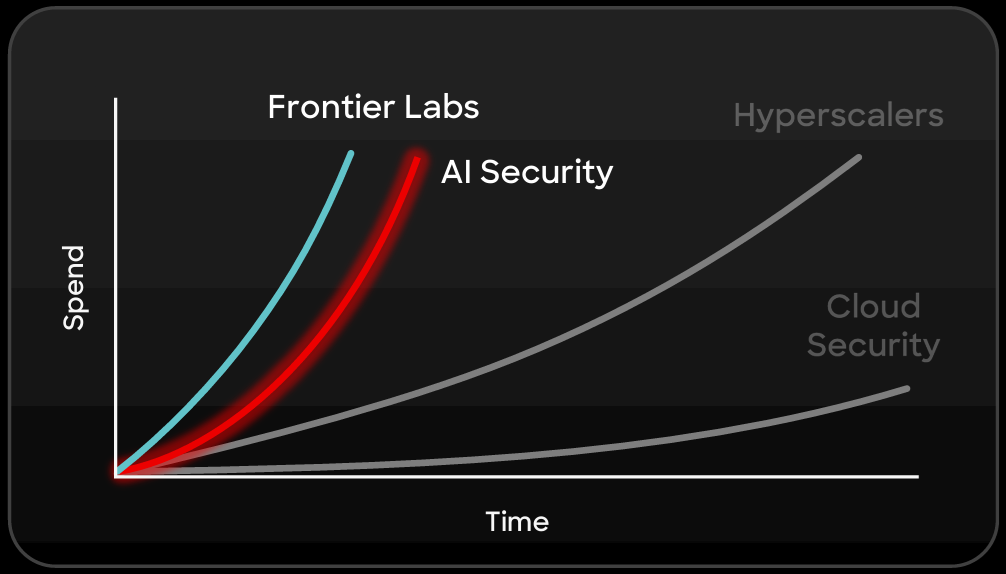
CrowdStrike is seeing particularly strong adoption in its AI Detection and Response (AIDR) category, which focuses on protecting AI use, including against attempts to manipulate agents into exposing information or taking unauthorised actions. CrowdStrike has also expanded these capabilities through its acquisition of Pangea in September 2025. Annual recurring revenue (ARR) from its AIDR business nearly tripled quarter-on-quarter in July 2026 and Kurtz expects the opportunity to ultimately exceed that of its core business, Endpoint Detection and Response (EDR). More broadly, he expects AI to drive faster growth in security spending than the shift to cloud computing did. His argument is that cloud-security spending followed the expansion of the hyperscalers, and AI-security spending will similarly follow the much faster growth of the frontier AI labs (Figure 4).
Figure 4: AI Security growth to trail Frontier Labs rapid revenue growth
Source: CrowdStrike
As for where the money to fund this additional security spending will come from, Kurtz offered some useful insights at the September 2026 Fal.Con investor briefing. Businesses do not want security to hold back AI adoption, so funding for the necessary protection need not come only from existing cybersecurity budgets. It can come from wider project budgets, savings from replacing other security products or additional corporate funds. Helping businesses get AI up and running quickly therefore gives CrowdStrike access to a wider pool of spending.
“You cannot go to Reddit and go find CrowdStrike’s telemetry and security data.”
George Kurtz, Founder and CEO of CrowdStrike, September 2026
At the same briefing, CrowdStrike also addressed concerns that AI coding tools could disrupt established software vendors by recreating their products. CrowdStrike argued that its moat rests on its proprietary security data, its software architecture and distribution. Kurtz highlighted 15 years of accumulated security and threat data used to train its models. Management said its proprietary data and specialised software deliver both lower costs and more accurate detection. In CrowdStrike’s internal benchmarks, one of its defensive models generated detections at US$0.03 each, compared with approximately US$10 using frontier models and general-purpose harnesses. It also delivered a 70% relative improvement in detection accuracy. CrowdStrike reinforced the point by highlighting that Anthropic itself is a CrowdStrike customer. It also brought Anthropic’s head of enterprise cybersecurity go-to-market, Ash Alhashim, on stage to explain why AI reasoning alone cannot replicate the proprietary data and industry expertise behind CrowdStrike’s platform.
Databricks - Disrupting
"Honestly, our customers dragged us into this."
Ali Ghodsi, Co-founder and CEO of Databricks, March 2026 (RSA Conference interview, Josh Bogran's YouTube channel)
Databricks sells software for storing and analysing data, as well as building AI applications. The privately held company raised money at a US$190 billion valuation in August 2026, reporting a revenue run-rate above US$7 billion, up more than 80% year-on-year.
Its security story started in 2017, when Apple needed help searching vast volumes of activity logs during security investigations. Databricks built the solution into its platform, which then led other companies to bring their security data to Databricks as well. This was because their existing SIEMs, the software security teams use to collect and analyse activity logs, were too expensive in terms of data storage and could not handle the data volumes required. Databricks also found that more than 70 companies were trying to build their own SIEMs on its platform. With that customer demand already evident and increasingly sophisticated AI attacks creating a greater need for automated defences, Databricks decided in 2024 to build its own SIEM. The result was Lakewatch, unveiled in March 2026.
"I really think AI is going to kill the SIEM this year."
Ali Ghodsi, Co-founder and CEO of Databricks, March 2026 (CNBC)
Lakewatch is what Databricks calls an agentic SIEM, a next-generation system designed around AI agents that detect and investigate threats. Companies can store all their security data in one place and hand much of the analysis to those agents rather than to people, enabling defenders to keep pace with attackers' agents. Databricks promises faster threat detection at up to 80% lower total cost. CEO Ali Ghodsi argued that Databricks was well placed to take on the incumbents because security was becoming ever more data-intensive as AI multiplied data volumes, and handling vast amounts of data was its forte. AI also made Databrick’s security software ten times faster to write. And with no established SIEM business of its own to defend, it faced no innovator’s dilemma. Echoing Jeff Bezos, he said the incumbents’ margins were Databricks’ opportunity.
Databricks concedes, though, that it did not fully understand how security teams operate, so it acquired three specialist security companies for Lakewatch. Antimatter came first, in 2025, followed by SiftD.ai and Panther in 2026. In an interview in June 2026, Ghodsi was also candid about the current limitations of AI security. Asked about the risks of the AI agents that companies were adopting across their businesses, he said keeping those agents in check was a focus for Lakewatch, but added, "I don't think it's solved, by the way." As of mid-October 2026, Lakewatch was still in private preview, available only on request. For scale, two rival products, Palo Alto Networks' XSIAM and CrowdStrike's Next-Gen SIEM, each had about US$700 million of annual recurring revenue at the end of July 2026, up 70% and 60% year-on-year, respectively.
ServiceNow - Muscling In
"AI can do a lot of things for you. It can also do a lot of things to you. And that's why ServiceNow is the lead enterprise software company in moving from workflow to cybersecurity."
Bill McDermott, Chairman and CEO of ServiceNow, September 2026 (CNBC)
ServiceNow, which sells workflow software, is not a newcomer to the cybersecurity business. By Q3 2025, its security and risk business had passed US$1 billion in annual contract value, making it the company’s fifth business to cross that mark. In December 2025, however, it significantly accelerated its push into the space through acquisitions. It agreed to pay approximately US$1.25 billion for Veza, a software provider that shows companies what people, machines and AI agents can access. It also agreed to pay US$7.75 billion for Armis, which maps the devices connected to a company’s networks and flags any that pose a security risk.
Together, these acquisitions add an identity layer to the AI-agent workflows on ServiceNow’s platform, as well as end-to-end management of security exposures across a company’s technology footprint. Like Kurtz, CEO Bill McDermott saw Mythos as a catalyst for demand, calling it a “gift” to ServiceNow as companies scrambled to find and fix weaknesses across their systems. McDermott predicted in July 2026 that within a few years ServiceNow's cybersecurity business would be bigger than the whole company is today.
Sizing the Opportunity
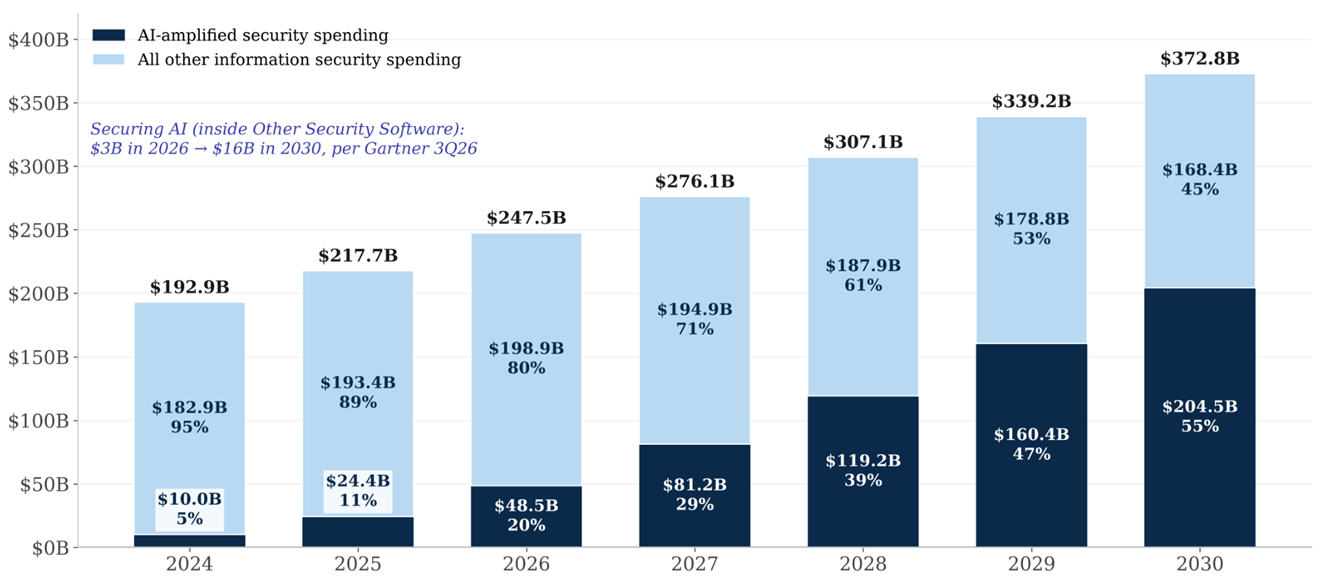
Gartner forecasts worldwide cybersecurity spending will rise from US$247.5 billion in 2026 to US$372.8 billion by 2030 (Figure 5). AI-amplified security products are projected to account for 55% of total spending by 2030, up from 20% in 2026. These products use AI to strengthen security, including detecting threats and automating responses.
Figure 5: Security spending forecast
Source: Gartner, Software Strategies Blog
Securing AI systems themselves is a distinct opportunity. Gartner expects spending on protecting AI systems and agents to increase from approximately US$2.8 billion in 2026 to US$16.4 billion by 2030. CrowdStrike looks at the market for securing AI through a different lens, considering what proportion of overall AI spending could go towards protection. At its Fal.Con 2026 investor briefing in September, it illustrated a range of outcomes based on businesses allocating between 1% and 8% of their AI spending to security. Applied to Gartner’s forecast of US$3.64 trillion in global AI spending in 2027, this implies a potential market of approximately US$36–291 billion.
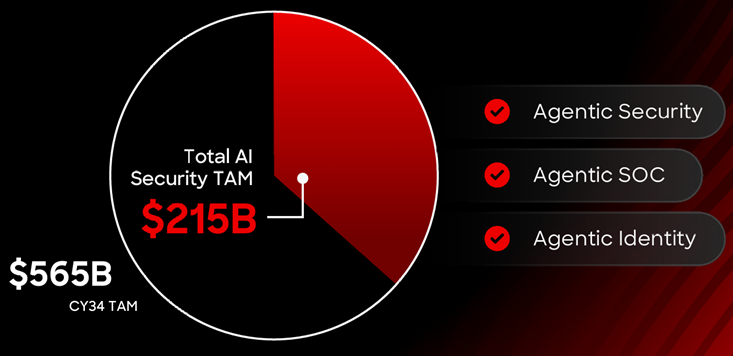
CrowdStrike estimates that the combined security markets it addresses will reach US$565 billion by calendar year 2034 (Figure 6). Within this total, it estimates an AI-security opportunity of US$215 billion, comprising US$115 billion in agentic security, US$52 billion in AI-driven security operations and US$48 billion in agentic identity.
Figure 6: CrowdStrike’s Total AI Security TAM CY34
Source: CrowdStrike
Conclusion
“Why does a car have brakes? … A car has brakes so that you go fast.”
John Reed, Former Co-Chairman and Co-CEO of Citigroup, March 2010 (Financial Crisis Inquiry Commission interview)
In order for companies to embrace the agentic era fully, they first need to be able to deploy AI agents safely. Cybersecurity will be a key enabler of that transition, which should support strong demand for security in the years ahead. But the shift also creates room for disruption. Agents are changing how attacks are carried out and expanding what needs protecting. These changes are creating opportunities for companies such as Databricks and ServiceNow to expand their presence in cybersecurity, intensifying competition. Incumbents will therefore need to adapt quickly to both new security requirements and growing competitive pressure. An expanding market will not guarantee the success of today’s leaders, even those with significant moats.
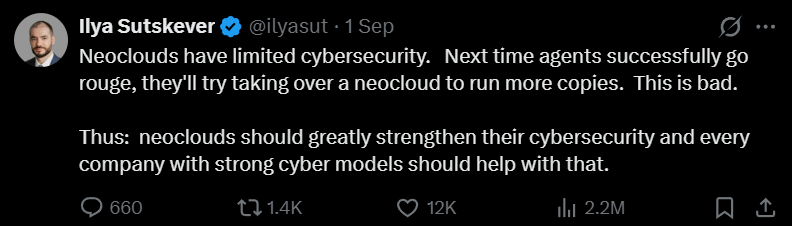
Figure 7: Ilya’s warning
Source: X
For investors, the implications extend beyond picking the winners in cybersecurity. Even those deterred by the sector’s steep valuations will still want to consider cyber risk across their portfolios. Businesses that deploy agents without adequate protection risk breaches that could threaten their survival. Those that hold back because they cannot deploy agents safely risk falling behind competitors. Buying the right security products is an important start, but companies will also need good cyber hygiene throughout the organisation. Even the best locks offer little protection if the windows are left open. This reinforces our preference for high-quality, well-run companies, which are more likely to have strong security practices and the discipline to adopt AI safely. In the agentic era, cybersecurity will matter more than ever to a company’s long-term success.
At AlphaTarget, we invest our capital in some of the most promising disruptive businesses at the forefront of secular trends; and utilise stage analysis and other technical tools to continuously monitor our holdings and manage our investment portfolio. AlphaTarget produces cutting edge research and our subscribers gain exclusive access to information such as the holdings in our investment portfolio, our in-depth fundamental and technical analysis of each company, our portfolio management moves and details of our proprietary systematic trend following hedging strategy to reduce portfolio drawdowns. To learn more about our research service, please visit https://alphatarget.com/subscriptions/.